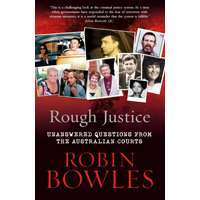
‘ A useful reminder that the system is fallible’ – Rough Justice: True Crime by Robin Bowles

rough-justiceThis is a challenging look at the criminal justice system. At a time when governments have responded to the fear of terrorism with extreme measures, it is a useful reminder that the system is fallible. Julian Burnside QC, quoted on the cover of Rough Justice
I picked up my copy of Rough Justice by Robin Bowles through a discount online bookstore over a year ago and it has been sitting on my shelves waiting for a moment when I had the time and inclination to pick it up. That moment came this week when I tripped and gashed my knee, forcing me to take time off. What better way to recover from an injury than to read. As I’m currently writing a novel which involves crime, the “true crime” genre appeals to me: I welcome any insights I can glean into the workings of police, investigative journalists, prosecutors and defence lawyers, as well as the courts, as background material for my fiction. Rough Justice provides plenty of such insights.

Bowles’ book is subtitled “Unanswered Questions from the Australian Courts” and it certainly raises more questions than it answers. It discusses eight cases, three in Victoria, one each in South Australia, Western Australia, the Northern Territory, Queensland and New South Wales. Some of the cases are well known, including that of Bradley Murdoch, convicted of murdering British backpacker Peter Falconio; and of Greg Domaszewicz, who, despite having been acquitted of murdering toddler Jaidyn Leskie, subsequently had a coronial finding against him. Other cases are less well known, at least to me. In each case, the defendants have protested their innocence. Several have been exonerated; others are still fighting for “justice” – or, at least, to clear their names.

But what is “justice”? That’s the real unanswered question this book poses.

Bowles looks at the processes behind these cases and reveals grave flaws in the judicial system. Her discussion identifies various points at which an innocent person can be unjustly convicted, including incompetence in how evidence is gathered or interpreted, possible police corruption and coercion of witnesses, bias created in the minds of both witnesses and potential jurors by the media, and flawed judicial proceedings. The problems, she suggests, come from our adversarial system which demands two sides play off against one another; the winner, she implies, is often the side with the deepest pockets. Thus wealth, privilege and class – or the lack of these – ensure not a “fair” trial, but what can be successfully argued in court, a recipe for creating an underclass who risk being incarcerated simply because they are too poor to mount a convincing defence.

Readers of reviews on my blog may know of my ambivalence to the fiction of Caroline Overington. Despite being riveted by Overington’s tales, I’m left with an uneasy feeling resulting from a forced encounter with moral ambiguity. I experience something similar when reading Bowles’ book. In her efforts to tell two (or more) sides of the story, Bowles, I feel, manipulates me; it’s as if I’m being drawn to form one opinion, only for the facts subsequently to be presented in an equally convincing, sometimes opposite way. It’s a clever ploy, as it reinforces the book’s theme and underlines the problems faced by police, investigators, jurors and judges in deciding what is “true”. Often, it appears to come down to, not what is true but what is “believable”, and that is restricted by the evidence known or presented at any one time.

I’m also made uneasy by the subtext about class, derived by way of language. In looking for information about these cases online, I came across a thread on a website where people (the “public”) were giving their opinions on the Jaidyn Leskie murder. One commentator mentioned how so many of these sensational cases involve communities where people have names that are spelled with “yn”, instead of (presumably upper-class) names like “Jeremy”. This (somewhat bizarre) comment made me think. Both Favel Parrett in Past the Shallows and Tara June Winch in Swallow the Air write about poor, uneducated protagonists; but both authors depict these protagonists’ worlds using language which is richly poetic. The authors’ beautiful prose has the effect of dignifying the poverty and tragedy of their characters’ lives. Both Bowles and Overington, by contrast, use plain language – a “journalistic” style – combined with, at times, the idioms consistent with the class, background and education of the people they write about; this plainness – and, at times, crudeness – does nothing to disguise the poverty of these people’s lives and values. As readers, we’re forced into an uncomfortable position. Are we meant to judge or empathise with these people? Do we stand above, or do we consider “them” to be our equals?

Bowles weighs down, in my view, on the side of empathy for the defendants, not because she demonstrates their innocence or virtue, but because she shows how these people – guilty or innocent – are equally screwed by the system. At the same time, she shows how they’re equally capable of screwing the system in return – and so is she. At one point, she describes how Denis Tanner, a man who was found by a coroner to have shot his sister-in-law, had an entirely separate charge of assault brought against him. Bowles writes:

At one point, he was charged with whacking a photojournalist in the testicles with his heavy briefcase as he left the coroner’s court. He was acquitted because a visit by the Magistrate’s Court to the scene of the alleged ‘crime’ showed that the police witness who said he saw the whole thing couldn’t have seen anything from his office because of a tree outside his window. They didn’t ask me, though. I saw everything! (161)

What did Bowles see? She doesn’t state. But “everything” could hardly be “nothing”. It’s hard to escape the conclusion that, for Bowles, in this instance at least, seeming impartiality and actual complicity are one and the same thing. It could be a metaphor for the equally fraught nature of the Australian justice system. Perhaps it was intended to be.

~

Author: Robin Bowles
Title: Rough Justice: Unanswered Questions from the Australian Courts
Publisher: The Five Mile Press
Date: 2007
ISBN: 9781741786606

This review counts towards both the Australian Women Writers Challenge 2014 and the 2014 Aussie Author Challenge.

Dreams, books and weird experiences

Do you believe in psychic phenomena?

I was at a reunion of old school friends yesterday and I mentioned how, years ago, I went to India with my mum and sister, and stayed in a hotel in Agra near the Taj Mahal. One of the services promoted there was a reading with a psychic, and my sister and I promptly booked into a session. At breakfast, just before our appointment, I told my sister about a friend whose boyfriend was “jealous and possessive”. Minutes later, the psychic used those same words. “You’re going to marry someone who is jealous and possessive.”

I went away after listening to all he had to say, impressed but sceptical. The man had a gift. How else could he have lifted that phrase from my mind? But his predictions couldn’t be trusted. He’d mentioned nothing about me being a writer, for instance, which everyone knew was my burning goal. He’d thought I was a doctor or a teacher. With a little prompting, he mentioned that writing would figure in my life, in some capacity. But I was hoping for more than that.

Years later, having obtained my PhD (the doctor part) and having derived most of my paid work as a teacher (despite never wanting to teach), I look back at that exchange and wonder. Have I unconsciously fulfilled the destiny that was predicted for me, despite not wanting to? I remember Oedipus.

In drafting several novels, I’ve often had what I can call minor psychic experiences. A lot of novelists have them, apparently. I’ll choose a character’s name and invent a place, only to discover such persons and places really exist. Once, when I was in London, I had the sudden urge to go to an exhibition at the British Library, only to discover a sign on the first exhibit included the name of my character.

Weird, but rather pointless coincidences.

Now I’m drafting a novel in which dreams figure prominently. I also have trouble sleeping. Last night, I woke up in the early hours and downloaded a podcast from Radio National, a repeat of the Law Report. It’s about children in the US who get mandatory sentences of life in prison, and not just for homicide, but also burglary. (Source)

After finally getting back to sleep, my partner woke me up this morning by bringing me a coffee. The kind gesture interrupted a library caper dream. In it, I was an investigator, looking into the disappearances of rare and valuable books from a library collection. I was just about to let a sweet old couple drive off, when I noticed they had a stack of rare books on the floor of their car. I realised they were stealing the books because the library couldn’t be trusted to look after them.

Instead of dobbing the couple in, I asked if they had taken a particular title. They had. I said, if they’d give me that book, I’d let them go. (I’d become complicit in their conspiracy.)

In came my partner with the coffee, and I woke up from the dream. I tried to remember the details, particularly which book the old couple had given me, and all I could think of was the name “Thomas More” and the word “justice”. That was enough for me to Google and this is what I found:

I must say, extreme justice is an extreme injury: For we ought not to approve of those terrible laws that make the smallest offences capital, nor of that opinion of the Stoics that makes all crimes equal; as if there were no difference to be made between the killing a man and the taking his purse, between which, if we examine things impartially, there is no likeness nor proportion. (Source)
Thomas More

Thomas More

The above quote is from Thomas More’s Utopia, a book I’ve never read. I don’t know whether the podcast mentioned it. Possibly. But I fell asleep. What interests me is not just the applicability of More’s thinking to the situation faced by so many (mostly underprivileged) juveniles in the US (although it’s life imprisonment, not the death penalty they face). I’m also interested in how dreams can tell us things we don’t know we know, make connections that our waking minds struggle to make. Maybe dreams draw on things we’ve heard or read; maybe we draw on a collective unconscious. I don’t know. But when I dream about books, about justice, and make connections such as those described above, I tell myself, it doesn’t matter if I ever get published as a writer. I’m playing my part in something wonderful and mysterious, human consciousness, and that’s enough for me.

~
If you’re interested, Bryan Stevenson was the person interviewed for that podcast. He is the executive director of the Equal Justice Initiative @eji_org.

What gets reviewed and why? AWW 2013 Wrap-up post

At the end of another year of the AWW challenge, I look down at the list of books I read and reviewed and wonder. How come I found the time to review these books and not those? 

Of the 25 books read, I managed to review only nine. They were (in rough ordering of reading):

The books I read and didn’t review were:

  • Kirsten McDermott, Madigan Mine (horror [edited as per coments])
  • Rebecca James, Sweet Damage (mild horror, contemporary fiction)
  • Dianne Hester, Run to Me (psychological suspense)
  • Sara Foster, Shallow Breath (psychological suspense)
  • Lucy Tatman, Numinous Subjects: Engendering the Sacred in Western Culture, An Essay (nonfiction)
  • In Falling Snow, Mary Rose MacColl (historical/contemporary fiction)
  • The Mother’s Group, Fiona Higgins (contemporary fiction)
  • Dawn Barker, Fractured (psychological suspense)
  • Karen Davis, Sinister Intent (crime)
  • Jaye Ford, Blood Secret (crime/psychological suspense)
  • Tara June Winch, Swallow the Air (literary)
  • The Meaning of Grace, Deborah Foster (literary, general fiction)
  • Liane Moriarty, The Hypnotist’s Love Story (contemporary fiction)
  • Jessie Cole, Darkness on the Edge of Town (literary)
  • Alison Stuart, Secrets in Time (time-slip/historical and contemporary romance)
  • Candice Fox, Hades (crime)

The books I reviewed weren’t necessarily my favourites. So why did I choose those to review?

Part of the answer is time, the time I intended to devote to crafting my response. Sometimes the most moving and engaging books are the ones I find it most difficult to respond to quickly. They deserve more considered reflection, I tell myself; they need to marinate in my unconscious for a while in the hope that I’ll come up with a response that does them justice. Then hours, days, weeks, even months go by and the freshness of my response is lost. I end up feeling as if I should reread the book before writing about them. The problem is, there’s usually a new book calling from my growing “To Be Read” pile.

A good example of such a delay is my piece on Kirsten Krauth’s just_a_girl. I first drafted my response in July; I didn’t publish it until November. Those who have read it may guess why. I found the book confronting and disturbing, but very well written and deserving of attention. I have to be honest, though. If it weren’t for the fact that I wanted to publish a Q&A with Krauth for the AWW blog, I might not ever have finished writing my response. That happened to several other books on my “read-but-still-to-be-reviewed” list: I never got back to them.

Books I thought initially I would respond to in depth, but never got around to, include Dawn Barker’s Fractured, Tara June Winch’s Swallow the Air, Jessie Cole’s Darkness on the Edge of Town and Mary Rose MacColl’s In Falling Snow. All these books deserve attention, and some have received it. Winch’s book is well known (it’s even on the HSC list). Barker’s book attracted many reviews for AWW throughout 2013 (and the author was interviewed for the AWW blog). In Falling Snow has attracted a handful of reviews, including Shannon, Belle and Natasha Lester in 2013, and Shelleyrae in 2012. Darkness on the Edge of Town has only attracted two reviews, by Lisa Walker and Shelleyrae, both in 2012. It hasn’t been reviewed at all in 2013, and I feel guilty that the missing review is mine. This book doesn’t deserve to be overlooked or forgotten.

Are there any books you read but didn’t review for the AWW challenge this year that you think deserve greater attention? (By the way, I hope you’ll join #aww2014. The sign-up page is now open.)

falling-snowdarkness-at-edge-townswallow-airfractured-barker