
Harmless by Julienne van Loon

With the right kind of mindfulness, William Blake tells us, one can behold infinity in a grain of sand. – Janette Turner Hospital on Harmless

When a writer like Janette Turner Hospital pens a back-cover blurb for another Australian author, I pay attention. What is it about Julienne van Loon’s novella, Harmless, soon to be released by Fremantle Press, which has attracted such a gifted admirer? The snippet from Hospital quoted on the front of the book states: Harmless is “suffused with a tough and totally unsentimental compassion”.
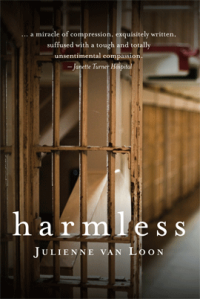
harmless-van-loonI notice, too, review words like “unsentimental”; it seems to be used often when female literary authors are praised. Sentimentality implies emotional manipulation, and a lack of subtlety and nuance. The term has been used to dismiss the work of a plethora of “female authors”, especially those writing in genres such as romance. But what does “unsentimental” mean? I’m tempted to think it’s code for “writes like a man”, or “give this book a girlie-looking cover at your peril”. It’s praise, but is it gendered praise?

In van Loon’s case, unsentimental certainly doesn’t mean unemotional. Far from it. Nor does it mean she avoids topics commonly associated with so-called “women’s writing”, such as relationships, children and family; it even has a female protagonist. What it might mean is a kind of unflinching courage to face the darkest aspects of human frailty and vulnerability while avoiding pathos or despair.

Harmless is another one of those “devastating” books that has been my privilege to discover through the Australian Women Writers challenge. It tells the story of an eight-year-old girl whose Thai step-mother has just died, and who is on the way to visit her feckless father in prison, accompanied by the dead stepmother’s frail elderly father. This father, who speaks little English and who is fresh off the plane from Bangkok, has no idea where he is or what to do with this child who has unexpectedly been placed in his care; he believed his daughter to be happily married to a good man, and with children of her own.

The two get lost on the way to the prison; they abandon their car on the edge of scrubland and are separated as they wander off to find help. The landscape is desolate, like the lives van Loon portrays; their survival uncertain.

This novel is about people on the fringes of society, “losers” one might say. Issues of race and class are central, but understated. There’s no obvious moral compass given, no superior perspective the reader is invited to occupy from which to judge these people. Rather, the focus is on love, and lack of love, and what might constitute a family.

By the end, I felt wrung out, hurt by the author’s bleak picture of humanity and yet consoled, too.

Who will enjoy this novella? Anyone who relishes subtle and emotionally powerful prose; who is interested in a portrait of contemporary Australian life that doesn’t shy away from issues of social disadvantage; and who can bear the heartbreak.

~

This review counts towards my Australian Women Writers 2013 challenge. My thanks to the publishers for supplying a review copy.

Title: Harmless by Julienne van Loon
Publisher: Fremantle Press, 2013
ISBN: 9781922089045

Lucy Clark’s A Baby for the Flying Doctor: Boundary-breaking Australian medical romance

A Baby for the Flying Doctor (Medical Romance)I have to say straight up: I’m not the target audience for this book. I borrowed it from a friend to read for the 2012 Australian Women Writers Challenge,* thinking it would be a quick read and might help me reach my target of 50 books by the end of the year. Life got in the way, and I only ended up finishing it after New Year.

It’s not the first Harlequin Mills & Boon (HM&B) Australian medical romance I’ve read. Years ago, I enjoyed reading some books by Marion Lennox set in Tasmania. While this book isn’t up to Lennox’s standard, it does have an interesting aspect to recommend it for readers of the genre and those interested in boundary-breaking romance novels. (Note: the following contains spoilers.)

The story – like all good HM&Bs – centres around the hero and heroine, two doctors who specialise in Emergency Medicine. They meet on a transcontinental train on the way to a conference where one, the English hero, Gil, will be the keynote speaker. The heroine, Euphemia, is a doctor with the Royal Flying Doctor Service who has escaped to live life in the Outback after devoting her childhood and young adulthood to helping care for a brother with Down’s Syndrome. As a teenager, Euphemia – or Phemie, as she’s known – had genetic testing and discovered herself to be a carrier of the “translocation trisomy 21 chromosome… [the] defective chromosome usually related to children being born with Down’s” (p 61).

What makes this story stand out from other HM&B romances I’ve read is the conflict which threatens to prevent Gil and Phemie getting together happily. It’s not just the fact he is a career doctor from the other side of the world, although that is an issue. More importantly, it’s that Phemie doesn’t want to risk having children. She fears subjecting a child to the kind of life she led: growing up in the shadow of a sibling with Down’s. Having a heroine who doesn’t want to fall pregnant is a risk for Clark, because, without careful handling, Phemie could seem unsympathetic. By making Phemie protective of her unborn (healthy) child, Clark attempts to retain the romance reader’s sympathy for her, despite the fact that there’s something narcissistic – although very human and understandable – in this kind of fear. But Clark also goes one step further (and earns my admiration): she has Phemie admit, much and all as she loves her brother, she’s not sure she’s up to the sacrifices required of a parent of someone with Down’s.

Clark manages to resolve Phemie’s conflict in a believable (and yes, happy) way. How? By hedging her bets: arranging for an adoption and having Phemie fall pregnant – with the hinted possibility of genetic testing in utero. Phemie and Gil will become parents, possibly of a biologically healthy child – or possibly only of an adopted child. It’s a happy ending, yes, but one that touches on what years ago was a taboo subject for HM&B novels: the possibility of termination.

Despite this interesting issue, this book didn’t grab me. Why? The written expression lets it down. Cliches abound. Some of the cliches are foregrounded in a way that suggests this author knows better. For example, Phemie thinks of Australia as a “wide brown land” not once, but twice. It nearly had me dropping the book. The second time, however, she pulls herself up with a thought (paraphrasing), “Not brown exactly, more like ochre.” Okay, so real people do think of the landscape in the generic terms of a Dorothea Mackeller poem, but I demand more from my fictional characters if I’m to spend time with them. The world Marion Lennox created with one of her stories, set in a coastal village in Tasmania and somehow involving penguins, is still vivid in my imagination, many years later. Good romance writing is out there. Clark’s flacid language, I’d assume, is symptomatic of the time HM&B authors are given to write their books: some are asked to write three or four a year. Not enough time to craft and hone the language but, even so, some of Clark’s clangers are unforgivable; and they do nothing to elevate the genre’s reputation of being the domain of hack writers.

Who will enjoy A Baby For the Flying Doctor? HM&B regular readers and students of romance interested in topics that push the genre’s boundaries.

This review counts towards my Australian Women Writers 2013 challenge.

* “Lucy Clark” is the pen-name for a husband and wife team.

The House of Memories by Monica McInerney: carefully crafted & moving

Following a tragic accident, Ella O’Hanlon flees to the other side of the world in an attempt to escape her grief, leaving behind the two people she blames for her loss: Aidan, the love of her life, and Jess, her spoilt half-sister. (From publisher’s summary.)

house-memoriesI felt uneasy through a fair bit of this book. At first I wasn’t sure whether I was being played with, but then I realised the story line is pretty straight forward. It ranges over a number of different points of view and deftly incorporates a variety of styles. There’s the first-person narrative of the brittle main character Ella; the stage-managed diary entries of her narcissistic younger half-sister, Jess; the folksy-jolly emails of her step-brother Charlie; and the heartfelt letters of her estranged husband Aidan.

The aspects that unnerved me, I discovered, were carefully crafted: I was meant to feel that way. Just as I was meant, slowly, to come to see the complexity behind the tragic events that provide the background to this story.

Last year, as part of the Australian Women Writers Challenge, I came across a genre-bending category: “family drama with elements of crime” – the kind that Wendy James and the controversial Caroline Overington do so well. I’m not sure this book fits: it’s perhaps not dark enough; but almost. The story portrays characters who act and react badly, who have been driven to extremes by circumstances, who don’t or can’t always see things from others’ points of view. It’s moving and uneven; uneven not through lack of writerly skill, but because the narrations of the characters – and the characters themselves – aren’t always what they seem.

Who will enjoy The House of Memories? People who love reading about Aussie ex-pats in London and imperfect, blended families; and readers who don’t mind being stretched emotionally in a way that resolves with a sense of hope, if not happiness, at the end.

~

Thanks to the publishers for supplying a review e-copy via NetGalley
The House of Memories, Monica McInerney
Published: September, 2012
Publisher: Penguin Australia, Michael Joseph
ISBN: 9781921518645