In June 2007, following the tabling of the ‘Little Children are Sacred’ report, the Australian government introduced the Northern Territory Emergency Response Act, prescribing a number of drastic measures, some contravening the Racial Discrimination Act and others revolving around land use.
A massive military and police emergency response ensued. The stated aim was to combat child abuse, though there was no reference to children in this massive bill. (read more here)
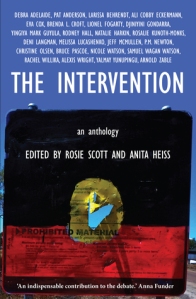
So Dr Anita Heiss and Rosie Scott introduced their article published a year ago in The Hoopla outlining the rationale behind their decision to crowdfund the publication of their anthology, The Intervention, after major publishers had turned it down.
In their essay, Heiss and Scott refer to Olga Havnen’s summary of aspects of the intervention: the arrival of the army; the dismantling of Aboriginal-run organisations; the atrophy of CDEP or the Aboriginal “work-for-the-dole” program; the implementation of mandatory and universal welfare income control; the depiction of Aboriginal men as drunks and paedophiles, and women and children as helpless victims; and the introduction of alcohol controls; measures whose impacts had yet to be assessed.
Last month, during NAIDOC week, I attended a launch of the book in Ashfield, which featured guest speakers Rosie Scott, author Nicole Watson and Aboriginal and Torres Strait Islander Social Justice Commissioner Mick Gooda. In her launch speech, Scott spoke of her determination to have the anthology published, and the reasons why it should be of interest to all Australians:
I believe that the deliberate spin, lies and disinformation that underpins this crisis need to be countered by a language that is powerful, clear and truthful enough to enable people to understand what’s really going on; the kind of language that moves people to right these wrongs. (video of Scott’s launch speech here)
The Intervention provides just such language. A collection of fiction, essays, memoirs and poetry written by over twenty writers and commentators, both indigenous and non-indigenous, it details the varied impacts of the emergency response on remote Indigenous communities – almost all negative.
Of great interest to me is the contribution by Pat Anderson, one of the authors of the “Little Children are Sacred” report that provided the pretext for the government’s actions. In her essay, “The Intervention: Personal Reflections, June 2009”, Anderson writes that in 2006, she was a co-chair of the Northern Territory Board of Inquiry into the Protection of Aboriginal Children from Sexual Abuse. Over a period of a year, she attended meetings in dozens of remote communities with the aim of hearing the views of Aboriginal peoples. She was, she writes, heartened by the response:
What struck me most in these talks with the Aboriginal communities was their attitude. They had suffered much as a result of the historical processes in this country, and many of them had suffered violence and abuse themselves…
People were worried about kids not going to school, about girls having babies too young, about drugs and alcohol, the lack of jobs, and the presence of pornography. And while we did not uncover individual cases of child abuse, we found all the conditions present under which it happens: poverty, overcrowding, drugs and alcohol, pornography, and perhaps most disturbingly of all, a breakdown of structures of authority and meaning. We found, too, that many who came forward and spoke to us were child victims of abuse and neglect, who had never had their trauma acknowledged and dealt with. (31)
In their subsequent report, Anderson and co-author Rex Wild, QC, made almost one hundred recommendations, the very first of which, Anderson writes, “was the most significant”:
‘It is critical that both [the Northern Territory and Federal] governments commit to genuine consultation with Aboriginal people in designing initiatives for Aboriginal communities [to address child sexual abuse and neglect].’ (34)
According to Anderson, despite the prominence given to the report, far from it forming the basis for the government’s actions, its chief recommendation, that of the need for community consultation, was ignored. Moreover:
Where we emphasised the need for resources and for flexible processes of engagement with Aboriginal families and communities, the Intervention emphasised external control and blanket provisions affecting all Aboriginal people.
The “headline” elements of the Intervention, Anderson writes, were deeply problematic:
They included compulsory health checks of Aboriginal children to check for evidence of abuse, blanket quarantining of welfare payments … and the scrapping of the permit system that allowed Aboriginal people some control over access to their land.
In other words, the actions of the government were further promoting the very conditions,”the breakdown of structures of authority and meaning”, that Anderson identifies as having contributed to the problems.
Larissa Behrendt writes in her contribution:
Heavy-handed, top-down interventions such as enforced prohibition have never proven effective in the black or white community. Apart from the protocols and niceties, the research clearly shows that the most effective way to develop policies and implement programs in Indigenous communities is to have those communities integrally involved in them. It’s not just a matter of good manners; it is effective practice and policy. The top-down, paternalistic imposition of half-baked policy ideas is a recipe for failure. (65-66)
Without community consultation and involvement, is it any wonder the impacts of the Intervention, outlined and dramatised so effectively in this anthology, have been negative?
Rachel Willika, a Jaowyn elder from the remote Aboriginal community of Manyallaluk, writes of the immediate trauma created by news of the Intervention:
I was living at Barunga when I first heard about the intervention. I was told by mobile phone. It was on the news. When we found out, everyone was worried. The girls wanted to go to hide in the bush. When we saw the army on TV, I felt frightened. Some people, not just children, but adults, too, thought they might come with guns. (42)
Rosalie Kunoth-Monks, an Areente, Alyawarra elder, discusses the intervention in terms of generations of trauma:
We are all aware in Australia of the horrific journey that Aboriginal people have had to take right from the beginning. People say invasion but I say on our first encounter… Trauma, emotional and mental, a lot of us are going through – tremendous, tremendous trauma and that’s not over exaggerating.
Because we live in terror of our languages, our ceremonies and our land being taken off us right at this time in our history. (14)
Not least in this history of trauma is the after-effects of the Stolen Generations. As Brenda L Croft, whose father was taken as a child, writes:
My father wanted kardiya [non-indigenous] people to try and comprehend the impact of colonisation on our people, not only throughout their lives, but also the ongoing deleterious effect on their descendants, whether we live in remote communities or in far-flung towns and cities. (172)
It is one of the strengths of this anthology that so many diverse Aboriginal voices are represented in its pages, people who live in remote communities as well as those from cities or regional centres. Non-indigenous perspectives also make a valuable contribution: among them, P M Newton’s story, “567,000 kms Driven”, tells of the army’s arrival from a soldier’s point of view; while Arnold Zable offers the moving meditation, “Here is Where We Meet”.
For me, however, the highlights are the Indigenous voices, particularly Melissa Lucashenko’s powerfully rhetorical “What I Heard about the Intervention”:
I heard that the last officially recorded massacre of Aboriginal people occurred in the NT in 1928.
I heard that other Aboriginal people tell of massacres which followed in later years, within living memory, but that these massacres were not recorded in white history…
I heard first-hand reports of a white man from Perth expressing a wish, in early 2014, to travel to the Northern Territory to “shoot an Aboriginal”…
I heard that the suicide rate of Aboriginal people in the NT increased five-fold after the Intervention…
And I heard what the esteemed Aboriginal writer Alexis Wright, who has spent the bulk of her life living and working in Alice Springs, told me, when I asked her about the Intervention. I heard her when she said vehemently:
‘Yes. Yes, of course the government should do something about the living conditions and the violence. But not this…’ (109-111)
Wright makes her own contribution to the anthology with her short story, “Be Careful About Playing With the Path of Least Resistance”. In it she depicts a gifted boy who witnesses the panic engendered among the adults of his community by the arrival of the army, their sense of shame at the allegations of child sexual abuse, their confusion over why such drastic measures are being implemented, and their fear that their incomes may be taken away if children – like the boy – do not attend school. Wright depicts complex layers of these issues, the seeming lack of relevance of a Westernised education; the lure of nihilism that accompanies a loss of meaning, and its consequent risk of adolescent suicide; and the power and potentially redemptive qualities of traditional stories and the guidance of elders.
Yet it is the straightforward prose of the final contribution that sticks in my mind, a submission from the Yolnguw Makarr Dhuni (Yolngu Nations Assembly) in regard to Stronger Futures, the Labor government’s extension of the earlier Howard administration’s Intervention:
We want self-determination. We want democracy. We want the power of the people in Arnhem Land and in all Aboriginal communities to be recognised and our rights respected…
We have our own system of law to prevent disagreements from escalating. We keep peace and order through good governance and we have very serious and consistent ways of teaching respect and discipline to all our young peoples. We have ways of dealing with people who have broken the law that means they are not a threat to the community while they are taught responsibility and maturity. These processes are being eroded through community disempowerment and government attacks on our legitimacy as leaders and our society as a while. (245-46)
Reading The Intervention, it’s hard not to conclude that, rather than solving the problems faced by remote Indigenous communities, the government’s actions have compounded them. While clearly action still needs to be taken, surely a first step towards helping would be for non-Indigenous Australians to recognise and respect the expertise of Indigenous leaders within the communities themselves, as well as to acknowledge the part our current and former generations have played in the creation of those problems. Given the lack of such acknowledgement and respect, it’s hardly surprising that several of the contributors to this anthology see the Intervention as little more than a cynical land and power grab.
~
Title: The Intervention: an anthology
Eds: Rosie Scott and Anita Heiss
Publisher: ‘concerned Australians’
Year: 2015
ISBN: 978-0-646-93709-0
Facebook page: The Intervention
This book was read for NAIDOC week, inspired by the “reading for diversity” initiative of the Australian Women Writers Challenge 2015.

 What can you say about a book that already has over 8000 reviews on Amazon?

 Devoted Eclectic