
What Came Before by Anna George

‘My name is David James Forrester. I’m a solicitor. Tonight, at 6.10, I killed my wife. This is my statement.’
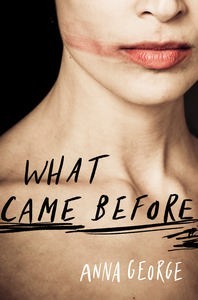
What Came Before Anna GeorgeThis is the dramatic opening of What Came Before, the brilliant psychological thriller debut by Melbourne writer Anna George. The rest of the novel reveals how the murder came to happen.

We see Forrester’s wife, Elle, before her death. She’s working in the film industry, having left a career in law. With one successful film behind her, she is busy directing another. This latest is about “limerance”, the early stages of romantic love.

Elle encounters Forrester, a high-powered lawyer she remembers from her legal days. She is immediately attracted. By what? His looks, the interest in art they share. Certainly not his sociability, as he proves indifferent to her friends. As they begin their relationship, she experiences an almost delusional infatuation – the “limerance” of her film’s title – which leads her to ignore warning signs that the relationship isn’t healthy.

Unknown to Elle, Forrester’s marriage has disintegrated, leaving him angry at his ex and missing his young step-daughter. He’s also a frustrated artist, a control freak and a very unhappy man.

Throughout the narrative, point of view switches from Forrester, as he dictates his “witness statement” and consults a retired QC for legal counsel, to Elle, as she lies in death – or the imagined transition that follows death. This dual narration, swapping tenses between past and present, makes for compelling reading as we are led inexorably to the inciting incident, Elle’s death.

One question often asked about women in abusive relationships is, “Why did they stay?” What Came Before answers this question. “Limerance” makes us idolise our partners, letting us see only what we want to see; tells us to forgive their failings, to look only at their good qualities; blinds us to the escalating “cycle of violence”. The longer we stay, the more we believe they are essentially “good”, that their character defects are a result of damage done in childhood, that we are connected to them in some essential way, the more dangerous the relationship becomes.

Anna George has drawn on her own experience* of “emotional abuse” to create the relationship between Forrester and Elle, and her experience shows. For me, though not for all reviewers, she manages to make Elle sympathetic, despite her irrational choices. George also conveys what it’s like to be the man who resorts to violence, his self-justifications, his belief that he was provoked. If I had one criticism of the characterisation of What Came Before, it’s of the moment when Forrester makes a transition from “emotional abuser” to “physical abuser”. For me, the transition appeared too abrupt. Thinking about his behaviour in terms of “narcissistic rage”, however, I can make more sense of it. Far from being egoistic, Narcissists lack the internal resilience that would allow a healthier psyche to take criticism, perceived rejection or opposition. In this light, George gets the psychology for Forrester right; the result is believable and frightening.

The publishers have described this novel as “literary”, and in the vein of Gillian Flynn’s Gone Girl. What Came Before is clever, like Flynn’s novel, but the cleverness isn’t at the expense of its emotional truth. The characters come across as real, their motivations consistent, their delusions understandable. Does this make it “literary”? It’s a well-written psychological thriller which deserves to become a best-seller.

Anna George has been added to my already impressive list of “must read” Australian female crime and suspense authors. I can’t wait for her next book.

* Anna George mentioned this in an interview with Carol at Reading, Writing and Riesling blog, here.

~

This review forms part of my contribution to the Australian Women Writers Challenge and Aussie Author Challenge. A review copy was kindly supplied to me by the publishers via Netgalley. What Came Before has already been reviewed for the AWW challenge by:

Author: Anna George
Title: What Came Before
Published:25/06/2014
ISBN-13:9780670077731
ISBN-10:0670077739
Publisher:Penguin Aus
Imprint:Viking

The Lost Girls by Wendy James: ‘Suburban Noir’

Lost Girls Wendy JamesIt’s 1978. A fourteen-year-old girl goes missing from a suburb on Sydney’s Northern Beaches. A few days later, her body is found in bushland in Palm Beach. She’s been strangled with her own scarf and there’s evidence of sexual activity.

Under suspicion are those last to see her alive, including the girl’s cousin Matt and his mates. Suspicion lingers, despite the police being unable to bring a case – until a second girl is found dead at Kings Cross some time later, killed in a near-identical fashion. The murders are attributed to an unknown “serial killer”, dubbed the “Sydney Strangler”, even though no other murdered girls are found.

The two dead girls, local “chick” Angie and country runaway Kelly, aren’t the only “lost girls” in Wendy James’ latest novel, The Lost Girls. There’s Jane, Angie’s younger cousin, and Kelly’s younger sister Kath and her mother. There’s also Angie’s mum Carol and her aunt Barbara. Each is “lost” in some way, coping – or not coping – with the impact of those violent deaths.

The Lost Girls explores this impact thirty years later, when a mysterious journalist, Erin Fury, appears. Ostensibly she’s doing research for a radio program, aiming to explore the impact of such deaths on the families of murdered women. Her first interview is with cousin Jane, now middle-aged and married to childhood sweetheart Rob, with a teenaged daughter. Jane, reassessing what she has done with her life, is eager to revisit the time when her beloved cousin was killed. It’s as if she might answer some pressing personal questions by reviewing that time through adult eyes.

Jane isn’t the only one Erin targets. She also interviews Jane’s brother, one-time suspect Matt; Jane and Matt’s policeman father Doug, now a nursing home resident suffering from dementia; their mother, Barbara; and Jane’s husband, Rob. Each has a take on past events and, as Erin inveigles herself into their lives, long-held, sometimes painful, secrets are revealed.

One aspect of The Lost Girls I particularly admire is its evocation of place and time. I grew up on the Northern Beaches around this time, and many of the specific details James gives – from the local milk bar with its pin-ball machine, to the type of lollies the characters buy – bring back vivid memories. Another aspect is James’ ear for dialogue. So many of the characters sound like people I know or have known. I also admire her skill as a storyteller, her ability to create suspense and her seemingly effortless transitions of time, point of view and tense.

Chiefly I’m interested in the way James uses a sensationalistic premise, that of serial killing, in order to explore facets of human nature. Unlike many contemporary crime and thriller writers, she doesn’t offer violence as entertainment; nor does she place it somewhere “out there”, beyond the experience of the reader. Rather, she shows how individuals respond to such traumatic events, and the effects of the choices they make as a consequence. Along the way, she suggests how such choices shape us as human beings; how we come to terms with suffering, loss, mistakes and betrayal; how we love or try to love, despite disappointment; and the meanings we make of our own and others’ lives.

Crime author Angela Savage has remarked that the reader of James’ novels doesn’t have to suspend disbelief. In general, I’d agree. However, initially while reading The Lost Girls, I found the journalist Erin’s character unconvincing, particularly in terms of motivation. She seemed more of a device than a psychologically realised character. Then I began to see her as one of the “lost girls” of the title and she made more sense to me. And it’s for that reason that I’d disagree with the criticism both Savage and Michelle McLaren make of the Epilogue, that it’s somehow a mis-step or unnecessary. For me it resolves the central motif of the story.

With The Lost Girls, James consolidates her place alongside Honey Brown and newcomer Dawn Barker among Australia’s foremost proponents of an emerging genre of psychological suspense, which some have dubbed “suburban noir”. I’m eager to find other Australian authors who might fit into this category. Do you know of any?

~

This review forms part of my contribution to the Australian Women Writers Challenge and the Aussie Author Challenge. A review copy was kindly supplied to me by the publisher via Netgalley. The Lost Girls has attracted a lot of attention from AWW reviewers including: Shellyrae at Book’d Out, Carol at Reading Writing and Riesling, Bree at All the Books I Can Read, Jess at The Never Ending Bookshelf, and Bernadette at Fair Dinkum Crime.

Title: The Lost Girls
Author: Wendy James
Published:
26/02/2014
ISBN-13: 9781921901058; ISBN-10: 1921901055
Imprint: Michael Joseph
Publisher: Penguin Australia.


Let Her Go by Dawn Barker – powerful contemporary drama

Dawn Barker Let Her GoTwo sisters – step sisters – one, Nadia, is happily married with three children; the other, Zoe, has suffered a debilitating illness and a number of miscarriages, and finds herself infertile. Both have reasons for wanting to have a baby: Zoe, to complete her long-held desire to be a mother; Nadia, ostensibly, to help her deserving sister. After years of counselling and legal advice, they enter into a surrogacy agreement. They are adults. They care for each other. What could possibly go wrong?

Fast forward seventeen years to a troubled teenager, Louise, who is getting busted for stealing drugs, self-harming, engaging in drunken sex and whose performance at school is deteriorating. She knows her – unnamed – parents are fighting, senses it has something to do with her, but has no idea of the trauma that followed her birth or the bitter custody dispute that tore her extended family apart.

In Let Her Go Dawn Barker – a psychiatrist by training – successfully juggles different points of view as well as jumps forward and backward in time. Throughout the novel, the reader has a sense that something really terrible could happen – or maybe has happened already – but the suspense isn’t gratuitous. It derives organically from the fraught emotional situations she forces her characters to confront. As I approached the novel’s climax, I was struck by the story’s similarity to the Judgement of Solomon, as if Barker had taken elements of this classic dilemma and brought it alive in a modern context. Both women have good claim to the child; how will the child’s best interest be served?

If Barker’s debut novel Fractured grabs the reader and forces her along a terrifying path, Let Her Go is more like a slow burn, but it’s no less powerful for that. For anyone who has yearned for a child and not been able to conceive or carry to term, the narrative is excruciatingly real at times, almost unbearable. Similarly, Barker captures the pressure on a marriage of women coping with hormones, fears and jealousies. Both Zoe and Nadia are portrayed at times in a poor (but very human) light. Zoe comes across occasionally as unreasonably demanding and judgemental towards her husband, a man with secrets who has never seemed as enthusiastic about the surrogacy and who fails to pull his weight. In portraying the deteriorating relationship, Barker uses irony to good effect: the reader is ahead of Zoe in sensing the effect of her behaviour on her husband, and waits in suspense for the explosion we fear will come. Nadia (understandably) seems at times to be selfishly blind to anyone’s needs but her own, and the reader is torn, sympathetic to her suffering, but alarmed at the lengths she is willing to go to get her way.

With both Let Her Go and Fractured, Barker joins a number of women writers in Australia who create compelling psychological suspense out of difficult moral and social issues, including Honey Brown, Wendy James and Caroline Overington. Each of these writers’ novels demonstrates that issues facing contemporary Australian women, in the hands of skilful storytellers, make for powerful drama. I can’t wait to read Barker’s next scenario.

~

This review forms part of my Australian Women Writers Challenge and Aussie Author Challenge. A review copy was kindly provided to me by the publisher via Netgalley.

It has been reviewed for the AWW challenge by Emily Paul.

Publisher: Hachette Australia
ISBN: 9780733632228
Published: July 2014