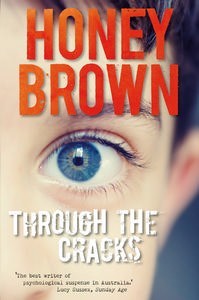
Through the Cracks by Honey Brown – don’t read the back cover

If I’ve enjoyed an author’s previous books, through the cracks brownI never read the back covers of their latest. So I knew very little about Honey Brown’s psychological suspense novel, Through the Cracks, before I picked it up. Later, I read through some reviews posted for the Australian Women Writers challenge and saw that several reviewers were dismayed and annoyed that the book’s back cover “blurb” gave away a lot of the story’s suspense. So, fair warning: don’t read the back cover.*

Told from the point of view of Adam Vander, a boy who has been kept locked away from the world by an abusive and controlling father, Through the Cracks traverses difficult territory. Adam has been victimised for so long, he exhibits all the hallmarks of “learned helplessness”: he has become so conditioned to abuse that he appears almost incapable of acting to stop it. Only as he hits puberty, and his father succumbs to health problems, does his sense of agency begin to assert itself. But how can he save himself when he knows nothing about the world, and the few people he encounters, apart from his father, don’t recognise him as someone who desperately needs help?

Brown’s tale of Adam’s escape is both compelling and distressing. Slowly the events that led to his predicament are revealed, and the full horror of what he has endured unfolds. Along the way, Brown touches on issues of race, class, sexuality and, most importantly, identity. Who are you when everything that makes you human has been stripped away?

One of the many elements of this powerful and emotionally wrenching novel that impressed me was its style. The sentences are often short and descriptive; the point of view character indulges in very little introspection and makes few inferences of other characters’ thoughts and feelings. It is as if one of the after effects of abuse is an almost complete lack of interiority. For me, this created an unnerving sense of Adam’s dissociation, his feeling of being utterly separate from the world, both emotionally and psychologically, even as he slowly rejoins it, just as formerly he was isolated physically.

With Through the Cracks, Brown cements her place as one of the foremost writers of psychological suspense in Australia.

~

This book was kindly supplied to me by the publishers through Netgalley. It forms part of my contribution to the Australian Women Writers Challenge and Aussie Author Challenge. It has already attracted a lot of attention from AWW challenge reviewers, including:

~

Title: Through the Cracks
Author: Honey Brown
Published:23/04/2014
ISBN-13:9781921901546; ISBN-10:1921901543
Imprint:Michael Joseph; Publisher:Penguin Australia.

Skinjob by Bruce McCabe, sex dolls and gender issues

Bruce McCabe SkinjobThe Good: gender issues
The Bad: gender issues
The Ugly: gender issues (and I foresaw the twist at the end)

Setting: US in the near future

Recommended for: thriller and suspense fans,
people interested in human factors in technology
innovation and adoption

When I heard Bruce McCabe speak at the National Book Bloggers Forum about his debut novel, Skinjob, I was hooked. Not by the title. If I’d seen that title on the library shelves, I wouldn’t have picked it up without gloves. When I first saw it, it reminded me of “hand-job”. It still reminds me of hand-job, even though I’ve read the book and there’s nothing titillating in it. Exciting, yes. Adventurous, yes. It has all the elements Robert McKee writes about in Story: a ticking clock, a vulnerable hero, powerful antagonists, and an interesting (pretty “high”) concept.

The concept: what could happen when robotics advance to the extent that the “world’s oldest profession” can be performed by robots, “Skinjobs”? What if the powerful forces of the pornography/sex trade industry and the neo-conservative Christian right waged an epic battle to sway the hearts and minds of the American people? What if a lie-detecting FBI agent and a San Francisco PD (female) surveillance officer teamed up in a race against time to prevent the annihilation of thousands of innocent people?

Juicy stuff, right? It is. And McCabe does it well. Well enough to have gone from being a self-published author hand-selling to Berkelouw Books in Dee Why to attracting the attention of J K Rowling’s agent and scoring a contract with Random House.

What really interests me about the book, though, is its take on gender issues.

Some background.

At the book bloggers’ forum, I asked Bruce McCabe whether he read books by Australian women. No, he is more of a Michael Crichton, Frederick Forsyth and Stephen King guy. (All of whose books I have devoured.) Also Lee Childs. He did say that author Kathryn Fox had been very helpful to him though (she appears in the acknowledgements) and added, “I must read her books”.

It was with amusement and some consternation, therefore, that I came across a cameo appearance of a “Kathryn Fox” in McCabe’s novel.

The title of the novel, Skinjob, refers to an advanced form of sex doll. These life-like dolls have warm “skin”, a “heartbeat”, and can move in a “come hither” fashion. They can’t speak, but can make moaning and groaning noises. They don’t act other than to flirt or serve. They can also simulate realistic fear to threats and acts of violence (up to the point of actual physical harm). “Kathryn Fox” appears in the book as one of the manufacturer Dreamcom’s most successful dolls.

What is McCabe trying to say here?

One thing McCabe talked about at the forum was how there is no good and bad in human beings; we all have elements of both. The main character, Daniel Masden, isn’t perfect. Nor is the female  SFPD operative, Shahida Sanayei (Shari), whom Masden partners up with. Shari, in fact (spoiler alert) solves the enigma that is central to the plot and, therefore, effectively saves the day.

All good. But what if Skinjob became a movie – as it certainly could; it’s very filmic, action-packed and fast-paced, has lots of interesting “locations”, high-tech gadgetry and car chases – would it pass the Bechdel Test? That is, does it have “at least two women who talk to each other about something other than a man”?

It wouldn’t. That’s right. A story in which gender issues are crucial, all bar one of the main character roles are male. Shari is introduced in the context of having lost her male lover in a bomb-blast at a skinjob “brothel” – or pleasure house – run by Dreamcom. Her role in the story is to help Masden track down those responsible for the blast; all the suspects are male. The SFPD major figures and FBI personnel are male; the Dreamcom owners and employees are male; the leaders of the right-wing church suspected of being behind the blast are male. The majority of the “females” who would appear in the movie would be robots. (Imagine doing that screen test.)

Remember Skinjob is set in the future. Even if one asserted that the industries depicted in the story are currently male dominated, there is plenty of scope in a future world for more than one woman to be depicted as having agency and moral complexity. Why not a female pastor? A female pleasure parlour owner? Sure, the men in these roles in Skinjob don’t come off well and are often revealed to be self-serving hypocrites, sex-addicts and narcissists. That shouldn’t be a restriction. As McCabe was at pains to point out, human beings are complex moral creatures; that includes women.

In Skinjob McCabe sets out to address some really interesting questions about gender, sex and power, the most interesting of which, for me, is the ethics of using automatons for sexual relief. But, while writing about it for entertainment, he risks reinscribing the very kind of objectification and invisibility of women which, arguably, the sex industry and fundamentalist churches of all kinds have historically been guilty of.

My conclusion?  It’s still a page-turning read.

~

This review forms part of my contribution to the Aussie Author’s Challenge 2014

Review copy courtesy of the publishers at the National Book Bloggers Forum.
ISBN: 9780593074091
Published: 02/06/2014
Imprint: Bantam Press
Extent: 416 pages

 

ISBN: 9780593074091
Published: 02/06/2014
Imprint: Bantam Press
Extent: 416 pages

– See more at: http://www.randomhouse.com.au/books/bruce-mccabe/skinjob-9780593074091.aspx#sthash.KrlSSYff.dpuf


‘ A useful reminder that the system is fallible’ – Rough Justice: True Crime by Robin Bowles

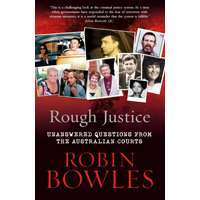
rough-justiceThis is a challenging look at the criminal justice system. At a time when governments have responded to the fear of terrorism with extreme measures, it is a useful reminder that the system is fallible. Julian Burnside QC, quoted on the cover of Rough Justice

I picked up my copy of Rough Justice by Robin Bowles through a discount online bookstore over a year ago and it has been sitting on my shelves waiting for a moment when I had the time and inclination to pick it up. That moment came this week when I tripped and gashed my knee, forcing me to take time off. What better way to recover from an injury than to read. As I’m currently writing a novel which involves crime, the “true crime” genre appeals to me: I welcome any insights I can glean into the workings of police, investigative journalists, prosecutors and defence lawyers, as well as the courts, as background material for my fiction. Rough Justice provides plenty of such insights.

Bowles’ book is subtitled “Unanswered Questions from the Australian Courts” and it certainly raises more questions than it answers. It discusses eight cases, three in Victoria, one each in South Australia, Western Australia, the Northern Territory, Queensland and New South Wales. Some of the cases are well known, including that of Bradley Murdoch, convicted of murdering British backpacker Peter Falconio; and of Greg Domaszewicz, who, despite having been acquitted of murdering toddler Jaidyn Leskie, subsequently had a coronial finding against him. Other cases are less well known, at least to me. In each case, the defendants have protested their innocence. Several have been exonerated; others are still fighting for “justice” – or, at least, to clear their names.

But what is “justice”? That’s the real unanswered question this book poses.

Bowles looks at the processes behind these cases and reveals grave flaws in the judicial system. Her discussion identifies various points at which an innocent person can be unjustly convicted, including incompetence in how evidence is gathered or interpreted, possible police corruption and coercion of witnesses, bias created in the minds of both witnesses and potential jurors by the media, and flawed judicial proceedings. The problems, she suggests, come from our adversarial system which demands two sides play off against one another; the winner, she implies, is often the side with the deepest pockets. Thus wealth, privilege and class – or the lack of these – ensure not a “fair” trial, but what can be successfully argued in court, a recipe for creating an underclass who risk being incarcerated simply because they are too poor to mount a convincing defence.

Readers of reviews on my blog may know of my ambivalence to the fiction of Caroline Overington. Despite being riveted by Overington’s tales, I’m left with an uneasy feeling resulting from a forced encounter with moral ambiguity. I experience something similar when reading Bowles’ book. In her efforts to tell two (or more) sides of the story, Bowles, I feel, manipulates me; it’s as if I’m being drawn to form one opinion, only for the facts subsequently to be presented in an equally convincing, sometimes opposite way. It’s a clever ploy, as it reinforces the book’s theme and underlines the problems faced by police, investigators, jurors and judges in deciding what is “true”. Often, it appears to come down to, not what is true but what is “believable”, and that is restricted by the evidence known or presented at any one time.

I’m also made uneasy by the subtext about class, derived by way of language. In looking for information about these cases online, I came across a thread on a website where people (the “public”) were giving their opinions on the Jaidyn Leskie murder. One commentator mentioned how so many of these sensational cases involve communities where people have names that are spelled with “yn”, instead of (presumably upper-class) names like “Jeremy”. This (somewhat bizarre) comment made me think. Both Favel Parrett in Past the Shallows and Tara June Winch in Swallow the Air write about poor, uneducated protagonists; but both authors depict these protagonists’ worlds using language which is richly poetic. The authors’ beautiful prose has the effect of dignifying the poverty and tragedy of their characters’ lives. Both Bowles and Overington, by contrast, use plain language – a “journalistic” style – combined with, at times, the idioms consistent with the class, background and education of the people they write about; this plainness – and, at times, crudeness – does nothing to disguise the poverty of these people’s lives and values. As readers, we’re forced into an uncomfortable position. Are we meant to judge or empathise with these people? Do we stand above, or do we consider “them” to be our equals?

Bowles weighs down, in my view, on the side of empathy for the defendants, not because she demonstrates their innocence or virtue, but because she shows how these people – guilty or innocent – are equally screwed by the system. At the same time, she shows how they’re equally capable of screwing the system in return – and so is she. At one point, she describes how Denis Tanner, a man who was found by a coroner to have shot his sister-in-law, had an entirely separate charge of assault brought against him. Bowles writes:

At one point, he was charged with whacking a photojournalist in the testicles with his heavy briefcase as he left the coroner’s court. He was acquitted because a visit by the Magistrate’s Court to the scene of the alleged ‘crime’ showed that the police witness who said he saw the whole thing couldn’t have seen anything from his office because of a tree outside his window. They didn’t ask me, though. I saw everything! (161)

What did Bowles see? She doesn’t state. But “everything” could hardly be “nothing”. It’s hard to escape the conclusion that, for Bowles, in this instance at least, seeming impartiality and actual complicity are one and the same thing. It could be a metaphor for the equally fraught nature of the Australian justice system. Perhaps it was intended to be.

~

Author: Robin Bowles
Title: Rough Justice: Unanswered Questions from the Australian Courts
Publisher: The Five Mile Press
Date: 2007
ISBN: 9781741786606

This review counts towards both the Australian Women Writers Challenge 2014 and the 2014 Aussie Author Challenge.