Every now and then a book comes along that you know will change your life. You may not know how, exactly, but the reading of it touches you in a way so profound, resonates so deeply inside you, that you recognize at once it will become part of your “soul”, for want of a better word, part of your being.
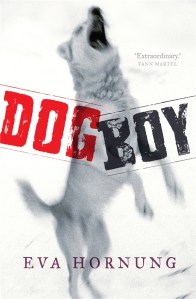
Eva Hornung’s Dog Boy is such a book for me.
For those who haven’t heard of what’s it’s about, I’ll state it briefly. It’s about a boy from an impoverished background in a dystopian contemporary state in Eastern Europe – identified later as Moscow – who is abandoned and finds himself taken in and nurtured by a pack of city-living feral dogs. It was inspired by real-life stories of a dog-nurtured boy and how he was found and “rescued” back into society. Romochka is the name Hornung gives the boy in this book.
I read Dog Boy some weeks ago for part of the Australian Women Writers Challenge and was so rocked by it I wondered how I would begin to review it; I began to think the subject was too big. It was only the prompting yesterday by Sue T from Whispering Gums that made me decide at last to tackle it. Though tackle isn’t the right word. Engage with it. Engage, celebrate, ponder, muse, discuss, extend, subject myself once again to its magic, its tragedy, the challenge it presents to me to think on, feel and embody what it means to be human, what it means to have been touched by – and to love – a species that is not my own.
So this is more than just a review, if it is one at all. I’m still uncertain which blog it belongs to: this “review blog” or my personal one. Because, rather than discuss elements of the story – although they are intrinsic to what I have to say – I have allowed myself the freedom to weave in and around what this story means to me, the way it writes me, the way it helps me to interpret aspects of my own history. If the personal impact of a story isn’t what interests you and you’re looking for a more traditional review, I suggest you skip this and check out what notable Australian bookbloggers Whispering Gums (positive) and AnzLitLovers (not convinced) have written about Dog Boy.
If you’re still here, please bear with me as I grope my way along and try to articulate why this book so touched me.
Anyone who has loved and been loved by a dog will not fail to be deeply moved by Dog Boy. My own history with dogs is fraught. At the age of eighteen months, I witnessed the horrific mauling of my older brother, a three-year-old toddler, by a German Shepherd. My brother’s face was savaged; his cheek required 24 stitches. I don’t remember the event; I remember the emotional aftermath and the stories told and retold to explain the jagged pink scar on my brother’s face. My father got into a fight with the owner of the dog and was charged with assault. At the time, my mother was pregnant with her ninth child, the eldest only just turned eleven. For most of my childhood, I feared dogs, big dogs especially, associating them with a visceral fear of violence.
So when our family finally got a dog – a sprightly terrier named Injun – I didn’t warm to it. I knew other kids loved their dogs and thought I should, too, but I was frightened, even though it was small. It nipped and scratched and yapped and tore my skirt. By then our family was disintegrating and, after some initial excitement, the dog was neglected. Over the years, Injun suffered from mange, grew manic and pined for lack of attention. Its official owner, the brother who had been mauled, left home, abandoning it. My mother, who had grown up on a farm, believed dogs belonged outside, so Injun never became part of the family; it was fed, but given little love. A woman who occasionally cleaned for us eventually took pity and rescued it, taking it to a good home.
That should have been enough. But another dog made its way into our mad family – mad because my father, his behaviour increasingly erratic, had been drinking heavily for years, overwhelmed by the stress of trying to provide for a brood of children that had swollen to twelve, and increasingly disturbed by the mental illness he had never openly acknowledged, though his mood swings, paranoia and violent outbursts certainly made us kids question his sanity. It was a difficult period generally. His own mother was ageing and demented, my mother in and out of hospital with bouts of pneumonia, her own elderly, half-blind, mostly deaf mother an intermittent resident in our household. The new dog’s name was Mutto; she was a stubby-legged cattle-dog, a brick with fur, whose pathological fear of storms amused my father. She came from up north where another older brother had migrated in the seventies along with a generation of hippies.
I did warm to Mutto eventually, but only distantly. She was my dad’s dog and I was glad when he focused his attention on her instead of on us kids who remained at home. His cruelty toward her disturbed me, the way he’d swing her round by her front paws, but I didn’t think to protect her. My father was a big man, and when I finally stood up to him in my own defence, the result was traumatic. I don’t remember how or when Mutto died; just her quivering, shivering, shaking body, the mad scramble of claws on the wooden veranda and her bullish determination to butt through the swing door well before any of us could smell or hear the coming storm.
Fast-forward to adulthood – past the terrible years where my father’s illness erupted into full blown psychosis and tore our family apart – to the time when Dad was finally diagnosed and medicated. For his rehabilitation, my eldest sister bought him another dog, a pretty Border Collie-Kelpie cross with shaggy black fur and rust-tinged ears. Our beloved Peppy.
If it’s true the mental health of an animal reflects the mental health of the family it belongs to, then Peppy’s steadiness and warmth is a sure sign of the healing that occurred within my family once my father was under psychiatric care. But Peppy’s life wasn’t easy. She was my dad’s nurse and companion in many more ways than us adult kids could be. She put up with his occasional cruelty, the way he’d take her paws and make her dance on her hind legs, showing a patience and gentleness that half-convinced me she understood how important it was for him to experience unjudging companionship, loyalty and devotion from another sentient being.
As my father withdrew into himself, distrusting everyone who had sought to protect ourselves against the worst of his illness, it was only Peppy to whom he showed affection. After having been estranged from my dad for years, I finally felt safe to visit, and Peppy would greet me at the gate, her whole body wagging with her tail, pink tongue lolling, lips drawn back in a smile. Slowly under her mute tutelage, I rebuilt the fractured relationship with my father, her unstinting patience teaching me how best to be with him: silent, getting on with the business of helping my mother tend to his and my centenarian grandmother’s needs. In the years I helped nurse him, Dad rarely spoke to me directly – never once used my name. But, just before he died, he responded to my morning greeting with a “G’day, Peppy.”
So what have these memories to do with Eva Hornung’s book Dog Boy and systems’ theory?
In Dog Boy Hornung poses the question: what is it that separates us from the brute? Traditional religion would have us believe it’s free will, the ability to discern good and evil, to reflect on our own choices, to shape our own characters, and to know how – and be willing – to choose the good. Hornung suggests that where we fall on that spectrum of awareness may depend on how “brutishly” we ourselves have been treated. In the story of Romochka, human beings are, by turns, complex and flawed; cruel and compassionate; well-meaning and misguided. Ultimately, however, Romochka’s treatment by dogs seems far more “human” than the treatment he suffers from members of his own species. So how does Hornung mean for us to understand what elevates humans above the animal?
It is a question that systems’ theory helps to enlighten.
Current thinking on systems’ theory is too broad, complex and subtle a subject for me to attempt to address in an intelligent way here. But it’s a measure of the remarkable nature of our universe, which so often throws up seemingly inexplicable synchronicities – in a quantum manner, perhaps – that just this morning as I woke up in the early hours, pondering how I might discuss this subject in relation to Dog Boy, I switched on the radio and heard a repeat of last night’s broadcast on Big Ideas of the Rollie Busch lecture by Nancey Murphy. Her subject: systems’ theory and the nature of subjectivity; her words found instant resonance with me.
Murphy is a physicist (and Christian) who rejects traditional Christianity’s Platonic dualism between the mind and body. Rather, she sees the “mind” or brain as comprising processes and relationships, with each part influencing and being influenced by the whole in a continuous feedback loop. Human behaviour isn’t pre-determined by our biology, our neurochemistry or genetic make-up, she asserts, nor by our environment. Rather, these elements both influence and are influenced by the behaviour of the system as a whole. While Murphy’s emphasis is on the brain as a complex system, the same thinking can apply to complex systems at all levels, to organs, the body, the family, the community, the state, the nation and the globe. Each can be construed as a system of relationships and processes which create organisms of increasing complexity, where component parts influence and are influenced by the whole.
Significantly, according to Murphy, what distinguishes the human from the animal in a systems’ theory approach is the acquisition of symbolic language which allows humans to learn from and reflect on their behaviour over time. By being able to reflect and choose our response to changes within the complex system of processes and relationships, we gain agency, which in turn creates moral responsibility. And it is this ability to learn, this entry into moral agency which Hornung so graphically and movingly depicts in Romochka’s story.
[Vague spoilers ahead]
By inserting Romochka into a non-human world, Hornung offers us a view of subjectivity that differs from both the dualistic notions of neo-Platonic Christianity, where mind is separated from body, and of Western individualism. In Romochka’s dog-world, each individualis connected to the whole, helping to create a self-supporting, self-regulating organism, the “pack”, which collectively has the intelligence necessary for survival. In Romochka’s identification with and entry into the pack, adoption of its “language”, mores and values, Hornung illustrates a flaw in individualistic notions of subjectivity: without the group, we perish; if we work as a team, nurture the young and vulnerable, individuals may at times be sacrificed, but collectively we survive.
The climax of Dog Boy occurs at the point when Romochka must choose either to abandon the idea of being a dog, one who belongs to a pack that no longer exists, or “go back” into human society. According to Murphy’s thesis, the moral choice he makes in the story is moral, not brutish, because it shows him having learned from the past, from Mamochka’s actions during a lean winter. The decision he makes regarding his pup “brothers” results is an action which, by then, given our empathy with the dog-world, appears to be an act of brutality; yet such is Hornung’s skill in creating this moral dilemma, the act also strikes the reader as a tragic sacrifice, as Romochka recognises that he cannot nurture himself as a dog, nor is he willing to raise the next generation if they cannot be considered his equals, his “pack”, his tribe.
The bigger picture here – and the reason I thinkHornung chose to write this story – is the question it poses to humanity. Our world is threatened. Millions of people are dying of hunger, disease, poverty and malnutrition; others are locked up and chained, languishing in prison for their religious and political beliefs. Women are subject to untold violence. Habitats are being cleared; non-human species are going extinct at an unprecedented rate. Billions of plastic bags are manufactured daily, used once and discarded, left to choke our waterways and strangle our marine life. Catastrophic climate change is growing ever more likely. Our traditional ways of seeing our relationship to animals and nature, one of separation, dominion over and exploitation is killing us. Yet we have not been sufficiently educated to realise that we are component parts of a giant, creative, living, intelligent system, and that without those larger systems in balance we place at risk the very things that give us life and sustain us, our food, our water, the air we breathe, let alone the loving relationships among other sentients that makes our souls sing. “It’s all alive,” as the Bioneers say. “It’s all intelligent. It’s all relatives.”
So where is our sense of moral agency and responsibility? If faced with catastrophic conditions that threaten not just our individual survival, but also that of our communities, our species and Earth’s living systems, will we have the emotional intelligence and courage to make sacrifices, to choose tough moral decisions? Or are we so blinded by out-dated notions of what makes us human that we will continue to act like brutes, unable to reflect on our own behaviour, to learn and adapt, respond and change?
You might say it’s a long stretch from Dog Boy to systems’ theory, let alone to a revolutionary project of changing the very basis of how we live. Perhaps it is. Perhaps Hornung’s story is a fable, nothing more. You might suggest that Mamochka’s and Romochka’s decisions are driven by instinct and imitation, not considered reasoning. We, on the other hand, are human, we’re civilised; we’ll know what to do when the crunch comes. Maybe. I hope so. But books like Dog Boy bring these questions alive for me in a way few others have managed – without pessimism, and with such beauty.
And Peppy?
Peppy died when Mum and I spent a week in St Petersburg a few years ago. It was my second visit. I’d been there as a student in the days before Perestroika and I was staggered to find that the Communist propaganda symbols which had once dominated every venue had been swept aside in favour of the gilded iconography of the Russian Tsars. We visited in February with its long dark nights, snow turning to slush in the streets and grey, icy river. We stayed in one of the best hotels on Nevsky Prospekt and were chauffeured around the city by a fur-coated guide and a driver in a limousine. Outside a Russian Orthodox church, where priests chanted the service and men and women queued to kiss an icon of the black virgin, we saw old men begging, communist war veterans with amputated legs, scarfed matrons crouched on blankets offering for sale a meagre bunch of carrots and straggling bunches of herbs; we saw beautiful young women in high heels and glossy leather coats striding by, oblivious to the red-faced survivors of an older generation who had given decades of their lives to a corrupt regime and been left with nothing. We saw stray dogs scrounging for food down darkened allies…
And came home to news of Peppy.
Back then, Dog Boy had already been published. I can’t help thinking that its stark, beautiful prose might have helped me through my grief – the loss of a dog, a friend, a beautiful soul, one last painful link to my father – if only such brilliant books by Australian women were better known.
Dog Boy, Text Publishing 2009
- winner, Fiction category, Prime Minister’s Literary Awards, 2010
- shortlisted, Vance Palmer Prize for Fiction, Victorian Premier’s Literary Awards, 2009
- shortlisted, ASL Gold Medal, 2010
- shortlisted, Literary Fiction Book of the Year, ABIA, 2010
A note on Australian ebook pricing craziness:
Dog Boy can be bought as an ebook from Aussie e-platforms: ReadCloud and Booki.sh stores, including:
- Megalong Books ebookstore: $23.95 (my local bookshop in Leura).
- Pages&Pages ebookstore has 2 editions, one for $23.95, another for $32.95.
- Avid Reader ebookstore advertises one edition on their website for $14.95 but notes: “We’re sorry, this book isn’t for sale in your country.”
- Avid Reader has another edition, the same one available from Megalong Books and Pages&Pages, but on sale for $15.80.
(Pages&Pages and Avid Reader bookshops have staff signed up for the AWW2012 challenge and have a AWW challenge tab on their ebookstore webpages.)

Eva Hornung’s Dog Boy and the challenge to moral thinking; or Towards a Systems’ Theory view of Subjectivity. by Elizabeth Lhuede is licensed under a Creative Commons Attribution-NonCommercial-NoDerivs 3.0 Unported License.
Based on a work at elizabethlhuede.wordpress.com.
Permissions beyond the scope of this license may be available at http://www.elizabethlhuede.com.

 This novel is well told, but populated by a cast of highly unlikeable, often misogynistic characters that, by the end, made me feel angry and unsettled. The scenario is interesting; its insight into police, media and political cultures in Hobart scathing. Whereas in Erskine’s debut novel, The Brotherhood, I felt I had someone to cheer for, in this I didn’t, not even Lucy, the cadet who instigates the investigation that forms the basis of the novel’s plot. Her behaviour, for a police officer, seems naive in the extreme.


 Devoted Eclectic