
Let Her Go by Dawn Barker – powerful contemporary drama

Dawn Barker Let Her GoTwo sisters – step sisters – one, Nadia, is happily married with three children; the other, Zoe, has suffered a debilitating illness and a number of miscarriages, and finds herself infertile. Both have reasons for wanting to have a baby: Zoe, to complete her long-held desire to be a mother; Nadia, ostensibly, to help her deserving sister. After years of counselling and legal advice, they enter into a surrogacy agreement. They are adults. They care for each other. What could possibly go wrong?

Fast forward seventeen years to a troubled teenager, Louise, who is getting busted for stealing drugs, self-harming, engaging in drunken sex and whose performance at school is deteriorating. She knows her – unnamed – parents are fighting, senses it has something to do with her, but has no idea of the trauma that followed her birth or the bitter custody dispute that tore her extended family apart.

In Let Her Go Dawn Barker – a psychiatrist by training – successfully juggles different points of view as well as jumps forward and backward in time. Throughout the novel, the reader has a sense that something really terrible could happen – or maybe has happened already – but the suspense isn’t gratuitous. It derives organically from the fraught emotional situations she forces her characters to confront. As I approached the novel’s climax, I was struck by the story’s similarity to the Judgement of Solomon, as if Barker had taken elements of this classic dilemma and brought it alive in a modern context. Both women have good claim to the child; how will the child’s best interest be served?

If Barker’s debut novel Fractured grabs the reader and forces her along a terrifying path, Let Her Go is more like a slow burn, but it’s no less powerful for that. For anyone who has yearned for a child and not been able to conceive or carry to term, the narrative is excruciatingly real at times, almost unbearable. Similarly, Barker captures the pressure on a marriage of women coping with hormones, fears and jealousies. Both Zoe and Nadia are portrayed at times in a poor (but very human) light. Zoe comes across occasionally as unreasonably demanding and judgemental towards her husband, a man with secrets who has never seemed as enthusiastic about the surrogacy and who fails to pull his weight. In portraying the deteriorating relationship, Barker uses irony to good effect: the reader is ahead of Zoe in sensing the effect of her behaviour on her husband, and waits in suspense for the explosion we fear will come. Nadia (understandably) seems at times to be selfishly blind to anyone’s needs but her own, and the reader is torn, sympathetic to her suffering, but alarmed at the lengths she is willing to go to get her way.

With both Let Her Go and Fractured, Barker joins a number of women writers in Australia who create compelling psychological suspense out of difficult moral and social issues, including Honey Brown, Wendy James and Caroline Overington. Each of these writers’ novels demonstrates that issues facing contemporary Australian women, in the hands of skilful storytellers, make for powerful drama. I can’t wait to read Barker’s next scenario.

~

This review forms part of my Australian Women Writers Challenge and Aussie Author Challenge. A review copy was kindly provided to me by the publisher via Netgalley.

It has been reviewed for the AWW challenge by Emily Paul.

Publisher: Hachette Australia
ISBN: 9780733632228
Published: July 2014
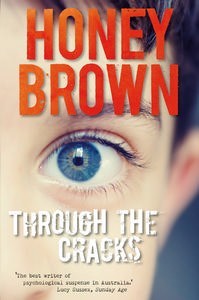
Through the Cracks by Honey Brown – don’t read the back cover

If I’ve enjoyed an author’s previous books, through the cracks brownI never read the back covers of their latest. So I knew very little about Honey Brown’s psychological suspense novel, Through the Cracks, before I picked it up. Later, I read through some reviews posted for the Australian Women Writers challenge and saw that several reviewers were dismayed and annoyed that the book’s back cover “blurb” gave away a lot of the story’s suspense. So, fair warning: don’t read the back cover.*

Told from the point of view of Adam Vander, a boy who has been kept locked away from the world by an abusive and controlling father, Through the Cracks traverses difficult territory. Adam has been victimised for so long, he exhibits all the hallmarks of “learned helplessness”: he has become so conditioned to abuse that he appears almost incapable of acting to stop it. Only as he hits puberty, and his father succumbs to health problems, does his sense of agency begin to assert itself. But how can he save himself when he knows nothing about the world, and the few people he encounters, apart from his father, don’t recognise him as someone who desperately needs help?

Brown’s tale of Adam’s escape is both compelling and distressing. Slowly the events that led to his predicament are revealed, and the full horror of what he has endured unfolds. Along the way, Brown touches on issues of race, class, sexuality and, most importantly, identity. Who are you when everything that makes you human has been stripped away?

One of the many elements of this powerful and emotionally wrenching novel that impressed me was its style. The sentences are often short and descriptive; the point of view character indulges in very little introspection and makes few inferences of other characters’ thoughts and feelings. It is as if one of the after effects of abuse is an almost complete lack of interiority. For me, this created an unnerving sense of Adam’s dissociation, his feeling of being utterly separate from the world, both emotionally and psychologically, even as he slowly rejoins it, just as formerly he was isolated physically.

With Through the Cracks, Brown cements her place as one of the foremost writers of psychological suspense in Australia.

~

This book was kindly supplied to me by the publishers through Netgalley. It forms part of my contribution to the Australian Women Writers Challenge and Aussie Author Challenge. It has already attracted a lot of attention from AWW challenge reviewers, including:

~

Title: Through the Cracks
Author: Honey Brown
Published:23/04/2014
ISBN-13:9781921901546; ISBN-10:1921901543
Imprint:Michael Joseph; Publisher:Penguin Australia.

Skinjob by Bruce McCabe, sex dolls and gender issues

Bruce McCabe SkinjobThe Good: gender issues
The Bad: gender issues
The Ugly: gender issues (and I foresaw the twist at the end)

Setting: US in the near future

Recommended for: thriller and suspense fans,
people interested in human factors in technology
innovation and adoption

When I heard Bruce McCabe speak at the National Book Bloggers Forum about his debut novel, Skinjob, I was hooked. Not by the title. If I’d seen that title on the library shelves, I wouldn’t have picked it up without gloves. When I first saw it, it reminded me of “hand-job”. It still reminds me of hand-job, even though I’ve read the book and there’s nothing titillating in it. Exciting, yes. Adventurous, yes. It has all the elements Robert McKee writes about in Story: a ticking clock, a vulnerable hero, powerful antagonists, and an interesting (pretty “high”) concept.

The concept: what could happen when robotics advance to the extent that the “world’s oldest profession” can be performed by robots, “Skinjobs”? What if the powerful forces of the pornography/sex trade industry and the neo-conservative Christian right waged an epic battle to sway the hearts and minds of the American people? What if a lie-detecting FBI agent and a San Francisco PD (female) surveillance officer teamed up in a race against time to prevent the annihilation of thousands of innocent people?

Juicy stuff, right? It is. And McCabe does it well. Well enough to have gone from being a self-published author hand-selling to Berkelouw Books in Dee Why to attracting the attention of J K Rowling’s agent and scoring a contract with Random House.

What really interests me about the book, though, is its take on gender issues.

Some background.

At the book bloggers’ forum, I asked Bruce McCabe whether he read books by Australian women. No, he is more of a Michael Crichton, Frederick Forsyth and Stephen King guy. (All of whose books I have devoured.) Also Lee Childs. He did say that author Kathryn Fox had been very helpful to him though (she appears in the acknowledgements) and added, “I must read her books”.

It was with amusement and some consternation, therefore, that I came across a cameo appearance of a “Kathryn Fox” in McCabe’s novel.

The title of the novel, Skinjob, refers to an advanced form of sex doll. These life-like dolls have warm “skin”, a “heartbeat”, and can move in a “come hither” fashion. They can’t speak, but can make moaning and groaning noises. They don’t act other than to flirt or serve. They can also simulate realistic fear to threats and acts of violence (up to the point of actual physical harm). “Kathryn Fox” appears in the book as one of the manufacturer Dreamcom’s most successful dolls.

What is McCabe trying to say here?

One thing McCabe talked about at the forum was how there is no good and bad in human beings; we all have elements of both. The main character, Daniel Masden, isn’t perfect. Nor is the female  SFPD operative, Shahida Sanayei (Shari), whom Masden partners up with. Shari, in fact (spoiler alert) solves the enigma that is central to the plot and, therefore, effectively saves the day.

All good. But what if Skinjob became a movie – as it certainly could; it’s very filmic, action-packed and fast-paced, has lots of interesting “locations”, high-tech gadgetry and car chases – would it pass the Bechdel Test? That is, does it have “at least two women who talk to each other about something other than a man”?

It wouldn’t. That’s right. A story in which gender issues are crucial, all bar one of the main character roles are male. Shari is introduced in the context of having lost her male lover in a bomb-blast at a skinjob “brothel” – or pleasure house – run by Dreamcom. Her role in the story is to help Masden track down those responsible for the blast; all the suspects are male. The SFPD major figures and FBI personnel are male; the Dreamcom owners and employees are male; the leaders of the right-wing church suspected of being behind the blast are male. The majority of the “females” who would appear in the movie would be robots. (Imagine doing that screen test.)

Remember Skinjob is set in the future. Even if one asserted that the industries depicted in the story are currently male dominated, there is plenty of scope in a future world for more than one woman to be depicted as having agency and moral complexity. Why not a female pastor? A female pleasure parlour owner? Sure, the men in these roles in Skinjob don’t come off well and are often revealed to be self-serving hypocrites, sex-addicts and narcissists. That shouldn’t be a restriction. As McCabe was at pains to point out, human beings are complex moral creatures; that includes women.

In Skinjob McCabe sets out to address some really interesting questions about gender, sex and power, the most interesting of which, for me, is the ethics of using automatons for sexual relief. But, while writing about it for entertainment, he risks reinscribing the very kind of objectification and invisibility of women which, arguably, the sex industry and fundamentalist churches of all kinds have historically been guilty of.

My conclusion?  It’s still a page-turning read.

~

This review forms part of my contribution to the Aussie Author’s Challenge 2014

Review copy courtesy of the publishers at the National Book Bloggers Forum.
ISBN: 9780593074091
Published: 02/06/2014
Imprint: Bantam Press
Extent: 416 pages


ISBN: 9780593074091
Published: 02/06/2014
Imprint: Bantam Press
Extent: 416 pages

– See more at: http://www.randomhouse.com.au/books/bruce-mccabe/skinjob-9780593074091.aspx#sthash.KrlSSYff.dpuf