
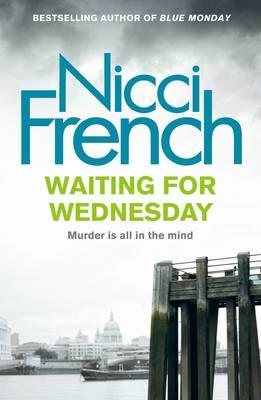
Whatever happened to Nicci French? Review of Waiting for Wednesday

waiting-for-wednesday-a-frieda-klein-novelAs avid fans of Nicci French novels will already know, ‘Nicci French’ is the pen-name of best-selling writing couple Nicci Gerrard and Simon French. What I didn’t know until I read it on their Goodreads page is that both Gerrard and French graduated with First Class Honours in English Literature from Oxford University.

It doesn’t surprise me.

I’ve been a fan of their psychological suspense novels for years, so much so that I set up a Facebook page to seek out other fans. I wanted to know who gravitated toward their work and why. Instinctively I thought they would be people like me, people who might enjoy what I liked to read and write. My own future readers, perhaps… if only I could learn to write as well as the Nicci French team.

So what is it about their novels I find so compelling?

One clue may lie in Nicci Gerrard’s professional background. Her first job was working with emotionally disturbed children in Sheffield, and an interest in mental health underpins much of the couple’s writing. In fact, I told a friend once that they seemed to create their characters by making their way through the DSM-IV, the Diagnostic and Statistical Manual of mental disorders. It was a joke, but it may not be so far from the truth. Each book, variously, has dealt with mental health issues, particularly the questionable human behaviour that results from severe trauma and abuse.

From the start, Nicci French stories have had multiple layers. Sometimes the books are ‘murder mysteries’; other times they are portrayals of characters, usually women in their thirties, who are pushed to extreme limits; often they are a combination of the two. In the early novels, point-of-view characters are likely to be victims of some kind – victims of life, of their own behaviours and mental states, as well as victims of crime – and these experiences test their grip on reality. Avid readers of these books identify with the main characters’ fear of losing control, their journeys in stepping across the line between sanity and insanity. The books enact and exploit that journey, and also play on one’s fear of other people’s reactions to such a loss of control. In Losing You, the seeming ‘madness’ of the main character stems from her grief over the disappearance of her daughter. In Catch Me When I Fall, the main character is progressively depicted as an almost text book example of someone with Bipolar Disorder. Even in the more ‘crime’ oriented books, mental health issues are paramount. The perpetrators who victimise the protagonists often exhibit classic personality disorders. In Secret Smile there is a sociopath who targets and traumatises a woman who rejected him. In Killing Me Softly is a chilling and memorable portrait of a psychopath, one who displays the compelling ‘Dark Triad’ of Narcissism, Antisocial Personality Disorder and Machiavellianism.

For people like me, there is a vicarious thrill in reading such stories. The interesting question to ask is why.

Recently Professor Richard Landy, Professor of Educational Theatre and Applied Psychology at New York University, featured on an ABC All In The Mind program, discussing ‘drama therapy’ and the therapeutic effects of art. According to Landy, it’s all about ‘mirror neurons’. When we see something on stage (or, for the purpose of this discussion, read about it in a book), our brains behave as if we are the person engaged in the behaviour we’re watching/reading. We literally become excited, recognising in the characters portrayed something ‘human’ and ‘true’, and we experience this as therapeutic.

But how could it be therapeutic to read about mental illness and violent crime, as we do in the Nicci French novels, conditions and events that would be deeply traumatising if experienced in real life?

Landy’s discussion of the ‘framing’ of the drama/story, I believe, is pertinent here. In real life, circumstances only too often are out of our control: we can be struck randomly by illness, by events, by crime. There’s no come back, no cathartic sense of justice or happy ending. In a book or play, it’s different. By engaging with the fictional world, according to Landy, we enter into an implied contract with the playwright/author. In psychological suspense novels like those the Nicci French team writes, I’d suggest, the contract implies that we’ll be taken through our journey safely and both ‘sanity’ and ‘justice’ will be restored in the end. This is the pay-off for the reader: the illusion of control. For many readers – perhaps especially those of us who have experienced trauma or an intense sense of loss of control in our own lives – that illusion is very comforting. It’s like, in a way, we get to re-play being traumatised, but to experience an alternative, more empowering, less victimising outcome. Yet, this doesn’t tell the whole story. Not all of the Nicci French point-of-view characters survive being victims – and this uncertainty appears to be part of the suspense or thrill. The sense of risk, of the danger that this time things may not work out, would seem to be central to the pleasure the books create.

The Nicci French team has been able successfully to exploit this desire for the illusion of control in their standalone psychological thrillers/suspense novels over a period of many years. In 2011, they changed tack, publishing Blue Monday, the first in a series which features a London-based psychotherapist, Frieda Klein, who teams up with detectives Malcolm Karlsson and Yvette Long to solve a crime. Since then, they have published two more in the series, Tuesday’s Gone and, most recently, Waiting For Wednesday. In starting this series, the couple has taken a risk. Instead of the creating a protagonist who embodies a victim suffering the vertigo of losing control, in Frieda Klein they have created a character far more cerebral.

Klein’s world view is one fans would be familiar with:

She believes that the world is a messy, uncontrollable place, but what we can control is what is inside our heads. This attitude is reflected in her own life, which is an austere one of refuge, personal integrity, and order. (Source: Goodreads series page)

As this quote suggests, the emphasis of the series would seem to be more on understanding and articulating this world view, rather than dramatising it. Consequently, it would seem the reader has been robbed of the pleasure of a vicarious sense of loss of control. In its place is something far less visceral, less exciting.

For the small group of dedicated fans who belong to my Facebook page, the reaction has been one of disappointment. As recently as yesterday, one fan who is looking forward to hearing the couple at the upcoming Edinburgh International Book Festival, expressed her preference for the earlier books and said she hopes to be able to ask the authors whether they planned to write any more standalone thrillers. A chorus of responses followed: these fans, it seems, prefer those earlier books.

But what of Waiting for Wednesday, the most recent book in the series?

This hook is from the publisher’s website:

Ruth Lennox, beloved mother of three, is found by her daughter in a pool of her own blood. Who would want to murder an ordinary housewife? And why? (source: Penguin Australia)

The  book starts out like a detective story, even police procedural. But the difference is that this mystery is woven in with Frieda Klein’s story, a story which has more resemblances to the earlier novels than the first two in the series. In this novel, Frieda Klein, a woman who loves order above all things, inhabits a chaotic, messy world, a world partly created by her semi-out-of-control friends and family, partly by her own actions. Once again she is a sleuth, but this time she is without the sanction of the police force. While her obsession to solve a crime appears to be a kind of self-therapy, or possibly merely a diversion as she fails to deal with the trauma she experienced in the previous novel, her sleuthing is seen by others as dangerous, even borderline psychotic. She has become, like the protagonists of earlier Nicci French novels, a woman living on the edge.

Whether, for this story, the authors have changed tack in response to feedback from disappointed fans, or whether this was always going to be their trajectory for Klein is unclear. The result is that Klein’s world once again traverses familiar territory: loss of control, risk-taking, the appearance of madness, with justice and order – of a kind – triumphing in the end.

The strategy may or may not be enough to convince dedicated fans, but the book certainly hasn’t disappointed other readers who have reviewed it so far (including two Aussie book bloggers, Shelleyrae and Bree).

For me?

Reading Waiting For Wednesday I barricaded myself in against wet, winter weather, resenting interruptions and staying up late, marveling at the couple’s virtuosity in keeping my attention gripped. I recognised the ‘truth’ of various characters’ behaviour, including their fascination with drama:

She had that excited calm that some people get in an emergency. Karlsson had seen it before. Disasters attracted people. Relatives, friends, neighbours gathered to help or give sympathy or just to be part of it in some way, to warm themselves in the terrible glow. (2% through ebook [no page numbers given])

I found the insights into mental health issues fascinating:

When they reached Tottenham Court Road, they stood for a moment and watched the buses and cars careering past them. ‘You know,’ said Frieda, ‘that if you move from the countryside to a big city like London, you increase your chance of developing schizophrenia by five or six times.’ (85%)

And I enjoyed the patches of poetry that the writing team – all-too-rarely, for me – occasionally indulge in:

The path broadened out into a wide track. The river was slow and brown. If she lay down here, would she ever get up? …would she cry at last? Or sleep? To sleep was to let go. Let go of the dead, let go of the ghosts, let go of the self.

Cranes. Great thistles. A deserted allotment with crazy little sheds toppling at the edge of the river. A fox, mangy, with a thin, grubby tail. Swift as a shadow into the shadows. (98%)

Whatever happened to Nicci French? They tried something different and it works, for me.

~

Author: Nicci French
Title: Waiting for Wednesday
ISBN: 9780718156978
Genre: Thriller/suspense

Ebook review copy kindly supplied through Netgalley by the publisher.
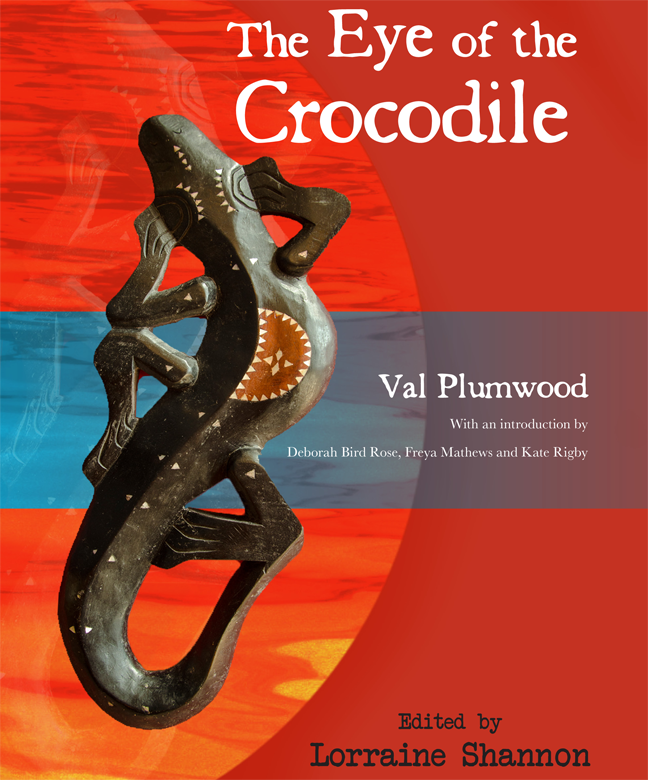
The Eye of the Crocodile by Val Plumwood

eye-of-crocodile-plumwoodOne of the best things to come out of the Australian Women Writers challenge for me has been exposure to books that I might never have discovered on my own. Recently ANU E Press joined the challenge, tweeting links to (free) e-books by Australian women. Val Plumwood’s The Eye of the Crocodile, edited by Lorraine Shannon, is one such book.

Part memoir, part collection of philosophical and eco-feminist essays, The Eye of the Crocodile contains Plumwood’s last pieces of writing – she was working on the draft when she died in 2008. According to authors of the book’s introduction:

Val Plumwood was one [of] the great philosophers, activists, feminists, teachers, and everyday naturalists of the late 20th and early 21st centuries… Her stature as a thinker of power and influence was reflected in the fact that she was included in the 2001 book 50 Key Thinkers on the Environment [edited by Joy Palmer, David Cooper and Peter Blaze Corcoran]… She was not only an influential environmental thinker, whose book Feminism and the mastery of nature has become a classic of environmental philosophy; she was also a women who fearlessly lived life on her own deeply considered terms, often in opposition to prevailing norms. (1)

The first section, which gives the book its title, contains an account of Plumwood’s near-death experience when, during a trip to Kakadu in 1985, she became prey to a large crocodile which death rolled her three times before releasing her. The remaining sections bear out the impact of this experience on her life and thinking. The collection includes a discussion of the movie Babe and a moving account of her friendship with – and grief over the death of – a wild wombat named Birubi. The third, most philosophical, section contains essays on radical vegetarianism and “a food-based approach to death”.

The coupling together of “pieces” rather than a unified work means the writing styles of The Eye of the Crocodile are varied. Passages of beauty and emotional power sit alongside some heavy-weight philosophical pondering. Plumwood admired creative writers for their ability to convey new ideas to a wide audience, and in the memoir section it is clearly a mainstream audience which she hoped to reach. Had she lived, this section would, I imagine, have made up the bulk of the book, with some of its more florid stylistic touches toned down by editors. As a short, incomplete work, however, The Eye of the Crocodile still has much of value to offer the reader.

The collection begins with Plumwood’s reflections on the fateful canoeing trip she made to the remote area of Kakadu when she encountered the crocodile. Her account gives an indication both of her personality and her writing style:

I suppose I have always been the sort of person who ‘goes too far’. I certainly went much too far that torrential wet season day in February 1985 when I paddled my little red canoe to the point where the East Alligator River surges out of the Stone Country of the Arnhem Land Plateau. It was the wrong place to be on the first day of the monsoon, when Lightning Man throws the rainbow across the sky and heavy rains began to lash the land. (10)

After surviving the crocodile attack, injured and alone, Plumwood crawled for help and was found by a park ranger. Reflecting on her experience at various points throughout the essays, Plumwood reveals how, by facing her own mortality and insignificance, she was inspired to question the dualistic thinking that underpinned both her reaction to the event as well as much of Western philosophy. This thinking sees humanity as an exception to nature, above and beyond it, instead of a part of it. It sees humans as separate from animals because we have “souls” and can reason, and this enables us to commodify animals as a food source, taking little care of the lives of the creatures whose flesh we eat. At the same time, we respond with rage, disbelief and a desire for retribution when predator animals prey on us, threatening the illusion of our supremacy and safe autonomy. In this, we deny our part in the food chain or “foodiness”, as Plumwood calls it.

In between dipping into Plumwood’s collection, I also listened to the latest ABC RN podcast of All in the Mind:Animal Minds”. In this program, author Virginia Morell discusses a conversation she had with Jane Goodall over Goodall’s witnessing in the 1980s of the “deceptive” behaviour of a chimpanzee. What was clear in Morell’s account was that while Goodall attributed to the chimp a sense of “intention” – if not downright personality – she was also deeply wary of declaring such beliefs openly, for fear of being labelled “anthropomorphic” by a scientific community which, back in the 1980s, still thought of animals as little more than stimulus-response machines.

In her discussions of both the crocodile and her wild wombat “friend”, Plumwood seeks to avoid being anthropomorphic by depicting these wild animals as “radically other”, as seeming to share in aspects of human-like cognitive functioning, but also experiencing consciousness in their own terms, in their own environmental contexts and with their own needs as paramount. While Plumwood avoids sentimentalising animals, there are elements in her attitude to animals and the land that strike me as romantic, particularly in her evocation of Thoreau and in passages which borrow from motifs and themes of indigenous cultures. By contrast, there is little that is romantic in her critique of central tenets of Classical and modern philosophical thinking.

While Plumwood critiques Platonic idealist thinking and Christian monotheistic views of “heaven”, she also identifies similar dualistic thinking among those whose views, at first glance, would appear to be in radical opposition to the views of these other two groups: animal defence activists and material atheists. This is the area of her discussion which I found most compelling, and it helped me to clarify some of my own thoughts about how we can honour and respect animals, while at the same time deriving the nourishment we need for survival in an ecologically aware manner.

According to Plumwood, “Ontological Vegans” would deny humans the right to eat meat (often adopting a “holier-than-thou” attitude), by extending to (some) animals a separate, soul-like consciousness. In this, their stance is not dissimilar to the theists who claim humans are set apart from (other) animals: it is because of this “separateness” from lower-order life-forms that animal flesh becomes inviolable. (And the question becomes, at which animal/level of consciousness do we draw the line?) Embedded in this position, Plumwood claims, is the same Cartesian separation of mind/body that has led humanity to the utilitarian use of the environment which now threatens the planet.

Materialist atheists are also bound by this dualistic thinking. Those who see death as the “End of the Story”, she says, valorise individual, separate human consciousness as if it were the pinnacle of existence. Yet their so-called “bravery” in the face of a perceived nothingness after death is merely a factor of their deep sense of loss – if not nostalgia – for the “heavenism” of those who believe in an after-death eternal life for the spirit. Both Ontological Vegans and modernist-atheists fail to see the inter-connectedness of the human to ongoing life narratives, narratives which would allow human bodies, in death, to nourish and replenish the earth. Such non-dualistic thinking Plumwood refers to as “Ecological Animalism”.

Plumwood’s final piece, “Tasteless: Towards a food-based approach to death”, reveals how her non-dualistic view has been informed by her understanding of Australian indigenous cultures. In an Ecological Animalist framework, barriers between so-called materialist and more “spiritual” approaches to life are broken down:

By understanding life as circulation, as a gift from a community of ancestors, we can see death as recycling, a flowing on into an ecological and ancestral community of origins. In place of the Western war of life against death whose battleground has been variously the spirit-identified afterlife and the reduced, medicalised material life, the Indigenous imaginary sees death as part of life, partly through narrative, and partly because death is a return to the (highly narrativised) land that nurtures life. (92)

I learned today that Plumwood helped to launch feminist Susan Hawthorne’s book Wild Politics at Gleebooks in Sydney in 2002, and that she lived and died not so very far away, at Braidwood, on the Southern Highlands, between Sydney and Canberra. She was old enough to be my mother, having had a daughter (who later died) the same year as I was born. Yet, while I can name several Australian sportswomen of that era, I’d never heard of Plumwood or her ideas till now. An Australian woman named internationally as one of “fifty key thinkers on the environment”, yet so little recognised.

How and why is that so?

~

Author: Val Plumwood
Title: The Eye of the Crocodile
Edited by Lorraine Shannon
ISBN 9781922144171 (Online)
Published November 2012
Citation url: http://epress.anu.edu.au?p=208511

Honey Brown’s Dark Horse

honey-brown-dark-horseYesterday Sydney was hit by a storm from the south east. Rain pounded on the tin roof, gutters overflowed, the temperature plummeted. In my inbox came an email from NetGalley stating that Penguin Australia had approved my request to review Honey Brown’s latest novel, Dark Horse, out this week. I’d read Brown’s Red Queen last year and have heard lots of good things about The Good Daughter, so I couldn’t resist downloading the ebook and peeking at the first page.

That was it for the rest of the day. I was hooked.

If you’re a fan of Jaye Ford’s Beyond Fear, Dawn Barker’s Fractured and Gillian Flynn’s Gone Girl, you’re going to love Dark Horse. It’s quite a ride. I would have read it in one sitting, if I hadn’t had to sleep. I curled up in front of a glowing slow combustion stove and, while the weather went crazy outside, was swept into the drama. Brown has a style that I love: it’s immediate, the descriptions are fresh, the action is urgent. I could almost feel the Victorian alpine hills crowding in, felt every bump and jerk of the heroine’s ride up the mountain on her endurance-trained horse, held my breath at the enormity of what she faced going up, when she reached the summit and going down again. It’s that kind of book: suspenseful, urgent, adrenaline-pumping.

And it’s clever. I’m used to twists in suspense fiction and I can usually read the signs. This book proved no exception, except I realised I was being played. Every time I anticipated the narrative, there was an unexpected payoff; each time I thought something was unlikely or stretched credulity, it proved well motivated or explained.

It was the perfect read for a rainy day, better than a movie. (Far better than its trailer.)

Do I go away with things to think about? I’m not sure. It ranges over what, to me, is very interesting territory: the extremes of human emotions and behaviour; infidelity; depression/mental illness; the breakdown of relationships; childhood trauma and its effects on the family. It belongs to the “family drama with crime” genre that writers like Wendy James and Caroline Overington are so successfully carving a niche in. It’s edgy. It’s sexy, too. But I’m not sure the degree to which it touched me emotionally and intellectually, or simply thrilled me. (To explore this further would necessitate spoilers.)

What it did do is confirm for me that Australian women psychological suspense writers are right up there among the best in the genre. I’m also glad I have two more Honey Brown books, The Good Daughter and After the Darkness, tucked away for another rainy day.

~

This review counts towards the Australian Women Writers Challenge. It has been reviewed elsewhere for the challenge by Simone at Great Aussie Reads and by Brenda in Goodreads.