Wit and pathos – The Half-Child by Angela Savage

I haven’t read any Angela Savage books before. Had I known  The Half-Child was part of a series, I’d have opted to start with the first book, rather than join the adventures of Jayne Keeney, private detective, after they’d begun. Right from the start, however, I enjoyed the Thai setting of this novel and was intrigued by the mystery Savage presents. As I read on, I discovered more and more to like.

Although I’ve been a fan of both conspiracy stories and detective stories for light reading, I can usually take or leave ones with the degree of humour I found in Savage’s story. Alexander McCall Smith’s The Number One Ladies Detective Agency Volume 6 has never appealed to me to pick up and read, even though I enjoyed hearing excerpts on the radio. And while I enjoyed the ABC’s Phryne Fisher detective series, I haven’t raced out to read Kerry Greenwood’s witty Aussie historical detective novels, either. As I read The Half-Child, however, I warmed to its humour, especially as it plays out in Savage’s depiction of the protagonist Jayne’s relationship with her Indian offsider, Rajiv.

While Savage’s insights into the seedier side of touristic Thailand give rise to indulgent laughter, there is also a fair degree of pathos in the tragic plight of some of the sex workers. Flashes of political comment and insights in regard to inter-race relations, inter-country adoptions and the attitude of Australians to Asian immigrants in the 1990s are also woven through the narrative. The story held my interest till the end, the twists, as well as the characters and their relationships, avoiding cliche.

I’d recommend this book to readers who enjoy tom-boy Aussie female ‘anti-hero’ protagonists, quirky humour and exotic settings, and who don’t mind their detective stories giving them something more to think about than your average mystery.

Note: This review appeared first in a modified version on GoodReads earlier this year. It fulfilled part of my AWW challenge and is Book 5 for my Aussie Authors Challenge.

The Old School by P M Newton

The Old School by P M Newton is outstanding in so many ways…

The language – I kept having to stop and write down one-liners, so superb is Newton’s command of prose.

The setting – a careful rendering of Sydney unlike any I’ve read. It’s refreshing to read a book of the city one has grown up in, so finely evoked in its sense of place, weather, character and idiom. Newton mentions many things I can identify with, from the man made of tyres along Sydney Road as one drives down to Manly (long gone, probably), to the waterfront of Greenwich Point with its oil terminal – as well as places I’m not so intimately familiar with, like the multicultural suburbs of the south-west.

The characters: I found the detective protagonist’s personal life absorbing, her mixed Irish-Vietnamese background disconcerting (brave of Newton to portray this cross-cultural perspective), and her relationships with others complex, nuanced and believable.

Plot: who cares, when you have all these other things so well drawn? But the plot was fascinating. It managed to weave in so many aspects of Sydney life, cultural, historical, political and personal.

Pace: this was a page-turner, but not a fast read. I was absorbed and found myself staying up late (and once waking up at 3am and reaching for the book). At the end, I wanted to finish – because in some ways I found the topic exhausting and confronting, but at the same time I didn’t want my journey with the characters to end.

Don’t just take my word for it. The Old School has attracted well-deserved rave reviews, including a couple by participants in the #AWW2012 Reading & Reviewing Challenge: Yvonne Perkins and Walter Masson.

The Old School won the Sisters in Crime Reader’s Choice Davitt Award and the Asher Literary Award, and was shortlisted for the Indie Award for Debut Fiction and the Ned Kelly Award for Best First Fiction.

Creative Commons License

P M Newton The Old School (review) by Elizabeth Lhuede is licensed under a Creative Commons Attribution-NonCommercial-NoDerivs 3.0 Unported License.
Based on a work at http://wp.me/pSU9K-9v.

(This short review first appeared in Goodreads; it fulfilled part of my AWW challenge and is Book 4 of my Aussie Author 2102 challenge)

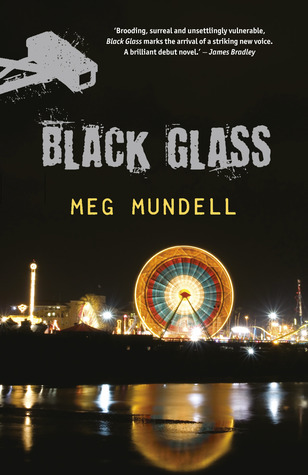
Black Glass by Meg Mundell

Set in a near future, Black Glass is about two teenaged sisters who get separated after the death of their father, and are thrown on their own resources in a strange and sometimes violent city.

While it’s the girls’ story the reader comes to care about, there are a number of secondary characters who appear intermittently throughout the novel, including a ‘mood enhancer’, Milk, whose job it is to micro-manage the populace through the manipulation of scent, and an investigative journalist. The journalist is trying to get the next big scoop in a city which has slid beyond the ‘haves’ and the ‘have nots’ into the ‘docced’ and ‘undocs’ – those with and without identifying papers.

In a society where surveillance and control are everything, and the undocumented are prey to all sorts of – fascinating – dangers, the two sisters, due to their lack of papers, are pushed to the edge of survival. While I love a good conspiracy story, the conspiracies in Black Glass – and there are more than one – don’t pay off in the way of a traditional thriller. They are evoked, rather than explored.

Mundell opts for an experimental structure which, for the lazy reader, isn’t straightforward to follow – mostly because the episodic, report-like format makes it a task to get to know and care for the main characters. The girls aren’t traditional ‘heroic’ protagonists, either, as, for much of the novel, they lack a sense of agency, of being in control of their own lives. They have almost no resources at their disposal beyond what comes their way by chance, so it’s hit or miss whether they’ll be able to find one another. With the possibility of a happy ending unlikely, Mundell creates and sustains an alarming sense that these two could be victims in the making.

Had the novel started closer to the events dramatized toward the end, this story could have been truly disturbing and gripping, instead of simply fascinating – but perhaps less true to the possible future society that Mundell has carefully imagined. As it now stands, Black Glass would make a compelling movie.

Black Glass was given “Highly Commended” in the 2012 Barbara Jefferis Award, an “Honourable Mention” in the 2012 Norma K Hemming Awards, and shortlisted for the 2011 Aurealis Awards  (in two categories), and the 2012 Chronos Award. It has been reviewed for the Australian Women Writers Challenge by Tsana – who considers it an outstanding read; Janine Rizzetti, Annabel Smith and Jason Nehrung.

This review appeared earlier this week on GoodReads and is Book 3 in my Aussie Authors Challenge.