
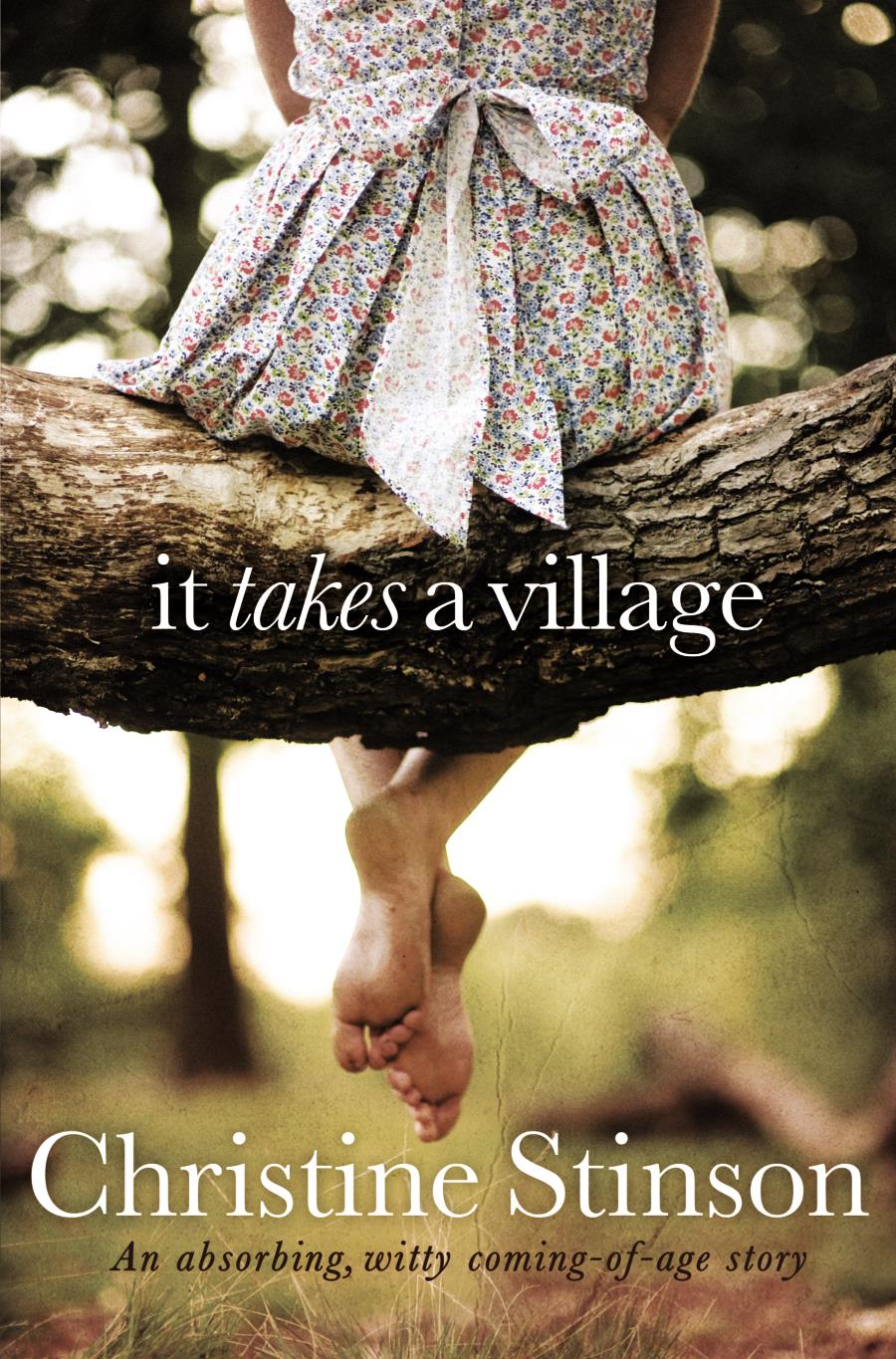
Christine Stinson, It Takes a Village – An Australian childhood

Australian author Christine Stinson’s first novel was the marvellously witty and engaging, Getting Even with Fran. That story celebrates the complexity of life-long friendships, centering around a thirty-year Catholic girl’s school reunion. After such a debut, Stinson’s second novel, It Takes a Village, comes as a surprise.

Told from the point of view of a young orphaned girl being brought up by her shell-shocked grandfather, It Takes a Village doesn’t have the biting humour of Getting Even with Fran. Rather, it weaves a gentle spell around the lives of the various characters who populate a poor suburb in Sydney in the 1950s and early 60s.

In this fictional memoir, Stinson deftly creates a portrait of an Australian way of life long gone. With strict morals and, at times, narrow-minded attitudes, this life also created a sense of  compassion and community that contemporary suburban life rarely offers. Having read the story in manuscript, as well as the finished novel, I kept hearing echoes of the sayings and expressions of people from my own Australian childhood, those ancient great-aunts and their companions who have long since passed away.

Although It Takes a Village touches on some serious social questions, including the aftermath of the deployment of United States army personnel in war-time Sydney, it doesn’t attempt to provide serious social commentary. Instead it achieves a moving as well as feel-good atmosphere which reminded me of the novels of Maeve Binchey.

Given that the second novel was such a contrast to the first, I’ve been fascinated to watch Stinson approach the writing of her third, yet to be published, novel Epiphany (working title). Set in the Blue Mountains, Epiphany revisits the “group of friends” theme, and again conveys the complexity of relationships among contemporary Australian women, this time with the added international flavour of having one of the main characters a leading conductor. The story builds on a deeply moving emotional dilemma which touches many Australian women in their late thirties-early forties juggling motherhood and career, and promises to be ranked among the best contemporary mainstream Australian women’s fiction when it appears.

(This review appeared in Amazon in July 2011 and has been revised)
Creative Commons Licence
Review of It Takes a Village by Christine Stinson by Elizabeth Lhuede is licensed under a Creative Commons Attribution 3.0 Unported License.
Based on a work at elizabethlhuede.wordpress.com.
Permissions beyond the scope of this license may be available at http://www.elizabethlhuede.com.
Love is a Four-Legged Word – A charming, mad cap read

Love is a Four-Legged Word, by Australian author, Kandy Shepherd, is a light, fun-filled read. Its quirky characters, an aspiring celebrity chef and an uptight lawyer, are brought together when the chef’s elderly neighbour dies, leaving her the guardian of an ugly pug who inherits a fortune.

Set on the west coast of the USA, this zany romance reminds me of an old Cary Grant movie – it has the same, light-hearted, feel-good factor. In this story’s world, nothing is too serious, despite seeming life-and-death stakes for the “millionaire mutt”. It’s impossible not to be charmed by the heroine, Maddy, with her bubbly personality and whacky way of seeing the world. Even uptight Tom, the lawyer hero, proves to be just as lovable by the end.

Some readers think the ugly mutt Brutus steals the show, but I disagree. It’s Kandy Shepherd’s delightful comic voice that makes this story. Editors often say that want a new “voice” and some aspiring writers think they have to manufacture that. It’s not true. Writers need to bring out those aspects of themselves that will appeal to the reader.  Kandy’s writing persona very much reflects her warmth and humour in real life – it shines through her stories.

I recently reread the novel after the sequel Home is Where the Bark Is, which tells the story of Maddy’s model friend Serena. The sequence doesn’t matter: each novel stands well on its own. I’m looking forward to the next Shepherd romantic comedy. Kandy’s Castaway Bride came out on ebook recently – and I’m not surprised to see it is topping the best-seller lists.

I’m looking forward to more. How about it, Kandy?

(This review first appeared on Amazon in July 2011 and has been slightly revised)

Creative Commons Licence
Review of Love is a Four-Legged Word by Kandy Shepherd by Elizabeth Lhuede is licensed under a Creative Commons Attribution-NoDerivs 3.0 Unported License.
Based on a work at elizabethlhuede.wordpress.com.
Permissions beyond the scope of this license may be available at http://www.elizabethlhuede.com.

Lying for a living and Kirsten Tranter’s The Legacy

According to Dr David Craig, everyone lies. All the time. Whether it’s a small white lie to avoid hurting someone else’s feelings, or something more serious, none of us are blameless. Often we lie several times an hour when we’re in company. And apparently we’re all a lot better at lying and fooling others than knowing when we’re being lied to.

This morning Dr Craig was interviewed by Richard Aedy on Life Matters about his book Lie Catcher – become a human lie detector in under 60 minutes. I haven’t yet read the book and I don’t know that I will, but it did get me thinking.

According to Craig, there are lots of “tells” when we lie. Physiological reactions including everything from quickened breath and increased heart rate to trembling hands. Then the cover-up actions that try to disguise our instinctive responses. The “micro expressions” featuring on the TV program Lie To Me are real. But they are over within 1/25 of a second, so you have to be quick to catch them. Even so, if lie detecting is so easy that we can learn it in under 60 minutes, how come we’re all not a whole lot better at knowing when we’re being lied to?

My suspicion is that there might be an evolutionary advantage to our poor ability to detect lies, something to do with the need to fit in with the group, easing communication and preventing friction. We keep up the illusion of civilisation by believing what we want to believe. But there’s a cost, obviously, attached to our gullibility. The potential to get ripped off by a real estate agent or car salesman. Or, more seriously, making a mistake when sleeping with someone or choosing a life partner. Not recognising the signs of someone in distress before it’s too late, preferring to believe that everything’s okay…

Then there’s another kind of liar, one whose lies I’m always desperate to believe.

Over the weekend, I attended a workshop at the NSW Writers Centre with Kristen Tranter, author of the novel, The Legacy (which I’m three-quartes the way through and don’t want to end). The novel is about friendship, lies, half-truths and self-deception. It’s a mystery, of sorts, psychological suspense. The first-person narrator is a young Australian woman who travels to New York in the aftermath of 9/11: Julia Aspers – Ju-LIAR, perhaps, because she’s definitely untrustworthy. But while Julia is untrustworthy, she’s totally believable as a character. With Julia, Tranter captures a truth that I don’t often get to appreciate in the news. It’s an emotional truth, a sense that this is how human beings are with themselves and one another – complex and flawed; lonely, lusting and confused.

I lie. You lie. Fiction writers lie for a living. But only in the best fiction do I forget I’m suspending my disbelief.

For a much more erudite take on the truth and fiction, see this recent NY Times articleby William Egginton.