
The Lost Swimmer by Ann Turner: a debut psychological thriller

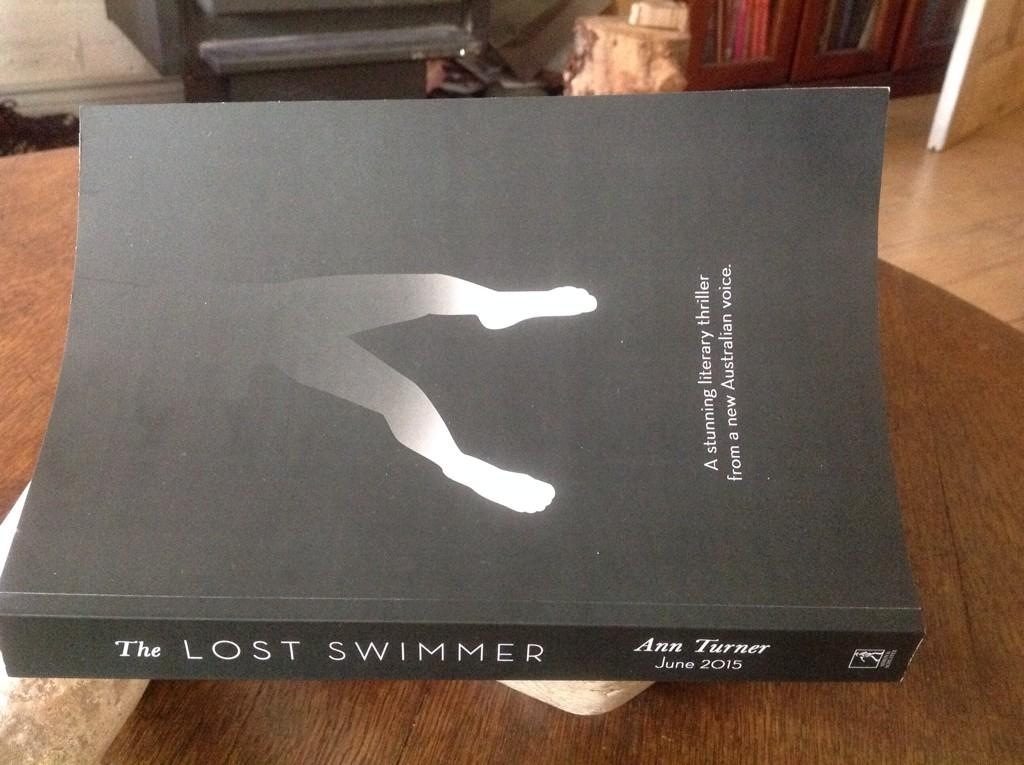
imageAnn Turner’s debut novel, The Lost Swimmer, is prefaced with a quote from Heraclitus:

Everything flows and nothing abides, everything gives way and nothing stays fixed. (Heraclitus c. 535-475 BC)

Both the theme of “time” and the image of water pervade the novel.

The first-person narrator, Rebecca Wilding, is a professor of archaeology at the generically-named Coastal University in regional Victoria. She is passionate about ancient artefacts, and the layers of time that make up history. When Rebecca was little, her father drowned at sea, and she has since been wary of water. Despite this, she and her husband Stephen, another academic, have chosen to live close to an ocean beach. Together they travel to Greece and, from there, to Italy, soaking up the past, travelling by boat and holidaying by the sea.

With a first-person narrative, if you’re a thriller reader, you’re primed to suspect an unreliable narrator. Turner does a good job of laying seeds of doubt as we follow Rebecca’s story as she faces more than one mystery that threatens her happiness. These include financial problems that beset her in her role as a less-than-conscientious Head of her department; as well her suspicions about her one-time friend, Priscilla, the attractive Dean, who may or may not be deliberately undermining Rebecca’s job – or, worse, be after her husband. Then there are a plethora of secondary characters whose allegiance to Rebecca may be self-serving, who help and/or hinder her as she attempts to save her family from calamity and discover the truth. And there’s Stephen, the seemingly ideal husband and loving father, who appears to be keeping secrets.

The Lost Swimmer is billed as a “stunning literary thriller” on the front of my review copy. It made me wonder what the publicists think constitutes “literary”. Certainly there are eloquent descriptions and the story is intelligent in its approach, but there is very little in the way of figurative language; the narrative is straightforward linear realism; and there doesn’t appear to me to be layers of ideological or philosophical complexity.

Maybe I’m missing something?

The Lost Swimmer offers a good, solid story and it’s a fine achievement for a debut author who is also, according to the information from the publisher, “an award-winning screenwriter and director”. I can see it as a film.

~

This review forms part of my contribution to the Australian Women Writers 2015 Challenge and Aussie Author Challenge. A review copy was kindly supplied by the publisher.

The Lost Swimmer
Ann Turner
Simon & Schuster: Cammeray, NSW, 2015
ISBN:9781925030860

Entitlement by Jessica White

Their daughter, when she stepped onto the platform, looked to Leonora as hard and weary as a soldier. There were blue circles beneath her eyes and she was scrawny, her hair dull. Leonora embraced her. The girl’s body was like steel, but her mother didn’t care. It was Cate, and she was home. (p 2)

So Jessica White introduces the main character of Entitlement, Cate McConville, a thirty-year-old doctor who returns from her practice in Sydney to the small Queensland town of Tumbin, to face her ageing parents’ desire to sell the family farm.

It is eight years since Cate’s brother, and Leonora and Blake’s son, Eliot, went missing. As well as burying herself in work to the point of malnutrition, Cate has spent every spare moment searching for her beloved brother. She blames herself for her brother’s disappearance, for the choices she made and the company she kept; and she blames her parents, for encouraging Eliot to stay on and work the farm instead of following his passion for music; but she never gives up hope that one day she will find him: one day, he will come “home”. With this hope still alive, Cate doesn’t want to sell the farm, and, having made her and Eliot partners in the venture, her parents need her signature. Her unwillingness drags up old family tensions that come to a head as secrets about the past are revealed.

Entitlement is a moving story about grief and loss. It deals with these themes on more than one level.

Alongside the story of the McConvilles is that of Mellor and his extended, Aboriginal family who have kept almost continuous ties to their ancestral land, the land now “owned” by the McConvilles and other white families who have bought or inherited it. It’s a complex and challenging endeavour to write from the point of view of an indigenous character when you’re white, and Sue from WhisperingGums discussed this very point in her review of Entitlement published last month. Like Sue, I think White handles this sensitively.

image

~

This review forms part of my contribution to both the Australian Women Writers 2015 Challenge and the Aussie Author Challenge. I own a copy of the book which I won in an AWW competition and received from the author.

Jessica White
Entitlement
Melbourne: Viking, 2012
ISBN: 9780670075935

House Rules by Jodi Picoult

imageWhat happens in a family where one child is diagnosed with a disability like autism?

In primary school, I had a best friend who had two brothers and a sister, except the sister didn’t live with them any more. The term “autistic” was mentioned, but I had very little idea what that meant. All I knew was that there had been something wrong with her. She had never grown out of the “terrible twos”: her screaming and tantrums, her inability to communicate wants and needs, wore her (very kind and loving) parents down. She had been sent away to live in an institution, and my friend rarely spoke of her. I have a vague impression that the family visited her, but I can’t be sure. For the rest of us, she had ceased to exist as a person.

This was a time before the government policy of de-institutionalisation, of supporting children with disabilities to live in the community. In those days, the policy for autistic children was “out of sight, out of mind”.

But what would it have been like for my friend and her brothers if their sister had been kept at home? If the parents, in order to cope, had shaped every routine in the house around not triggering tantrums? If the “neuro-typical” – non-autistic – children had been asked to take second place – or not even asked, just relegated to that position? Would they have fantasised about what it would have been like to have grown up in a “normal” family? Maybe even been tempted to act out those fantasies?

This is the scenario explored in Jodi Picoult’s novel, House Rules. In the story, eighteen-year-old Jacob is the “boy” who has Asperger’s, a high-functioning form of autism which manifests as an inability to recognise and respond to social cues, as well as a lack of empathy and imagination. Jacob’s long-suffering and devoted mother Emma has made every sacrifice for her son, leaving Theo, Jacob’s fifteen-year-old brother, longing for a very different family. The boys’ estranged father, Henry, has long since abandoned them, and, when we finally get to meet him, he too displays some characteristic behaviour of autism.

A common feature of people with Asperger’s is a fixation on a particular area of interest, in Jacob’s case: forensic science. This fixation, in part, is the reason why the two boys find themselves embroiled in a dilemma concerning Jacob’s social skills therapist, Jess, a kind-hearted girl whom Jacob fears is being abused by her boyfriend.

In House Rules, Picoult once again weaves a compelling story, one that had me engaged from the start and wanting to stay up reading long into the night. At the same time, I found the story frustrating. From at least halfway through, I could see that the main conflict could be resolved with one good conversation. Ending the novel, I was wondering whether I’d been cheated as a reader, strung out unnecessarily by an unrealistic narrative; or whether the frustration resulted in part from Picoult’s use of irony. After all, the only reason I knew one good conversation would resolve things was because, as a reader, I was privy to Jacob’s point of view; the other characters – crucially, for the plot – were not. A feature of autism is an inability to communicate simply, just as frustration is one of the dominant emotions felt by those living with autism, as well as the people who interact with them. So maybe leaving the reader frustrated was intended? Or maybe not.

Whatever Picoult’s intention, House Rules is still a very good read.

~

Author: Jodi Picoult
Title: House Rules
Publisher: Allen & Unwin
Date: 2010
ISBN : 978 1 74237 365 2


I borrowed a copy from the library.