The Natural Way of Things by Charlotte Wood

Halfway through reading Charlotte Wood’s new novel, The Natural Way of Things, I felt compelled to post about it on Facebook and Twitter.
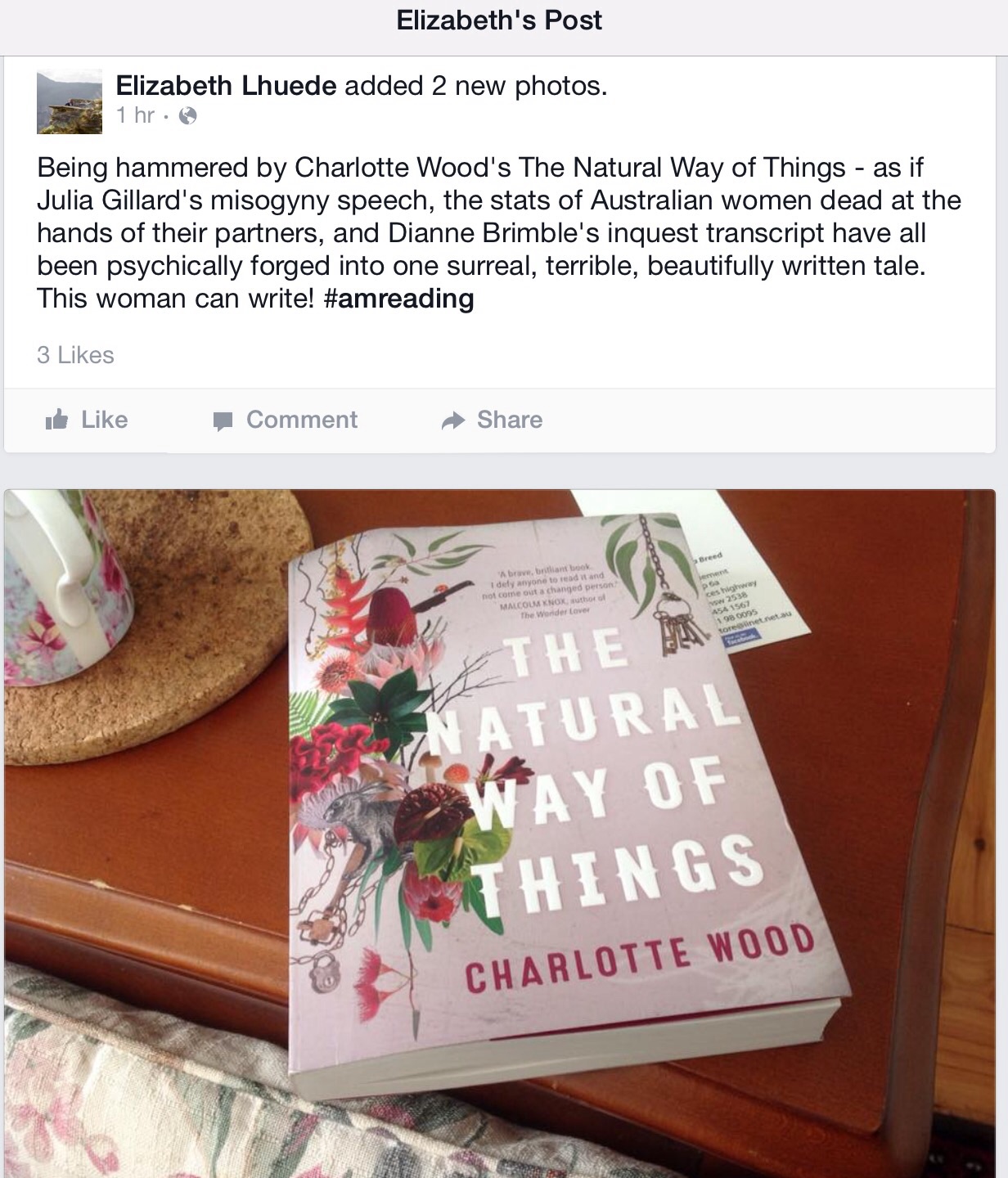
Reading The Natural Way of Things

Such is the power of this book that after I finished it, immediately I searched for someone to discuss it with. I rang a friend who had been to the book launch on Monday night, hoping she might have read it already. She was only a few chapters in, but she told me a friend of hers, after finishing it, had rolled up in a ball on the floor and wept.

I wanted to weep while reading this book. I felt like there was a lifetime of tears – behind my rage – waiting to be shed. But I didn’t cry and I think I know why.

This brilliant, beautifully written, terrible fable of our times was inspired when Wood heard about a group of girls/women who had been rounded up and drugged, and carted off to a decommissioned prison at Hay in Western New South Wales in the 1960s. Instead of setting her story back then, as Wood told Susan Wyndham in a recent interview, she decided to create a near-future dystopia. To populate her story, Wood drew from every possible sex scandal she had come across in the media, stories of women who had been depicted as in some way having “asked for it”. Among the group of ten women Wood depicts, there are figures of diverse class, ethnicities, educational backgrounds and personalities, many of whom bear similarities to actual historical figures. Some of these become fully realised characters in their own right, given life via exquisite prose.

Two such characters, Verla and Yolanda, are given points of view in the narrative. Verla is the educated former mistress of a politician who denied having “relations” with her; Yolanda is a beauty from a working-class background whose boyfriend dumped her after she was gang raped by a group of footballers. Such is Wood’s mastery of narrative that it took me a while to realise Verla’s story is told in the present tense, Yolanda’s in the past – so seamless are the transitions.

Throughout the story, Wood’s descriptive power is stunning. She describes the violence wielded by the girls’ warden, Boncer, in ironic terms as having the ease and fluidity, if not the beauty, of ballet:

[S]he didn’t see the man’s swift, balletic leap – impossibly pretty and light across the gravel – and the leather-covered baton in his hand coming whack over the side of her jaw.

A few paragraphs later, she extends the picture created with a vivid, terrible simile:

Turning his brown leather stick in his hands, its hard, lumpy stitched seams like a botched wound. Like a scar that would make worse ones. (25)

One of Wood’s techniques I particularly noted was her use of adjectives to add sound, texture, movement and atmosphere to her descriptions: “skittering footsteps”, “thickening bush”, “busy fingers” and “noisy silence” are a few examples chosen at random; while many others form powerful triplets, such as “slow, long-bodied wasps” and an ice-chest with a “hoary galvanised-metal face”.

Throughout the story Wood shows her mastery of figurative language, often drawing from domestic situations to create beautiful, fresh and deceptively simple images:

A flock of white cockatoos arrived, landing noisily down on the flat, the white line of them billowing and settling like a thrown bedsheet. (199)

A pleat of blue has opened up in the clouds. (249)

With such language, a terrible tale is wrought. The girls in the story suffer, endure, survive, collapse under pressure and revive – or not, each in their own way.

What the story didn’t do was something which from the outset I had unconsciously expected it would: depict from the inside the ultimate psychic degradation of abused women; that is, the learned helplessness and hopelessness of internalised misogyny, the self-hatred and self-abuse that leads to suicidal ideation and self-harm, that makes women believe they deserve whatever bad things happen to them. While girls with such attitudes are portrayed in the story, they remain somewhat at a distance, seen through the eyes of the point-of-view characters. Both Yolanda and Verla are far more empowered. Even the crisis Verla suffers towards the climax of the book isn’t one of self-worth or self-doubt; she and Yolanda are women whose sense of agency and ability to withstand is not seriously threatened – even as their physical survival isn’t assured. For me, there is a third, silent, untold narrative that haunts the book: the woman whose sense of self-worth doesn’t survive.

It’s that narrative, I think, that would have summoned my tears, but perhaps it’s just as well Wood didn’t write it. I might never have stopped crying.

I’d be stunned and disappointed if The Natural Way if Things isn’t shortlisted for both the Miles Franklin Award and The Stella Prize.

~

Author: Charlotte Wood
Title: The Natural Order of things
Publisher: Allen & Unwin
Date: October 2015
ISBN: 9781760111236

This review forms part of my contribution to the 2015 Australian Women Writers Challenge and the Aussie Author Challenge. A review copy was kindly supplied to me by the publisher.
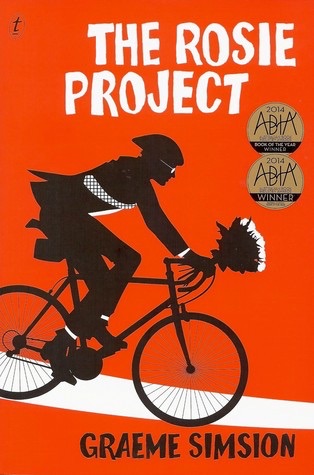
The Rosie Project by Graeme Simsion

Rosie Project SimsionWhat can you say about a book that already has over 8000 reviews on Amazon?

The overview.

Odd-ball genetics professor sets out to find a wife. He has a few stipulations: she must eat meat, must not smoke, must be punctual, and must like more than one flavour of ice cream. Along the way, he finds himself entangled with a late-arriving vegan smoker who is on a quest of her own: to find her genetic father. Much mayhem ensues.

The verdict?

The Rosie Project by Graeme Simsion is fun. It’s quirky. Reading it reminded me of enjoyable hours spent on wet Saturday afternoons as a kid watching Cary Grant in black-and-white re-runs of zany romantic comedies. (I loved Cary Grant.) I smiled, I chuckled, I laughed out loud. My mum loved it, my sister loved it; my partner took the audio book version on long walks and came back with a smile on his face.

And I also felt a little bit uncomfortable.

Simsion has written the character of the narrator, Don Tillman, with compassion, empathy and humour. But for me – and perhaps this is a reflection of the author’s skill – sometimes Tillman’s obsessiveness, gaffes and social ineptitude struck a little too close to home. While his character is never labelled with a clinical diagnosis, there are hints that Tillman’s behaviour would register somewhere along the Autism Spectrum Disorder (Asperger’s having been excluded from the DSM 5, the latest Diagnostic and Statistical Manual of Mental Disorders). On the other hand, there are suggestions, too, that Tillman is simply a flawed human being who has deliberately retreated from the world of social engagement into his “head”, or intellect. Why? It’s a defence mechanism, one which protects him from the tumultuous emotions engendered by such social encounters. In this reading, it’s not a lack of empathy he suffers, but an inability to regulate his emotions: he suffers from emotional overwhelm.

Many introverts, or anyone who has suffered social anxiety, might relate to such uncomfortability. The degree to which we can laugh with such a character, rather than at him, may vary with our ability to laugh at ourselves; this in turn might reflect the degree to which we still suffer the pain of social isolation and exclusion such defence mechanisms can create.

The Rosie Project is a very good book and deserves its many fans. It’ll make a very funny movie. It just may not be for everyone.

~

Author: Graeme Simsion
Title: The Rosie Project
Publisher: Text, Melbourne
Year: 2013
ISBN: 9781922079770

This review forms part of my Aussie Author Challenge 2015.

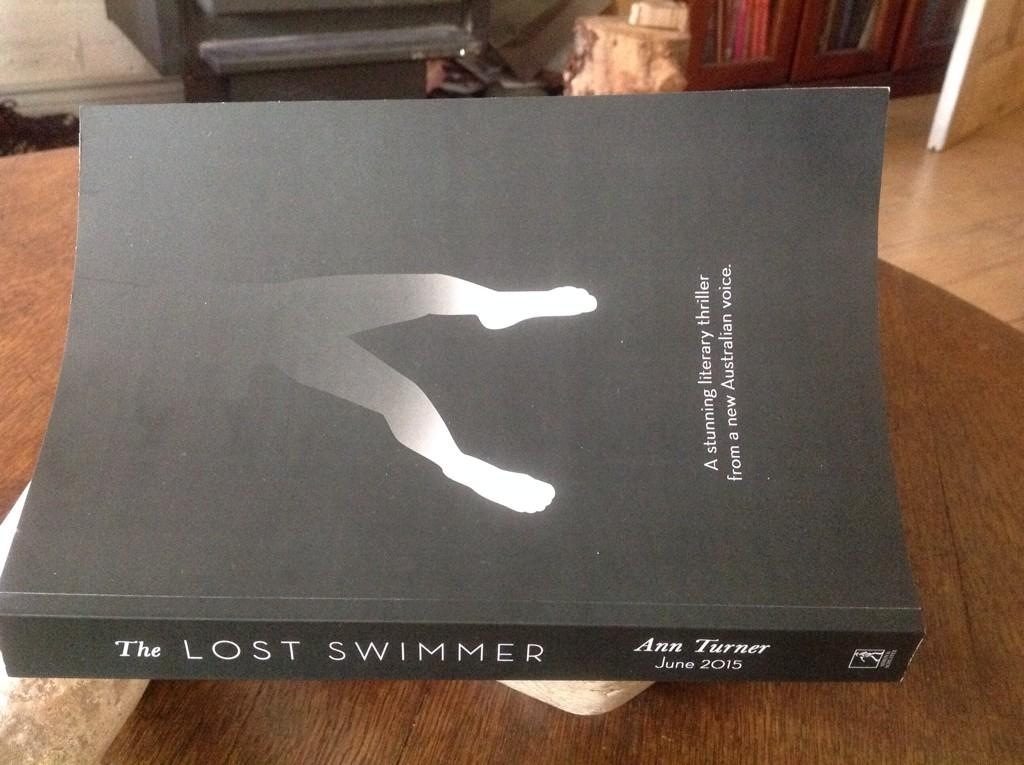
The Lost Swimmer by Ann Turner: a debut psychological thriller

imageAnn Turner’s debut novel, The Lost Swimmer, is prefaced with a quote from Heraclitus:

Everything flows and nothing abides, everything gives way and nothing stays fixed. (Heraclitus c. 535-475 BC)

Both the theme of “time” and the image of water pervade the novel.

The first-person narrator, Rebecca Wilding, is a professor of archaeology at the generically-named Coastal University in regional Victoria. She is passionate about ancient artefacts, and the layers of time that make up history. When Rebecca was little, her father drowned at sea, and she has since been wary of water. Despite this, she and her husband Stephen, another academic, have chosen to live close to an ocean beach. Together they travel to Greece and, from there, to Italy, soaking up the past, travelling by boat and holidaying by the sea.

With a first-person narrative, if you’re a thriller reader, you’re primed to suspect an unreliable narrator. Turner does a good job of laying seeds of doubt as we follow Rebecca’s story as she faces more than one mystery that threatens her happiness. These include financial problems that beset her in her role as a less-than-conscientious Head of her department; as well her suspicions about her one-time friend, Priscilla, the attractive Dean, who may or may not be deliberately undermining Rebecca’s job – or, worse, be after her husband. Then there are a plethora of secondary characters whose allegiance to Rebecca may be self-serving, who help and/or hinder her as she attempts to save her family from calamity and discover the truth. And there’s Stephen, the seemingly ideal husband and loving father, who appears to be keeping secrets.

The Lost Swimmer is billed as a “stunning literary thriller” on the front of my review copy. It made me wonder what the publicists think constitutes “literary”. Certainly there are eloquent descriptions and the story is intelligent in its approach, but there is very little in the way of figurative language; the narrative is straightforward linear realism; and there doesn’t appear to me to be layers of ideological or philosophical complexity.

Maybe I’m missing something?

The Lost Swimmer offers a good, solid story and it’s a fine achievement for a debut author who is also, according to the information from the publisher, “an award-winning screenwriter and director”. I can see it as a film.

~

This review forms part of my contribution to the Australian Women Writers 2015 Challenge and Aussie Author Challenge. A review copy was kindly supplied by the publisher.

The Lost Swimmer
Ann Turner
Simon & Schuster: Cammeray, NSW, 2015
ISBN:9781925030860