The Vanishing Point: Val McDermid

imageThe Wire in the Blood series is one of my all-time favourite TV crime shows. I love forensic psychologist Tony Wood’s tetchy relationship with detective Carol Jordan. I’ve read and enjoyed a few of the books in the series, as well as other novels written by the well-known Scottish crime writer, Val McDermid, so I was expecting a similar thrilling read from her stand-alone novel, The Vanishing Point.

But… The Vanishing Point didn’t quite do it for me.

With the words “It’s every parents worst nightmare…” emblazoned on the cover, there is no surprise that this is an abduction story – though it has a characteristic McDermid twist. The opening is as thrilling as it is horrifying. A woman, Stephanie, used to be the ghost writer for Scarlett, a now-deceased reality TV celebrity, and godmother and newly-appointed guardian of Scarlett’s five-year-old son, Jimmy. Stephanie has just arrived in the US with Jimmy, about to start a vacation, when the boy is taken in broad daylight from the airport while Stephanie is being checked through security.

In her effort to run after Jimmy and his abductor, Stephanie attracts the attention of airport security, thus providing the reason for her to be kept in custody for hours telling her story to Vivian, a helpful FBI agent. Stephanie discloses how she came to be the child’s guardian, what happened to the boy’s celebrity parents, and details of her own terrifying experiences with an abusive and controlling ex-boyfriend. Throughout her tale, the reader is invited first to suspect one character and then another of abducting the boy. The ex-boyfriend, the resentful cousin – even possibly Scarlett’s agent – all fall under suspicion.

As a narrative device for telling the story, the FBI interview technique is okay, though it does stretch credulity and I guessed the “mystery” element pretty early on. Guessing a mystery for me is not uncommon, but normally, when that happens, there’s something else that keeps me drawn into the story, concern for the characters’ fate perhaps, or an interest in the world the characters inhabit. In the case of The Vanishing Point, neither of those things happened.

For me, the celebrity world of reality TV, even set against a backdrop of News of the World-type phone tappings and the UK music scene, just isn’t compelling. More importantly, I never quite believed in the friendship between Scarlett and Stephanie – a crucial element in the story – which I’m tempted to put down to a lack of depth in characterisation. I finished the book, could even admire elements of the ending, but didn’t have that “Aha!” satisfied feeling of a really good thriller.

It wasn’t a bad story; but nor was it one I’ll be racing off to recommend to my Facebook book group. For what it’s worth, I’d say time would be better spent downloading and watching the series Happy Valley, starring Sarah Lancashire, which just finished playing on ABC TV. Now that was compelling and thrilling crime drama. I was sorry to see it end.

~

Author: Val McDermid
Title: The Vanishing Point
Publisher: Little Brown
Year: 2012

I borrowed a copy from the library.

Cop Town by Karin Slaughter

Cop Town Karin SlaughterSince her first novel, Blindsighted, made the CWA’s Dagger Award shortlist for “Best Thriller Debut” of 2001, US author Karin Slaughter has sold more than 30 million copies of her books and been published in 32 languages. Most of her novels are detective thrillers, set in present day Georgia. Her latest release, Cop Town, is a departure, a crossover between detective and general fiction.

Set in Atlanta, Georgia, in 1974, Cop Town portrays a hell-hole of bigotry, racism, misogyny, homophobia, religious sectarianism and class suspicion. The story follows a rookie police officer as she starts her career in a newly gender-conscious department. From a privileged background, newly widowed Kate Murphy is partnered with working class Maggie Lawson, the first female police officer from a cop family. Class isn’t the only barrier which divides these woman as they set about trying to find the culprit of a recent spate of cop killing. Each has to work hard to earn her place in the male-dominated force, and there’s little female solidarity shown – at least, initially.

Throughout the novel, Slaughter challenges stereotypes of women as “naturally” collaborative and supportive, peacemakers and homemakers. Rather, she shows her female characters actively resisting the expectations of such roles, their struggles typical of the era before “women’s lib” took hold.

Australian crime authors P M Newton and Angela Savage have discussed how violence against women is used as entertainment in much recent crime fiction. For this reason, I found Slaughter’s portrayal of women not just as victims of violence, but also as perpetrators, particularly interesting – and problematic. In our current age of the “war against terror” and extraordinary renditions, Slaughter’s seemingly unselfconscious reversal of gender stereotypes runs the risk of reinforcing yet another female stereotype, that of the ball-breaker.

The portrayal of women isn’t the only problematic element of the book. For me, the serial cop killer motif lacks sufficient motivation to be really convincing, although the ending is thrilling and rewards the reader’s persistence.

The strength of the novel lies in its sociological portrayal of a white, male power structure on the wane. As Maggie Lawson says to her abusive cop uncle Terry:

I think the whole world is gonna change. For me. For Kate. For the blacks. For the browns, yellows, greens. For you. Especially for you.

In this light, Cop Town gives an insight into the beginnings of a revolution in cultural values that is still being played out today.

Karin Slaughter will be touring Australia in August (details here).

~

An ebook copy of Cop Town was kindly provided to me by the publishers through Netgalley.

Title: Cop Town
Author: Karin Slaughter
ISBN: 9781473507913
Published: 19 June 2014
Publisher: Random House Australia

ISBN: 978147350791

ISBN: 9781473507913
Published: 19/06/2014
Imprint: Cornerstone Digital

– See more at: http://www.randomhouse.com.au/books/karin-slaughter/cop-town-9781473507913.aspx#sthash.DaYsqYLu.dpuf

ISBN: 9781473507913
Published: 19/06/2014
Imprint: Cornerstone Digital

– See more at: http://www.randomhouse.com.au/books/karin-slaughter/cop-town-9781473507913.aspx#sthash.DaYsqYLu.dpuf

ISBN: 9781473507913
Published: 19/06/2014
Imprint: Cornerstone Digital

– See more at: http://www.randomhouse.com.au/books/karin-slaughter/cop-town-9781473507913.aspx#sthash.DaYsqYLu.dpuf

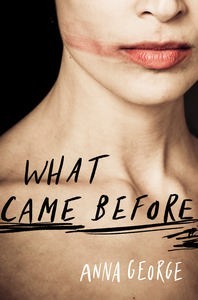
What Came Before by Anna George

‘My name is David James Forrester. I’m a solicitor. Tonight, at 6.10, I killed my wife. This is my statement.’

What Came Before Anna GeorgeThis is the dramatic opening of What Came Before, the brilliant psychological thriller debut by Melbourne writer Anna George. The rest of the novel reveals how the murder came to happen.

We see Forrester’s wife, Elle, before her death. She’s working in the film industry, having left a career in law. With one successful film behind her, she is busy directing another. This latest is about “limerance”, the early stages of romantic love.

Elle encounters Forrester, a high-powered lawyer she remembers from her legal days. She is immediately attracted. By what? His looks, the interest in art they share. Certainly not his sociability, as he proves indifferent to her friends. As they begin their relationship, she experiences an almost delusional infatuation – the “limerance” of her film’s title – which leads her to ignore warning signs that the relationship isn’t healthy.

Unknown to Elle, Forrester’s marriage has disintegrated, leaving him angry at his ex and missing his young step-daughter. He’s also a frustrated artist, a control freak and a very unhappy man.

Throughout the narrative, point of view switches from Forrester, as he dictates his “witness statement” and consults a retired QC for legal counsel, to Elle, as she lies in death – or the imagined transition that follows death. This dual narration, swapping tenses between past and present, makes for compelling reading as we are led inexorably to the inciting incident, Elle’s death.

One question often asked about women in abusive relationships is, “Why did they stay?” What Came Before answers this question. “Limerance” makes us idolise our partners, letting us see only what we want to see; tells us to forgive their failings, to look only at their good qualities; blinds us to the escalating “cycle of violence”. The longer we stay, the more we believe they are essentially “good”, that their character defects are a result of damage done in childhood, that we are connected to them in some essential way, the more dangerous the relationship becomes.

Anna George has drawn on her own experience* of “emotional abuse” to create the relationship between Forrester and Elle, and her experience shows. For me, though not for all reviewers, she manages to make Elle sympathetic, despite her irrational choices. George also conveys what it’s like to be the man who resorts to violence, his self-justifications, his belief that he was provoked. If I had one criticism of the characterisation of What Came Before, it’s of the moment when Forrester makes a transition from “emotional abuser” to “physical abuser”. For me, the transition appeared too abrupt. Thinking about his behaviour in terms of “narcissistic rage”, however, I can make more sense of it. Far from being egoistic, Narcissists lack the internal resilience that would allow a healthier psyche to take criticism, perceived rejection or opposition. In this light, George gets the psychology for Forrester right; the result is believable and frightening.

The publishers have described this novel as “literary”, and in the vein of Gillian Flynn’s Gone Girl. What Came Before is clever, like Flynn’s novel, but the cleverness isn’t at the expense of its emotional truth. The characters come across as real, their motivations consistent, their delusions understandable. Does this make it “literary”? It’s a well-written psychological thriller which deserves to become a best-seller.

Anna George has been added to my already impressive list of “must read” Australian female crime and suspense authors. I can’t wait for her next book.

* Anna George mentioned this in an interview with Carol at Reading, Writing and Riesling blog, here.

~

This review forms part of my contribution to the Australian Women Writers Challenge and Aussie Author Challenge. A review copy was kindly supplied to me by the publishers via Netgalley. What Came Before has already been reviewed for the AWW challenge by:

Author: Anna George
Title: What Came Before
Published:25/06/2014
ISBN-13:9780670077731
ISBN-10:0670077739
Publisher:Penguin Aus
Imprint:Viking