
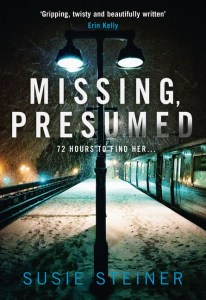
Missing, Presumed by Susie Steiner

imageWhen a review copy of Missing, Presumed by Susie Steiner landed in my post office box, I thought, “Great, some new Aussie crime fiction!” Publishers know that I’m dedicated to reviewing works by Australian women and it’s rare they send me anything else.

So when I discovered the book was set in the UK and the author is a former journalist of The Guardian, I was a little taken aback; but the publicist who sent the book had done her homework. Those of you who know I set up a “We Love Books by Nicci French” group on Facebook will know I’m a sucker for dark and moody books that centre around a flawed female protagonist. Missing, Presumed is one of these and it doesn’t disappoint.

The main point of view character in Missing, Presumed is DS Manon Bradshaw, a cop in her late thirties whose biological clock is making ticking noises, sometimes loud, sometimes buried beneath a mountain of work or drowned out by disastrous encounters while internet dating. She drinks too much, doesn’t take care of herself, is scared off by polite, kind, gentlemanly types. She has a good best friend, a seemingly ever-optimistic partner on the job, and a fraught history with her sister.

When she is called on to investigate the disappearance of a young Cambridge grad student, Edith Hind, the daughter of a GP and surgeon to the royal family, she senses the case will be big. For a small regional police force with a chequered history where it comes to missing persons cases, it’s a high risk, high opportunity endeavour: bungling it could mean career death; solving it could establish her career and guarantee promotion.

Manon proves herself up to the task, but only barely. Throughout an extended investigation that sometimes looks and feels like it’s going nowhere, she suffers the ups and downs of affairs of the heart, strained office politics and family estrangement, all the while growing fond of a neglected ten-year-old boy whose elder brother is killed in suspicious circumstances.

While Steiner’s characterisation of Manon is deft, Manon is only one of several point-of-view characters, all of whom are equally well rounded. There’s Miriam, the missing girl’s mother; and there’s Davy, the Detective Constable, who works with Manon. Each has a story to tell and a journey navigating through fraught human relations.

The novel is carefully crafted and beautifully written. I kept wanted to stop and savour some of Steiner’s images – not always what a reader wants from a crime novel; but even if, at times, the language drew attention to itself a little too much, I didn’t mind. As well as the finally honed language, there’s a sensibility in the book that attracts me. This is a book you read not just out of curiosity for “whodunnit?” of “what happens next?”. It’s also a book which portrays both the best and worst of what it means to be human.

When I finished it, I immediately looked up the local library catalogue to see whether it has Steiner’s first novel, Homecoming (it doesn’t). Given that I’ve dozens of books on my To Be Read pile, I’d say this means Steiner is an author to watch.

~

Author: Susie Steiner
Title: Missing, Presumed
Publisher and date: HarperCollins, February 2016
ISBN: 978-0-00-812328-4
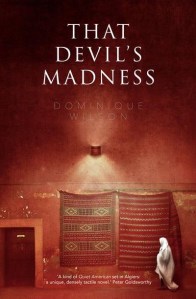
 

That Devil’s Madness by Dominique Wilson – a timely read

Devil's Madness WilsonWow! What a timely read.

The structure of That Devil’s Madness by Dominique Wilson is almost a double helix, seeming parallel narratives of France and Algeria from the late 19th century onwards, and Australia and Algeria in the 1960s. It follows the fates of four generations of French-Algerian-Australian immigrants and Algerian Berbers, narratives which come together in a thriller-like denouement.

The main point of view character is a novice photo-journalist, Nicolette de Dercou, who as a child immigrated to Australia from Algeria with her mother and grandfather, and who returns there to re-connect with childhood friends and cover the news of the president’s imminent death. Nicolette gets caught up in turbulent events as Berbers fight for liberation from the oppression they have suffered since Algeria’s independence from France after World War Two, a historical struggle illuminated by the other narrative which follows Nicolette’s great-grandfather from France to Algeria and her grandfather from Algeria to Australia.

This story interests me on numerous levels. It illuminates the complexity of post-colonialism and Christian-Muslim relations in North Africa; it gives a historical context for present-day political unrest, dissatisfaction with injustice and the root causes of terrorism; and it acts as a reminder for Australian readers of the tentativeness of our claims to sovereignty over Indigenous lands, and the historical and cultural blindness that attends our attitudes to “boat people”.

The novel also highlights the technical difficulty of wielding two disparate narratives. The risk is that the reader might temporarily lose interest at the point of changeover – not for lack of engagement, but because of their investment with the narrative thread already underway. Wilson manages to hold the reader’s attention in both stories until they come together in a powerful ending: no mean feat!

~

This is my first review for the 2016 Australian Women Writers and Aussie Author Challenge. A review copy was kindly supplied to me by the publisher.

Author: Dominique Wilson
Title: That Devil’s Madness
Publisher: Transit Lounge
Date: February 2016
ISBN: 978-1-921924-98-9

The Anchoress by Robyn Cadwallader

Anchoress CadwalladerIf The Anchoress by Robyn Cadwallader isn’t already on your radar, it should be.

Told in exquisite prose, it’s ostensibly the story of Sarah, a medieval nun who, at the age of 17, locks herself away from the world in a tomb-like room to pray; but it’s much more than that.

It’s a tale of grief as Sarah comes to terms with the loss of both her mother and sister in childbirth. It’s a narrative of gender politics, as she negotiates her weekly interaction with her father confessor, Ranaulf; fends off the unwanted advances of the local feudal lord, Sir Thomas; and bears witness to the scars inflicted on village women who have little power in a patriarchal, church-dominated world. It’s also a story about art and its possibility of liberation and redemption, whether it’s the art of the illuminated manuscripts that Ranaulf works on, or the art of living, of attuning to the least sensory inputs, the sounds, smells and glimpses of Sarah’s rural medieval world.

This is the standout achievement of this book, for me: the novel, while beginning as a tale of deprivation and renunciation, ends up celebrating the very embodied world Sarah was determined to reject.

…I could no longer resist the demands made by my senses. I’d had no idea that sounds and smells could separate themselves; as if unravelling a piece of cloth, day by day, thread by thread, I began to recognise them. This is mill wheel, this is cartwheels, this is dragging a sack, this is throwing a bucket of water, this is digging, scything, ploughing, and even, sometimes, whispered seed scatter. (120-21)

The Anchoress has already been extensively reviewed for the Australian Women Writers challenge, making it, I’d hazard, one of the challenge’s most popular books so far for 2015. I wouldn’t be surprised if it’s a front-runner for this year’s Stella Prize.

~

This review forms part of my contribution to the Australian Women Writers Challenge and the Aussie Author Challenge 2015. You can find other participants’ reviews via these links:

Author: Robyn Cadwallader
Title: The Anchoress
Publisher: Fourth Estate (an imprint of HarperCollins)
Year: 2015
ISBN: 978 0 7322 9921 7