
The Watcher by Charlotte Link

imageSince I finished my latest novel and sent it in to the publisher, I’ve been on a thriller-suspense reading binge. Most of the authors have been recommended to me by my “fans of Nicci French” Facebook group, but I can’t always find their novels at the library, so I’ve taken a few chances, too. Some have paid off; others, not.

A book cover that shows a solitary figure walking through a wintry forest has some appeal when you’re sweltering through the hot, humid days of early summer in Sydney. So does “16 million books sold”. Charlotte Link’s The Watcher must have something going for it, right?

Maybe it’s the translation from the German; maybe it’s the time-lag between when it was written and when it became available in English; maybe it’s the fact that a German writer has chosen an English setting for her story; whatever it is, Link’s book struck me as a little old-fashioned. And it never really grabbed me. There are dead women. There are women in danger. There are strangely fixated men and men with shady pasts. There are issues: domestic violence, marital discord, loneliness, isolation, paedophilia. The novel examines the question of envy in a way that I should have found more interesting.

Maybe I’ve just been spoilt by having read a few really engaging and structurally more challenging books lately.

The Watcher is absorbing enough for me to have read over a couple of days, but I have a sense it won’t stay in my imagination for long.

~

Author: Charlotte Link
Title: The Watcher
Publisher: Orion/Hachette
Date: 2013

I borrowed a copy from the library.
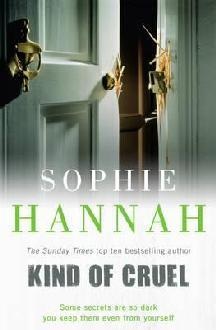
Kind of Cruel by Sophie Hannah

Some secrets are so dark you keep them even from yourself.

imageOn the surface, Kind of Cruel by Sophie Hannah is a book I should have loved right from the start. I’ll admit, though, it took me a while to get into. First I had to orient myself to the different first-person narratives, and the time shifts in point of view. The change of fonts should have given me a clue that I was dealing with more than one person, but initially I couldn’t “hear” the difference in voice. Looking back, it should have been obvious.

In retrospect, too, I can admire the structure that had me wondering, right from the start, what “mystery” I was being presented with. This isn’t your usual crime/detective story; nor is it straight psychological suspense/thriller. Rather, it blends the two genres while interrogating the nature of memory, what constitutes subjectivity and mental illness, as well as the intricacies of troubled human relationships and what keeps us from being entirely honest with ourselves and others.

The main character is Amber Hewerdine, a woman whose best friend was killed in an arson attack and who became the guardian of the friend’s two young daughters. She goes to see a hypnotist to help overcome her insomnia, a visit which leads her to become embroiled in a police investigation of another, unrelated woman. This forms the “murder mystery” aspect of the story.

The best thing about Amber is she’s cranky and her sleeplessness enables the reader to forgive her for it. She doesn’t suffer fools, behaves badly and speaks her mind; her one redeeming quality is her fierce love of her friend’s daughters. There’s an energy about this character that I found endearing and strangely liberating; it made me think of Sue Austin’s argument in her book, Women’s Aggressive Fantasies: A Post-Jungian Exploration of Self-Hatred, Love and Agency, that a woman’s acknowledgement of her aggressive thoughts can be healing (and a disavowal of them can be psychologically harmful).

Kind of Cruel is a clever novel, conceptually, structurally and plot-wise. There’s also something psychologically and emotionally satisfying about it, even though the story it generates is bleak. I’m grateful to members of my Facebook group for psychological suspense fans for recommending it to me.

~

Author: Sophie Hanna
Title: Kind of Cruel
Publisher: Hodder & Stoughton
Date: 2012

I borrowed a copy from the library.

A Thousand Lies by Laura Wilson

The judge said (I will never forget this), ‘In many ways your life has been a form of punishment.’ Sometimes I wonder what he would have said if I had told the truth.

imageSo Sheila Shand, a woman convicted of the manslaughter of her father, wrote in her journal in 1988, hinting at one of the many lies which Laura Wilson’s crime novel, A Thousand Lies, goes on to uncover and explain.

Sheila’s journals, and the sections from her point of view, are an important element of the novel, but the main story centres around her great-niece, Amy Vaughan. Amy is a journalist whose estranged mother has just died and left her another journal, one belonging to Sheila’s sister Mo, revealing a branch of the family she’d not known existed.

Throughout the novel, Amy struggles to deal with the complicated grief of losing a mother who blamed her for her father’s desertion, a ne’er-do-well father who returns in time to take advantage of her meagre inheritance and possibly endanger her life, and a neighbour who has the potential to become a future lover. At the same time she becomes increasingly caught up in the mystery surrounding the whereabouts of her great-aunt Mo, and the trauma that has kept Sheila and her ailing mother Iris silent for many years.

A Thousand Lies was first published in 2006 and was shortlisted for the inaugural Duncan Lawrie Dagger award. I discovered the author, Laura Wilson, via a Twitter suggestion after I’d followed Julia Crouch whose book Tarnished I reviewed last week.

I can’t say I was as riveted by A Thousand Lies as I was by Tarnished, but I am fascinated with its subject matter – domestic violence and its long-term psychological effects on women, particularly the ‘learned helplessness’ that keeps women trapped in a vicious cycle. Wilson deals with the subject with sympathy, subtlety and insight, and the plot intrigues the reader enough to keep the pages turning.

One shortcoming, for me, was to do with the novel’s structure: the most dramatic events occurred in the distant past, which the journal device and flashbacks bring to life. The effect of this ‘once-remove’ is an emotional distancing. For many crime readers, this distancing might be a good thing, as the events described are horrific. Readers of psychological suspense, however, might find the storyline lacks a desired sense of immediacy and engagement.

As events of the past begin to bleed into the present, however, the novel heads for a thrilling climax. A Thousand Lies is the first I’ve read by this novelist, but it won’t be the last. It is an engaging read.

~

Author: Laura Wilson
Title: A Thousand Lies
Publisher: Orion
Date: 2006

I borrowed a copy from the library.