Honey Brown’s Dark Horse

honey-brown-dark-horseYesterday Sydney was hit by a storm from the south east. Rain pounded on the tin roof, gutters overflowed, the temperature plummeted. In my inbox came an email from NetGalley stating that Penguin Australia had approved my request to review Honey Brown’s latest novel, Dark Horse, out this week. I’d read Brown’s Red Queen last year and have heard lots of good things about The Good Daughter, so I couldn’t resist downloading the ebook and peeking at the first page.

That was it for the rest of the day. I was hooked.

If you’re a fan of Jaye Ford’s Beyond Fear, Dawn Barker’s Fractured and Gillian Flynn’s Gone Girl, you’re going to love Dark Horse. It’s quite a ride. I would have read it in one sitting, if I hadn’t had to sleep. I curled up in front of a glowing slow combustion stove and, while the weather went crazy outside, was swept into the drama. Brown has a style that I love: it’s immediate, the descriptions are fresh, the action is urgent. I could almost feel the Victorian alpine hills crowding in, felt every bump and jerk of the heroine’s ride up the mountain on her endurance-trained horse, held my breath at the enormity of what she faced going up, when she reached the summit and going down again. It’s that kind of book: suspenseful, urgent, adrenaline-pumping.

And it’s clever. I’m used to twists in suspense fiction and I can usually read the signs. This book proved no exception, except I realised I was being played. Every time I anticipated the narrative, there was an unexpected payoff; each time I thought something was unlikely or stretched credulity, it proved well motivated or explained.

It was the perfect read for a rainy day, better than a movie. (Far better than its trailer.)

Do I go away with things to think about? I’m not sure. It ranges over what, to me, is very interesting territory: the extremes of human emotions and behaviour; infidelity; depression/mental illness; the breakdown of relationships; childhood trauma and its effects on the family. It belongs to the “family drama with crime” genre that writers like Wendy James and Caroline Overington are so successfully carving a niche in. It’s edgy. It’s sexy, too. But I’m not sure the degree to which it touched me emotionally and intellectually, or simply thrilled me. (To explore this further would necessitate spoilers.)

What it did do is confirm for me that Australian women psychological suspense writers are right up there among the best in the genre. I’m also glad I have two more Honey Brown books, The Good Daughter and After the Darkness, tucked away for another rainy day.

~

This review counts towards the Australian Women Writers Challenge. It has been reviewed elsewhere for the challenge by Simone at Great Aussie Reads and by Brenda in Goodreads.

On Art and Motherhood: or, this is not a romance – The Steele Diaries by Wendy James

wendy-james-steele-diariesThe Steele Diaries, Wendy James’ second novel, originally published in 2008, has recently been re-released as an ebook by Momentum. It’s a novel I’ve looked forward to reading since I discovered a paperback copy on my local library’s discard table. I’d enjoyed James’ The Mistake when I read it as part of the AWW challenge last year and I was hoping for another compulsive read.

This novel didn’t disappoint, but it was different from what I’d anticipated. The Steele Diaries takes a more considered approach than The Mistake, and it wasn’t till halfway through that I felt compelled to keep on turning pages. Loosely, it covers the same territory: family drama – or “Suburban Noir” – with the possibility of crime. In The Steele Diaries, the story unfolds at a gentler pace and has a more literary feel than The Mistake. In the end, however, it packs a similar punch and is arguably even more thought-provoking.

According to James, who was interviewed by Kirsten Krauth last year, the novel was inspired by “stories of various artists’ and writers’ lives — in particular Joy Hester, Sunday Reed, Sylvia Plath, Vanessa Bell, [and] Angelica Garnett — and their differing experiences of motherhood and childhood”. There’s no glossy, sentimentalising of motherhood here; rather, the depiction of the fraught nature of disappointed dreams and imperfect relationships makes for, at times, uncomfortable and confronting reading.

The drama revolves around three women: Ruth, a middle-aged doctor who has recently lost her father; Zelda, Ruth’s mother, an illustrator of children’s books; and Annie, acclaimed artist, Zelda’s mother. It weaves first person narratives from Ruth and Zelda – Zelda’s section being quite literally a “diary” – with a brief account of a time in Annie’s life, as imagined by Zelda.

While depicting the complex and painful relationships between these mothers and daughters, the story dramatises the pressures which childbearing places on a woman’s creativity, sense of autonomy and mental health. It draws on themes familiar to folk and “fairy” tales, the terror of abandonment and the hinted possibility of a mother’s indifference to her child, an indifference which borders on brutality. Such unsafe – even grotesque – preoccupations are reflected in the Art described in the novel, both in Annie’s paintings and Zelda’s wood-block illustrations, as well as in the narrative. Readers are positioned as eavesdroppers or voyeurs on these women’s private lives, a narrative strategy which creates a self-reflexive meditation on Art as a vehicle for telling unpalatable truths, particularly about women’s “failures” to live up to their own and others’ expectations. In portraying these failures, the story both stretches and tests our capacity to respond with sympathy.

Steele-Diaries_ebookGiven the weight of the book’s themes, you’d have to wonder about the covers, both the original – with its face of a beautiful, carefully coiffed woman floating over an Outback scene – and the more recent offering from Momentum, with coy lovers kissing under an umbrella. Both are seriously misleading.

James had something interesting to say to Krauth about book covers and marketing mistakes:

So many novels by women — especially those writing about domestic life — are given covers that don’t quite match the content. My first two novels — one about an infanticide, the other about art and motherhood — were marketed as romances. This misrepresentation certainly doesn’t help establish a readership.

Whatever genre you might call The Steele Diaries, it’s not a romance. Momentum book designers, what were you thinking?

~

This review counts towards Australian Literature Month hosted Kim at Reading Matters (who will donate 50p to the Australian Literacy Foundation for every review of an Australian book during April) as well as Australian Women Writers Challenge 2013.

ozmonth3

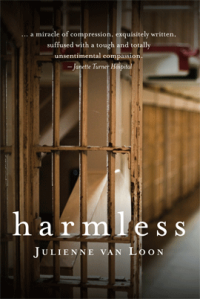
Harmless by Julienne van Loon

With the right kind of mindfulness, William Blake tells us, one can behold infinity in a grain of sand. – Janette Turner Hospital on Harmless

When a writer like Janette Turner Hospital pens a back-cover blurb for another Australian author, I pay attention. What is it about Julienne van Loon’s novella, Harmless, soon to be released by Fremantle Press, which has attracted such a gifted admirer? The snippet from Hospital quoted on the front of the book states: Harmless is “suffused with a tough and totally unsentimental compassion”.

harmless-van-loonI notice, too, review words like “unsentimental”; it seems to be used often when female literary authors are praised. Sentimentality implies emotional manipulation, and a lack of subtlety and nuance. The term has been used to dismiss the work of a plethora of “female authors”, especially those writing in genres such as romance. But what does “unsentimental” mean? I’m tempted to think it’s code for “writes like a man”, or “give this book a girlie-looking cover at your peril”. It’s praise, but is it gendered praise?

In van Loon’s case, unsentimental certainly doesn’t mean unemotional. Far from it. Nor does it mean she avoids topics commonly associated with so-called “women’s writing”, such as relationships, children and family; it even has a female protagonist. What it might mean is a kind of unflinching courage to face the darkest aspects of human frailty and vulnerability while avoiding pathos or despair.

Harmless is another one of those “devastating” books that has been my privilege to discover through the Australian Women Writers challenge. It tells the story of an eight-year-old girl whose Thai step-mother has just died, and who is on the way to visit her feckless father in prison, accompanied by the dead stepmother’s frail elderly father. This father, who speaks little English and who is fresh off the plane from Bangkok, has no idea where he is or what to do with this child who has unexpectedly been placed in his care; he believed his daughter to be happily married to a good man, and with children of her own.

The two get lost on the way to the prison; they abandon their car on the edge of scrubland and are separated as they wander off to find help. The landscape is desolate, like the lives van Loon portrays; their survival uncertain.

This novel is about people on the fringes of society, “losers” one might say. Issues of race and class are central, but understated. There’s no obvious moral compass given, no superior perspective the reader is invited to occupy from which to judge these people. Rather, the focus is on love, and lack of love, and what might constitute a family.

By the end, I felt wrung out, hurt by the author’s bleak picture of humanity and yet consoled, too.

Who will enjoy this novella? Anyone who relishes subtle and emotionally powerful prose; who is interested in a portrait of contemporary Australian life that doesn’t shy away from issues of social disadvantage; and who can bear the heartbreak.

~

This review counts towards my Australian Women Writers 2013 challenge. My thanks to the publishers for supplying a review copy.

Title: Harmless by Julienne van Loon
Publisher: Fremantle Press, 2013
ISBN: 9781922089045