Finding Jasper by Lynne Leonhardt

A couple of weeks ago, small Western Australia publisher Margaret River Press sent me a review copy of their first fiction offering, Finding Jasper. It’s by debut novelist Lynne Leonhardt, was successfully submitted for a doctorate in creative writing, and earned Leonhardt the Dean’s Prize.

According to the cover blurb:

It is 1956, and twelve-year old Ginny has arrived at the family farm, ‘Grasswood’, in the southwest Western Australia.  She has been left in the care of her lively, idiosyncratic aunt, Attie, while her mother, an English war bride, returns home for a holiday.  Ginny is the youngest of three generations of very different women, whose lives are profoundly affected by the absence of Jasper: son, brother, husband, father.  A fixed point in all their lives is the landscape, layered with beauty and fear, challenge and consolation, isolation and freedom.

The novel is beautifully written.

I read it almost in one sitting and promptly rang up my mum to see if she wanted to borrow it. Then I emailed an elderly poet and memoirist in WA to ask her if she would like to review it for the Australian Women Writers Challenge. As I hit “send”, I thought of another friend I think would enjoy it, a writer of historical fiction. It’s that kind of book: it deserves to find readers and I’m happy to recommend it and pass it around.

Yet, as I was reading Finding Jasper, several other texts kept clamouring for attention at the back of my mind. Sometimes these texts echoed the content, sometimes they were in counterpoint, until it seemed I wasn’t just reading one book, but several. Each sang together in a rich, complex, intricate piece – a fugue, if you will.

The musical metaphor is apt, as music is central to Finding Jasper.

The main character, Virginia – or “Gin”, plays the piano initially and wants to be a professional musician. During the Second World War, Virginia’s mother worked in the British army as a Morse Code specialist; Leonhardt makes the point of telling the reader that the opening bars for Beethoven’s 5th – the famous, “da-da-da-daah” – is the Morse signal for “V”, and came to stand for “Victory”. In the lead up to the novel’s most emotionally charged moments, Virginia plays a sombre Bach prelude as an act of defiance toward her neglectful, card-playing mother. The aftermath is devastating.

Music haunts Finding Jasper, by turns sad, angry, evocative, challenging and hip.

Of the various texts that echoed as I read Finding Jasper, three are recent releases by Australian women. The first is Emily Maguire’s Fishing For Tigers: it, too, more tangentially, deals with the impact of war on the lives of Australians (reviewed here). The second is Liz Byrski’s novel, In the Company of Strangers – another book I was happy to pass on to my mum. Like Finding Jasper, it’s set in WA’s south-west, and touches on the lives of English immigrants after the Second World War. The third is Kate Forsyth’s Bitter Greens (review forthcoming). All four novels depict women who don’t conform to gender-typical roles, some of whom behave “badly”.

I want to see more women like this, I’ve decided. Flawed women. Women whose poor choices and less-than-desirable mothering is explained by their personalities and their histories, histories of trauma, abuse and dislocation. These kind of women feel real to me.

Already the characters of Finding Jasper are haunting my memory.

~

Thanks to Margaret River Press for the review copy. It counts as book 9/12 for the Aussie Authors Challenge and is part of my ongoing contribution to the Australian Women Writers challenge.

Finding Jasper
ISBN-13: 978-0-9872180-5-6
Published: 2012

Leah Giarratano, Black Ice

Black Ice (A Detective Jill Jackson Mystery #3)Black Ice by Leah Giarratano

My rating: 3 of 5 stars

Leah Giarratano’s Black Ice is a crime novel that portrays a clash between the glitz-and-glamour of the Eastern suburbs and the underworld of Sydney’s west. It follows the exploits of undercover detective Jill Jackson (“Krystal”), her super-model-good-looking party-girl sister Cassie and single mother Seren, a woman with a heart of gold who got mixed up with the wrong people and ended up doing a jail sentence while her ten-year-old son Marco was farmed out to DoCs. Together and apart these women face the threats posed by hot-shot lawyer Christian, thug drug-dealer Nader and their hangers-on.

Sounds unlikely? It is. But Giarratano is an experienced forensic psychologist whose work has given her an entree into the seedy side of Sydney’s life, so at one level we have to trust that her characters and plot scenario are authentically portrayed. Yet there was little here I recognised here about the city I grew up in. Much of the language, characterisation, plot and setting came across to me as if they could easily translate into a Hollywood movie.

Maybe to critique Giarratano’s book for its lack of distinctive “Australianness” is unfair. Yet I couldn’t help thinking that when the author did go for local colour – like her description of the underground food court off Dixon Street – it brought the narrative to life.

There were flashes, too, of edgy, lyrical writing: “Right now, just eleven o’clock in the morning, thrumming beneath the city was Saturday night, waiting to be released. It pulsed and throbbed, biding time, emitting sub-threshold vibrations that caused apprentices to focus for once, to hurry to finish their morning shifts. Fifteen-year-old schoolgirls drilled each other on the elaborate fairytales they’d created for their parents, about who was sleeping at whose house, and what to do if the oldies actually checked. The beautiful people sipped coffees in cafes, waking slowly, apparently languidly, but Saturday night waited beneath them and the beat started an itch they knew would not be scratched until the dark came…” (p207)

While not exactly a page-turner, the novel didn’t drag. Part of my problem with it might be because Giarratano’s main character, the detective Jill Jackson, is a character regular readers will have met before. That crucial set-up, where a reader is introduced to a character and a bond of empathy is formed, was missing for me. I didn’t know enough about Jill and her background to really care what happened to her – until some of her backstory was revealed halfway through. Even then, though, her conflict with her sister and its denouement which could have been – should have bee, an emotionally moving scene – coincided with the plot climax in a way that both seemed unlikely and an odd choice by the writer. (Who has an epiphany – and *talks* about it! – at a crime scene?)

The one character I did feel empathy for from the start was single-mum Seren. But I found myself resisting this empathy because I felt the author’s manipulation: Seren’s character, the naive ex-con, didn’t ring true to me. The scenes of her pre-release from prison, however, were among the books most vivid, frightening and memorable. Here Giarratano’s background really gives us an insight into a world most of us – thankfully – will never have to know firsthand.

Giarratano chose to distance her main character from the thick of the fray before the climax, a choice which surprised and disappointed me. But maybe that was because, by then, I was expecting her story to adhere to the narrative conventions of Hollywood: I wanted the main character to have something more at stake, something I could get worried about. The ending, while satisfying, didn’t deliver that extra bang that such stories usually contrive to create, either. But why should it? There were some neat twists.

Despite the shortcomings and reservations expressed here, I enjoyed this book. Maybe it was always going to be a tough call, reading and reviewing a simple crime novel after having just finished Charlotte Wood’s brilliant – though flawed in its own way, too – novel of small-town Australian life and family, The Children.

Read as part of the Aussie Author 2011 challenge, this review first appeared in GoodReads.

View all my reviews

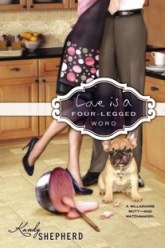
Love is a Four-Legged Word – A charming, mad cap read

Love is a Four-Legged Word, by Australian author, Kandy Shepherd, is a light, fun-filled read. Its quirky characters, an aspiring celebrity chef and an uptight lawyer, are brought together when the chef’s elderly neighbour dies, leaving her the guardian of an ugly pug who inherits a fortune.

Set on the west coast of the USA, this zany romance reminds me of an old Cary Grant movie – it has the same, light-hearted, feel-good factor. In this story’s world, nothing is too serious, despite seeming life-and-death stakes for the “millionaire mutt”. It’s impossible not to be charmed by the heroine, Maddy, with her bubbly personality and whacky way of seeing the world. Even uptight Tom, the lawyer hero, proves to be just as lovable by the end.

Some readers think the ugly mutt Brutus steals the show, but I disagree. It’s Kandy Shepherd’s delightful comic voice that makes this story. Editors often say that want a new “voice” and some aspiring writers think they have to manufacture that. It’s not true. Writers need to bring out those aspects of themselves that will appeal to the reader.  Kandy’s writing persona very much reflects her warmth and humour in real life – it shines through her stories.

I recently reread the novel after the sequel Home is Where the Bark Is, which tells the story of Maddy’s model friend Serena. The sequence doesn’t matter: each novel stands well on its own. I’m looking forward to the next Shepherd romantic comedy. Kandy’s Castaway Bride came out on ebook recently – and I’m not surprised to see it is topping the best-seller lists.

I’m looking forward to more. How about it, Kandy?

(This review first appeared on Amazon in July 2011 and has been slightly revised)

Creative Commons Licence
Review of Love is a Four-Legged Word by Kandy Shepherd by Elizabeth Lhuede is licensed under a Creative Commons Attribution-NoDerivs 3.0 Unported License.
Based on a work at elizabethlhuede.wordpress.com.
Permissions beyond the scope of this license may be available at http://www.elizabethlhuede.com.