Warning: this is going to be another of those part-review, part ramble posts, but for some books – some powerful books, especially – that’s the only kind I can manage.
 One of my earliest memories is of a dream I had when I was four or five. My brothers and sisters and I – the youngest of the group – were huddled in our lounge room, listening to a story told by a man who read from a giant nursery tale book. He was dressed like a pilgrim with a tall black hat, and he sat beside a magnificent white goose.
In the dream, instead of listening to the story, I was distracted by a flake of paint that fell from the wall behind the storyteller. Before long a crack appeared in the plaster and grew steadily wider, until I could see through the wall to the other side. Beyond was a man wearing jungle fatigues and a helmet; he was jabbing at the barrier with a bayonet attached to a rifle, widening the crack with each thrust. Behind him other men stole through trees to the muffled rat-a-tat of gunfire.
When the hole was finally big enough to draw the others’ attention and it became clear the soldier intended to break through the wall, panic set in. The storyteller grabbed my older sister, climbed onto the goose and flew off into a golden sunset, while the rest of us ran into the bedroom and hid under a bed. Lying there, next to my brother, my pulse booming in my ears, I tried not to breathe. A steady thump, thump, thump brought the soldier closer until his boots came into view, arm’s reach away.
This dream – nightmare – came to me in the mid-sixties, when my eldest brother was a few short years away from the ballot that might have sent him to Vietnam. Our family was no stranger to war; my father had been on a ship headed for New Guinea in 1945 when that war ended; his father had been in France during the First World War; but it hadn’t touched me personally, or not in a way I could understand then. We had no television, just an old “radiogram” which we kids would gather round to listen to Kindergarten On the Air. Nevertheless, war – the Vietnam war, in particular – entered via some crack into my world, creating an impression of horror that still remains vivid. Yet until reading Emily Maguire’s Fishing For Tigers, I hadn’t ever really considered how that war had helped to shape my hopes and fears, let alone its role in Australia’s history, or what it might mean for a storyteller in the twenty-first century.
Reading Fishing For Tigers challenged my illusion of distance from Vietnam in a number of powerful ways.
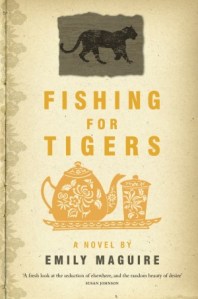
The novel tells the story of an Australian woman in her mid thirties who has made Hanoi her home. Mischa, an editor whose work includes stories about strong women in Vietnam’s mythology and history, is an escapee from an abusive (incidentally, American) husband. Her expat friend, Matthew, has an 18 year-old Australian-Vietnamese son, Cal, who comes to visit. Soon Mischa, starved for intimacy and a sense of belonging, is having an affair with Cal.
The tale is about lust and betrayal, belonging and the meaning of home and family. It’s about expats living in Vietnam, of dislocation and clashing cultures. It’s about trauma and abuse creating the conditions for more trauma and abuse. It’s also, obliquely, about war and its place in history, how it changes lives and nations. Finally, it’s about the stories we tell ourselves, and allow to be told about us. Emotionally, I found it disturbing, the depiction of the older women/younger man relationship being only one of its unsettling scenarios. It was particularly challenging and provocative to read about a woman with whom I identified but couldn’t wholly sympathise with, who behaves badly and refuses to conform to gender stereotypes (and who has been judged harshly by some GoodReads reviewers for that reason).
Most powerfully, however, the novel created for me a crack in the wall of my safe, cultural certainties. It gave me a glimpse of how because of the Vietnam war, because of the atrocities, trauma and dislocation suffered not only by those killed, but also by their survivors, and their children and grandchildren, including the refugees who came to Australia as “boat people” in the 1970s; because of our nation’s barely acknowledged involvement of the part we played in creating the horrors that led to these people’s flight and the ongoing trauma in the lives of those they left behind; because of all this, Australia is what it is today.
It’s in this sense that Fishing For Tigers is a book for this time.
On Sunday night, over a million people watched Underground, the biopic of the early life of the now notorious hacker and activist, Julian Assange. Back in April, Radio National’s Big Ideas Paul Barclay interviewed Andrew Fowler, author of The Most Dangerous Man in the World: A Biography of Julian Assange. The title of Fowler’s book is a reference to whistleblower, Daniel Ellsberg, whom Henry Kissinger described as the “most dangerous man in America”, after Ellsberg released top secret Pentagon papers relating to the Vietnam war. When prompted, Ellsberg passed the dubious mantle of being “The Most Dangerous Man” on to Assange.
Today, Assange is holed up in the Ecuadorian Embassy in London; US Army whistleblower Bradley Manning is enduring his 869th day of solitary confinement; Australian troops are engaged in a war in Afghanistan. Unmanned drones, sent by President Obama, wage silent war on civilians in Afghanistan, Pakistan and elsewhere. In the past few days, broadcaster Alan Jones has labelled as “terrorism” the protests of people who have objected to his misogynist references to our Prime Minister after our petitioning of sponsors resulted in his station 2GB’s pulling of all advertising from Jones’ radio program – this from a man whose conviction of inciting racial hatred in the lead up to the Cronulla anti-immigration riots of 2005 was this week upheld. Meanwhile, the 2010 release of footage titled Collateral Murder by Assange’s Wikileaks, which documents the deaths in 2007 of two Reuters journalists, remains one of the most chilling texts of our time.
Do most Australians even realise our nation is at war? When politicians and others create panic about the “boat people” “invading” our shores, do we have any idea the extent to which our nation has helped to create the conditions of war and trauma that these people are fleeing?
Speaking for myself, I know that we’re at war in the same sense that I know our earth is moving ever towards catastrophic global climate change. I know it, but I act – for the most part – as if it isn’t true, as if it has no real impact on me. It’s not until a novelist like Emily Maguire takes a seemingly provocative, sexy story about a cross-cultural encounter of a childless Australian woman and a boy almost half her age, and works it up to a climax which includes a visit to a Vietnamese war museum that I really get it. I get how important it is, to me, to us, to the nation and the world, to our future; to the whistleblowers; to the men, women and children risking everything and sometimes drowning in rough seas within arm’s reach of our shores.
By creating a crack in the wall to show the horror of war and its aftermath, Fishing for Tigers helps me understand that what happens “over there” – whether it be Vietnam, Iraq or Afghanistan, Sri Lanka, Syria or Mali – happens here, to us all. We are responsible for the unmanned drones that kill innocent civilians, the legacy of Agent Orange that caused such deformities, the plight of drug-addicted and alcohol-dependent veterans, the displacement of refugees. This is our story, as much as it is Vietnam’s history, even if it’s tales of romance and heroism, innocence and safety, moral righteousness and “national security”, that we’d prefer to hear.
~
Note: Fishing for Tigers has been reviewed for the Australian Women Writers challenge by Angela Literary Minded, Bree All the Books I can Read, and Janine Shambolic Living. I’m counting it as Book 6 toward my Aussie Authors Challenge.
Thanks to PanMacmillan for providing a review copy.
Fishing for Tigers: Picador
ISBN-13: 9781742610832
September 2012

 In March this year, the National Year of Reading’s theme was “laugh”. Two Australian authors whose names kept cropping up in my Twitter feed were Paddy O’Reilly and Toni Jordan. Initially I thought I wouldn’t get to read any books by Jordan until next year – my recent releases “to be read” pile is so high it’s tottering. But sometimes I buck my own system.

 Devoted Eclectic