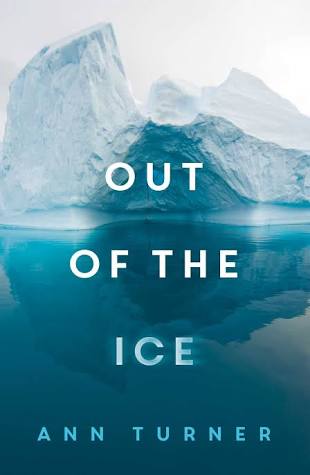
 Ann Turner’s second novel, Out of the Ice, starts with penguins. Don’t be put off. This isn’t a nerdy book. It does have environmental themes and it is set in one of the most fantastic and little-known parts of the globe – Antarctica; but it’s also an exploration of the life of a twice-divorced late-thirties woman who’s happy to set her own agenda. “Fearless”, a friend describes her; “reckless”, I was saying at more than one point in the book – but I didn’t mind that one bit.
Laura Alvarado has a double doctorate, a passion for cetaceans (whales and dolphins, etc.), and a healthy thirst for alcohol and adventure. She is typical of the misfits and mavericks who are attracted to life in one of the harshest environments on the planet. Having spent a long, dark winter as a researcher, she’s a bit “toasty”: a term she and her colleagues use to describe a loosening of one’s grip on reality caused by the harsh conditions. Although teamwork is vital and the base’s activities are designed to stop people from isolating, there’s plenty of time and opportunity for introspection and reflection, and sometimes things aren’t what they seem – or are they?
Laura has had lots to reflect on: two failed marriages, the first under tragic circumstances; being frozen out of her career as an academic after she acted as a whistleblower over dubious research findings of her superiors; and a fractious relationship with her ethnically Spanish mother and absent, fellow-academic father. As spring approaches, she is recruited to go to an old whaling town, Fredelighavn, on South Safety Island. The town was decommissioned decades before and is now in an Exclusion Zone to protect its wildlife, including colonies of Adele penguins. Established by Norwegians, it was a local centre of the brutal whaling industry in the early part of the twentieth century, and still has many of the buildings and facilities from that time. Laura and her partner are supposed to survey the township and environs to see if it should become a museum for tourists but, at the last minute, the partner falls ill, and she must begin the task alone. Her base is to be an all-male British research facility located not far from the town, and her welcome there is little short of hostile. Are the British merely protective of their research, or is there something more at play?
Out of the Ice sweeps the reader into larger-than-life events that span three continents and sees Laura travelling from Antarctica, to Nantucket (where the founders of the Fredelighavn spent the Northern Summer), to Venice; in each location, Turner creates scenes in vivid and loving detail. I read the novel from start to finish in a day, but was intrigued enough by the initial setting to stop and look up South Safety Island on the internet, convinced I’d see photographs of the colourfully-painted houses standing out from the white ice, the hulking wrecks of whaling ships, the rusting fuel containers and “flencing” sheds – where the whale meat is stripped from the bone. (Yes, there is some jargon in the book, but it’s seamlessly explained.) I didn’t find it, and I assume the location is a product of the author’s imagination, but it feels like a real place to me now – that’s how well Turner’s prose brings it to life.
I do have a few quibbles with the story, mostly to do with some lack of plausibility: Laura’s boss, an ex-detective and current Station Leader, suddenly has time to go off investigating; an environmentalist concerned about global warming doesn’t have even a twinge of guilt over taking multiple flights across the globe at a moment’s notice; but, for the most part, the quibbles were very minor (any elaboration would necessitate spoilers). The narrative is so engrossing and the settings so fascinating that I was happy to suspend my disbelief.
Out of the Ice is sure to please fans of Ann Turner’s first novel, The Lost Swimmer, and deserves to attract many more readers. It’s an excellent, well-written, fast-paced read.
~
Title: Out of the Ice
Author: Ann Turner
Publisher: Simon and Schuster Australia
Date: June 2016
ISBN: 9781925030891
This review forms part of my Australian Women Writers and Aussie Author Challenges. My thanks to the publisher for a review copy.

 I’m thrilled to announce my first novel, Snowy River Man, will be coming out in print with MIRA, as part of an anthology called, Country Secrets.
 After finishing
  Devoted Eclectic