
I For Isobel by Amy Witting

I For Isobel WittingConfession: Amy Witting’s I For Isobel (1989) has been on my shelf for ages and is the first work of hers I’ve read.

The novel records a decade in the life of Isobel Callaghan, from unhappy nine to unfulfilled 19. Isobel is a loner, someone who struggles to discern the rules other people live by; she always feels offside, “like being a spy in a foreign country having to pass for a native” (116). As a child, she is treated with barely disguised contempt and hostility by her mother, who favours her sister Margaret; she is bullied at school for being bright; she is haunted by her religious education, her seeming inability to be “good”, as well as her real and imagined misdemeanours.

Orphaned at 16, she goes out in the world to earn her living, finding work as a typist and German translator. She resides first at a boarding house, before taking her own room. Her great love is books – and books by Dead White Males comprise the bulk of her reading: Trollope, Dickens, Byron and, later, Dostoevsky, Auden and Eliot.

Isobel loves words, words to describe the people she meets, the places she goes in mid-twentieth-century Sydney. Words connect her to others, to the students she befriends in a Glebe cafe, to Frank the communist outsider where she works; they are also what separates her. Words are weapons to hurt and be hurt, as well as a balm to cure her loneliness; an oppressor and a liberator. Her mind is a “word factory” which never ceases production.

Eyes open, back to the ceiling: ornate plaster, baskets of flowers linked by swags of ribbon, a stain in one corner, yellow, like… sunshine? butter? honey? paler than pumpkin, darker than pee. Dirty old daylight, if there was a word.

There are words. Words we have plenty of, nasty little buzzing insects that they are. Awake two minutes and the word factory is at it already. And you at the loom, zoom, zoom.

It was going to be a bad day. (128)

Isobel isn’t always likeable as a protagonist: she is too passive; she is a “vacuum” that words rush to fill, a listener, a spectator of life rather than a participant. Her behaviour isn’t always admirable, but it is understandable; she is the embodiment of the phrase, “hurt people hurt people”.

The loosely linked chapters of I For Isobel chronicle Isobel’s travails as she struggles to come to terms with her identity, with her dishonesty (she is a “born liar”), with the half-buried hurts from childhood and misunderstandings that keep her yearning and, for most of the book, unfulfilled. At one moment she glimpses her place as the inheritor of a long line of genes that stretch back into history; as she looks in the mirror, hating her face because it reminds her of her mother, she has an epiphany:

the face shaped and softened with the beginning of a laugh because she was thinking those features weren’t her mother’s; she had had the tenancy of them for fifty years but they had been on the go for generations; that nose had taken snuff, sniffed at pomanders, plague posies, smelling salts, rose hip, orris root – things she had never smelt and never would – as well as honeysuckle, gas leaks and lavender… (137).

The book reaches a gentle crescendo when Isobel returns to the suburb she grew up in and comes face to face with an old foe. The encounter reduces her – and me – to tears. Left sobbing for the sorrow of having grown up in a family that failed her, the only comfort she receives is from the rock against which she rests her cheek, “as rough as a cat’s tongue and unyielding”.

I For Isobel may be the first of Amy Witting’s books I’ve read, but it won’t be the last.

~

This review forms part of my 2016 Australian Women Writers Challenge and Aussie Author Challenge. It’s also part of an effort I wish to make to read more Australian classics.

~

Author: Amy Witting
Title: I For Isobel
Publisher: Penguin
Date and place: Ringwood, Vic. 1989
ISBN: 0 14 012624 4

The Ice Twins by S K Tremayne

The Ice TwinsReading The Ice Twins by S K Tremayne is like going on a carnival ride, a combination of roller coaster and ghost train. By the end of it, I was a wreck, spooked, intrigued, fascinated by its exploration of the depths of human psychology and emotions – with its depiction of shock, grief, betrayal, anger and denial.
Set on a remote island of Skye, the story involves a young couple, Sarah and Angus, and their seven-year-old daughter Kirstie, a surviving twin, her sister Lydia having died in a fall over a year earlier. They are all grieving in their own ways, but Kirstie especially. With survivor guilt and haunted by the horror of her sister’s accident, she begins to imagine her sister hasn’t really left her.

The island where this damaged family retreat to make their new home is Eilean Torran, Gaelic for “Thunder Island”, a place of cold and violent storms, especially in winter. It’s also a place which locals call “thin”, where the spirit world meets the human. Sarah and Angus dismiss such tales, but they can’t dismiss their daughter’s eerie behaviour, or her sudden claim that they have mourned the wrong twin.

I enjoyed The Ice Twins, even as I felt highly manipulated by the many twists and turns of its narrative. One of the highlights for me was Tremayne’s setting, how it is woven into the fabric of the characters’ lives. In Sarah’s point of view, we get glimpses of the place’s history, the unforgiving backdrop to her family’s tragedy:

A lonely snowflake hits my windscreen, and is exterminated by the wipers. I look at the low balding hills. Shaved by winds and deforestation, I think of the people wrenched from this landscape by poverty and the Highland Clearances. Skye used to be populated by twenty-five thousand people. A century later it is half that. I often consider the scenes of that emigration: the crying farmwives, the sheep-dogs quietly killed, the babies screaming as they quit their beautiful, hostile homeland, and sailed west. And now I think of my daughter. (141)

Another pleasure was the author’s gift for thumbnail sketches of minor characters; here a portrait of a child psychiatrist:

Malcolm Kellaway is easily middle-aged, yet wears jeans which make him seem unconvincing. He has annoyingly effete gestures, a silly roll-neck jumper, and rimless spectacles with two perfectly round lenses that say oo. (100)

I was also taken with the author’s deft use of similes, the chilling comparisons that give this story its gothic, suspenseful atmosphere.

The climax coincides with the storm the setting always anticipated and the denouement is eerily satisfying (to say more would necessitate spoilers).

It has taken me a while to pull this novel off my To Be Read shelf, but I’m glad I did.

~

Author: S K Tremayne
Title: The Ice Twins
Publisher & date: HarperCollins, 2015
ISBN: 9780007459223

Ghost Girls by Cath Ferla

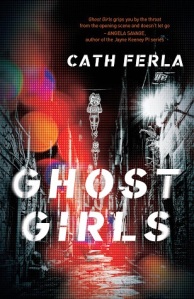
Ghost Girls FerlaGhost Girls is the debut novel by Cath Ferla from Echo Publishing, the publisher that last year gave us Emma Viskic’s excellent Resurrection Bay. It’s primarily a mystery story, rather than suspense or thriller, though there are thriller elements in it.

The story centres around Sophie Sandilands, an English language teacher, resident in Sydney, who is of mixed Chinese-European heritage. Sophie has memories of her birth place, Hong Kong, and she has experience teaching English in China. With this background, she occupies a unique space in relation to her mostly Asian students and friends, many of whom work part-time in China Town, either in restaurants or in the sex trade.

Other relevant features of Sophie’s background are that her father was a private investigator and she herself has been involved in a missing persons case. These factors provide the motivation for Sophie to become more than a little involved in the death of one of her female students and the apparent disappearance of others. Along with her flatmate, Jin Tao, a local chef, she follows the trail of one missing girl, a trail that leads her into the dark alleys and seedy underworld of Sydney’s illegal strip clubs.

Ferla has a talent for evoking settings and, it seems, a passion for Asian food, and her portrayal of the sights, sounds and smells of this pocket of Sydney life is well realised. Often her descriptions are entwined with characterisation, such as her reference to Sophie and Jin Tao’s tea drinking:

Forget reading the tea leaves afterwards, Jin Tao could read her mood by her choice of brew: oolong was for the weight of the world. The dark amber hue and the burnt bitterness of the leaves worked as a catharsis, helping Sophie clear her mind and refocus her senses. (58)

Another skill is the deft way she refers to characters’ pasts, dramatising them with economy and giving us insight what shapes people’s choices in later life:

[His] childhood had been one of slinking away from things: first from his father’s hand and then from his mother’s sweet, fermenting alcoholic breath. At school he had hidden from the bullies with his head down and shoulders scrunched together. He’d walked along walls and slid around corners, spent lunchtimes in graffitied library carrels and free periods locked in toilet cubicles. (174)

Ferla touches on some sensitive cross-cultural areas, especially in relation to immigrant Chinese women’s participation in the local sex trade. Her treatment of this, at times very dark, subject matter isn’t voyeuristic or moralistic, but rather acknowledges the complexities attendant on these women’s choices.

One aspect of the narrative which, for me, threatened to fall down was Sophie’s motivation for taking the risks she took in her endeavour to solve the mystery of the girls’ disappearance. Information relating to her mother which strengthens and explains Sophie’s motivation came, for me, a little late. If I’d known it earlier, I would have been more understanding and sympathetic towards Sophie’s choices and actions, and I couldn’t see any strong narrative reason for the delay. This is also the reason, I’d hazard, that the novel didn’t quite work for me as either a thriller or a suspense, despite several thrilling moments: because I didn’t fully identify with Sophie and the reasons she was getting herself into such trouble – until rather late, I wasn’t as engaged emotionally as I might otherwise have been. On the plus side, this is also probably why I wasn’t put off by the violent sequences and could read them with relative detachment (something I don’t find easy to do with more suspenseful stories).

These reservations aside, I found Ghost Girls a very competent debut with an interesting mystery and a fascinating cultural setting; another excellent production from Echo Publishing.

~

Author: Cath Ferla
Title: Ghost Girls
Publisher and date: Echo Publishing, 2016
ISBN: 9781760401177
Review copy kindly supplied to me by the publisher.

~

This review forms part of my contribution to the 2016 Australian Women Writers Challenge and 2016 Aussie Author Challenge.