
In the months before her arrest, Anne Baxter had many hours to think about her future.
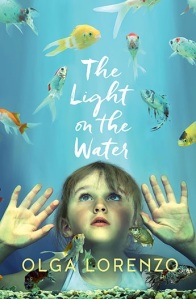 With this riveting opening, Olga Lorenzo begins a tale of woe, of a woman whose only ambition has been to love and nurture her own children, someone who had survived a harsh upbringing by a mentally unstable mother, whose marriage to a prominent barrister ended because he was unable to give her the emotional support she needed, and whose second child was born with a significant disability. The disappearance of this child, her younger daughter Aida, on an overnight bush walk in a remote coastal area of Victoria is the inciting incident for the novel: the trigger for Anne’s grief, her incarceration, her sense of guilt and the judgement of many among the community and remand centre inmates who mete out ongoing punishment.
On many levels this is a tough book to read. Despite the difficulties of her upbringing and her experience of every mother’s worst nightmare, the awful loss of her child, Anne isn’t the most sympathetic of characters. She displays something which, as I noted in an earlier review, is missing from characters in Charlotte Wood’s The Natural Way of Things: the learned helplessness of the victim, the utter mind-stultifying and body-disabling passivity of those who have discovered from a very early age that it’s no use fighting; that the opposition, be it an abusive parent, a judgemental waitress, a drunk outside an airport or a fellow prisoner, is more powerful and will prevail; that survival depends on “copping it sweet”.
It’s a psychologically astute portrayal, but it can also make the reader deeply uncomfortable. For survivors of abuse, it can trigger recognition and empathy for the weakest parts of ourselves, but not necessarily compassion. My own reaction was principally one of anger. I found myself wanting to shake Anne, to say, “Wake up to yourself. Do something. Act. Respond. Fight back. Don’t be such an idiot! Think.” That’s not to say Anne is totally passive: the times she does respond had me cheering, such as when she puts her hypocritical neighbour in her place. But for the most part I found her passivity disturbing, as it dramatised, as it were, the parts of myself that fill me with self-loathing.
Counteracting the toughness of this emotional response is the pleasure derived from the novel’s use of language. Lorenzo is a teacher of creative writing and it shows. Running through the text are images drawn from nature: fish, insects, the coastal tides and the weather. At times the beauty of these images counterbalance the horror of Anne’s experiences; at other times, they echo them dispassionately or reinforce them:
Life has picked her up and carried her away on its own tide, lapping her up in its various eddies, disgorging her on these dangerous shores. (155)
Anne’s contemplation of the fish in her home aquarium stimulates reflection on her own passivity:
Is there something in her that demands that she not be comforted and helped? She’s sure there’s a pecking order among human, just as there is among her mollies, who vie for supremacy the minute two are put together in the aquarium. So does she need to have her fins shredded and her eyes picked out to remind her of her rightful place in the scheme of things? (75)
There is also a philosophical thread in the novel, an insistence that, no matter what, suffering can be endured and will be overcome. At times, this lifts the narrative into a paeon to women’s work, the work of mothering, of nurturing and enduring. Anne comes to remember with fondness the bliss of everyday, ordinary activities associated with motherhood and caring for a family:
[S]he had loved washing day, the satisfaction of the clean smells emanating from the laundry, and then the calisthenics of bending and lifting and wrestling everything onto the clothesline. She had loved the breeze catching her family’s sheets and making them billow, as if they were setting off to new lands. She revelled in the sunshine trapped in the clothes when they were brought indoors. She had felt this was a way to love her family – folding their socks and t-shirts and underpants felt akin to stroking each person. (325)
This satisfaction is made all the more remarkable for the fact that women come to the – often thankless – tasks of domestic life and child-rearing unprepared:
No one trains them, explains the countless, simple lessons mothers give their children every day. The patience required. The mind-numbing patience. (262)
There are many more aspects of this book to praise: Lorenzo’s ear for Australian idiom and depiction of class differences; her deft thumbnail sketches of incidental characters that make these people come alive on the page; her use of powerful verbs; her insights into psychology and character; her sometimes sympathetic, sometimes harsh, portrayal of different types of families; as well as her skill in portraying a range of difficult and subtle human emotions:
Looking out over the water, life at that moment seemed sad and sweet and as fleeting as the day.
This was something she felt sometimes as a child – a wistfulness, but also a tentative inkling of future possibility, of life renewed and waiting, and of the transience of her own being. (242)
Despite the toughness of the reading experience, despite the harshness and horror of much of what is portrayed, Lorenzo leaves the reader with a sense that everything will be okay.
~
Author: Olga Lorenzo
Title: The Light on the Water
Publisher and date: Allen & Unwin, 2016
ISBN: 9781925266542
This review forms part of my 2016 Australian Women Writers and Aussie Author Challenge. Thanks to Allen & Unwin for providing a review copy.
 When a review copy of Missing, Presumed by Susie Steiner landed in my post office box, I thought, “Great, some new Aussie crime fiction!” Publishers know that I’m dedicated to reviewing works by Australian women and it’s rare they send me anything else.
 Australia Day always brings mixed feelings for me. Many of my friends prefer to think of it as “Invasion Day”. Some demand we change our national day to a date less reminiscent of our tragic treatment of our Indigenous peoples and their long history of suffering and mourning.



 Devoted Eclectic