
Let Her Go by Dawn Barker – powerful contemporary drama

Dawn Barker Let Her GoTwo sisters – step sisters – one, Nadia, is happily married with three children; the other, Zoe, has suffered a debilitating illness and a number of miscarriages, and finds herself infertile. Both have reasons for wanting to have a baby: Zoe, to complete her long-held desire to be a mother; Nadia, ostensibly, to help her deserving sister. After years of counselling and legal advice, they enter into a surrogacy agreement. They are adults. They care for each other. What could possibly go wrong?

Fast forward seventeen years to a troubled teenager, Louise, who is getting busted for stealing drugs, self-harming, engaging in drunken sex and whose performance at school is deteriorating. She knows her – unnamed – parents are fighting, senses it has something to do with her, but has no idea of the trauma that followed her birth or the bitter custody dispute that tore her extended family apart.

In Let Her Go Dawn Barker – a psychiatrist by training – successfully juggles different points of view as well as jumps forward and backward in time. Throughout the novel, the reader has a sense that something really terrible could happen – or maybe has happened already – but the suspense isn’t gratuitous. It derives organically from the fraught emotional situations she forces her characters to confront. As I approached the novel’s climax, I was struck by the story’s similarity to the Judgement of Solomon, as if Barker had taken elements of this classic dilemma and brought it alive in a modern context. Both women have good claim to the child; how will the child’s best interest be served?

If Barker’s debut novel Fractured grabs the reader and forces her along a terrifying path, Let Her Go is more like a slow burn, but it’s no less powerful for that. For anyone who has yearned for a child and not been able to conceive or carry to term, the narrative is excruciatingly real at times, almost unbearable. Similarly, Barker captures the pressure on a marriage of women coping with hormones, fears and jealousies. Both Zoe and Nadia are portrayed at times in a poor (but very human) light. Zoe comes across occasionally as unreasonably demanding and judgemental towards her husband, a man with secrets who has never seemed as enthusiastic about the surrogacy and who fails to pull his weight. In portraying the deteriorating relationship, Barker uses irony to good effect: the reader is ahead of Zoe in sensing the effect of her behaviour on her husband, and waits in suspense for the explosion we fear will come. Nadia (understandably) seems at times to be selfishly blind to anyone’s needs but her own, and the reader is torn, sympathetic to her suffering, but alarmed at the lengths she is willing to go to get her way.

With both Let Her Go and Fractured, Barker joins a number of women writers in Australia who create compelling psychological suspense out of difficult moral and social issues, including Honey Brown, Wendy James and Caroline Overington. Each of these writers’ novels demonstrates that issues facing contemporary Australian women, in the hands of skilful storytellers, make for powerful drama. I can’t wait to read Barker’s next scenario.

~

This review forms part of my Australian Women Writers Challenge and Aussie Author Challenge. A review copy was kindly provided to me by the publisher via Netgalley.

It has been reviewed for the AWW challenge by Emily Paul.

Publisher: Hachette Australia
ISBN: 9780733632228
Published: July 2014
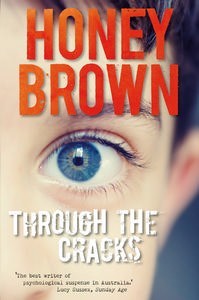
Through the Cracks by Honey Brown – don’t read the back cover

If I’ve enjoyed an author’s previous books, through the cracks brownI never read the back covers of their latest. So I knew very little about Honey Brown’s psychological suspense novel, Through the Cracks, before I picked it up. Later, I read through some reviews posted for the Australian Women Writers challenge and saw that several reviewers were dismayed and annoyed that the book’s back cover “blurb” gave away a lot of the story’s suspense. So, fair warning: don’t read the back cover.*

Told from the point of view of Adam Vander, a boy who has been kept locked away from the world by an abusive and controlling father, Through the Cracks traverses difficult territory. Adam has been victimised for so long, he exhibits all the hallmarks of “learned helplessness”: he has become so conditioned to abuse that he appears almost incapable of acting to stop it. Only as he hits puberty, and his father succumbs to health problems, does his sense of agency begin to assert itself. But how can he save himself when he knows nothing about the world, and the few people he encounters, apart from his father, don’t recognise him as someone who desperately needs help?

Brown’s tale of Adam’s escape is both compelling and distressing. Slowly the events that led to his predicament are revealed, and the full horror of what he has endured unfolds. Along the way, Brown touches on issues of race, class, sexuality and, most importantly, identity. Who are you when everything that makes you human has been stripped away?

One of the many elements of this powerful and emotionally wrenching novel that impressed me was its style. The sentences are often short and descriptive; the point of view character indulges in very little introspection and makes few inferences of other characters’ thoughts and feelings. It is as if one of the after effects of abuse is an almost complete lack of interiority. For me, this created an unnerving sense of Adam’s dissociation, his feeling of being utterly separate from the world, both emotionally and psychologically, even as he slowly rejoins it, just as formerly he was isolated physically.

With Through the Cracks, Brown cements her place as one of the foremost writers of psychological suspense in Australia.

~

This book was kindly supplied to me by the publishers through Netgalley. It forms part of my contribution to the Australian Women Writers Challenge and Aussie Author Challenge. It has already attracted a lot of attention from AWW challenge reviewers, including:

~

Title: Through the Cracks
Author: Honey Brown
Published:23/04/2014
ISBN-13:9781921901546; ISBN-10:1921901543
Imprint:Michael Joseph; Publisher:Penguin Australia.

Hades by Candice Fox – a disturbing debut

When I first read Candice Fox’s debut novel Hades earlier this year, I couldn’t bring myself to review it. Its themes are so dark, I couldn’t get over the emotional impact it had on me enough to write about it.

Dark themes, drawn from a chaotic childhood. Fox grew up as part of a “shared” foster household where encounters with police and visits to prison were routine.

As an author, I’ve spent years trying to shut out the late-night knocking, the grisly stories half-heard around the kitchen corner, the screaming and the crying and the wild eyes, by writing myself into safe places, predictable places. But lately, all that darkness has been creeping back in.

Because, really, the best writers will tell you that you should write what you know. I’ve known how bad the world can be from the very beginning. (Read more here.)

Hades Candice FoxRereading the book months later I was able to detach. I knew already the terrain it covered and could concentrate on the author’s skill – in coming up with the plot, in characterising the villains as heroes and the heroes as both victims and perpetrators, and in setting the scene.

Hades is a hard book to classify, though its title gives some clue. “Hades” refers to one of the book’s characters, a “fixer” for Sydney’s underworld who takes in two orphaned children, Eden and Eric, and raises them to become police officers – and avengers of their murdered parents. But Hades the Fixer isn’t the central character; the book’s narrator Detective Frank Bennett is. The story switches from third person flashbacks showing Hades and the children, to Frank’s first-person narration, to the points of view of various victims of a serial killer. The hunt for the serial killer provides the chief narrative drive and opportunity for moral questioning of the story. In this context, “Hades” refers more to the place of torment and suffering that many of the book’s characters appear to occupy. The language of morality pervades the book, nudging it from crime into the realms of horror – without ever being supernatural. As Fox has named Stephen King as the person she’d most like to be trapped in a lift with, perhaps this horror element isn’t surprising.

As crime-horror, the novel poses a number of ethical and moral questions. What creates a killer – nature or nurture? When is taking another human being’s life justified – if ever? What happens to victims of crime? What moral stance would we take if faced with the prospect of imminent death versus the chance of survival? Does every human being deserve to live, no matter what?

With a page-turning plot and enviable style, Fox’s narrative forces the main character – and the reader – to confront these questions.

One of the admirable features of Fox’s writing is her way of accomplishing several narrative tasks at once. In the following example, where Frank the narrator observes his new colleagues, Fox manages to characterise the narrator, provide backstory, introduce secondary characters in an interesting way, set the mood and foreshadow major themes:

My mother had been a wildlife warrior, the kind who would stop and fish around in the pouches of kangaroo corpses for joeys and scrape half-squashed birds off the road to give them pleasant deaths or fix them. One morning she brought me home a box of baby owls to care for, three in all, abandoned by their mother. The men and women in the office made me think of those owls, the way they clustered into a corner of the shoebox when I’d opened it, the way their eyes howled black and empty with terror. (Kindle location 142)

Rereading Hades, I highlighted countless examples of fine writing, way too many to include here.

The overall impression created by the story is that good and evil aren’t separable. As Eric remarks to Frank about working for the police:

This job is about knowing each other, Frank. It’s about knowing each other’s secrets and ignoring them. We’re all good guys here. No one’s better than anyone else. We’re all dirty. We’ve all got something shadowing us.

It’s my hunch Fox thinks this is also true about human nature.

Hades is a very interesting read.

~

Hades by Candice Fox was published 1st January 2014 by Random House Books Australia (Bantam imprint) ISBN: 9780857981172. Review copy kindly supplied by the publishers via NetGalley.

This review forms part of my Australian Women Writers Challenge and Aussie Author Challenge.