Hades by Candice Fox – a disturbing debut

When I first read Candice Fox’s debut novel Hades earlier this year, I couldn’t bring myself to review it. Its themes are so dark, I couldn’t get over the emotional impact it had on me enough to write about it.

Dark themes, drawn from a chaotic childhood. Fox grew up as part of a “shared” foster household where encounters with police and visits to prison were routine.

As an author, I’ve spent years trying to shut out the late-night knocking, the grisly stories half-heard around the kitchen corner, the screaming and the crying and the wild eyes, by writing myself into safe places, predictable places. But lately, all that darkness has been creeping back in.

Because, really, the best writers will tell you that you should write what you know. I’ve known how bad the world can be from the very beginning. (Read more here.)

Hades Candice FoxRereading the book months later I was able to detach. I knew already the terrain it covered and could concentrate on the author’s skill – in coming up with the plot, in characterising the villains as heroes and the heroes as both victims and perpetrators, and in setting the scene.

Hades is a hard book to classify, though its title gives some clue. “Hades” refers to one of the book’s characters, a “fixer” for Sydney’s underworld who takes in two orphaned children, Eden and Eric, and raises them to become police officers – and avengers of their murdered parents. But Hades the Fixer isn’t the central character; the book’s narrator Detective Frank Bennett is. The story switches from third person flashbacks showing Hades and the children, to Frank’s first-person narration, to the points of view of various victims of a serial killer. The hunt for the serial killer provides the chief narrative drive and opportunity for moral questioning of the story. In this context, “Hades” refers more to the place of torment and suffering that many of the book’s characters appear to occupy. The language of morality pervades the book, nudging it from crime into the realms of horror – without ever being supernatural. As Fox has named Stephen King as the person she’d most like to be trapped in a lift with, perhaps this horror element isn’t surprising.

As crime-horror, the novel poses a number of ethical and moral questions. What creates a killer – nature or nurture? When is taking another human being’s life justified – if ever? What happens to victims of crime? What moral stance would we take if faced with the prospect of imminent death versus the chance of survival? Does every human being deserve to live, no matter what?

With a page-turning plot and enviable style, Fox’s narrative forces the main character – and the reader – to confront these questions.

One of the admirable features of Fox’s writing is her way of accomplishing several narrative tasks at once. In the following example, where Frank the narrator observes his new colleagues, Fox manages to characterise the narrator, provide backstory, introduce secondary characters in an interesting way, set the mood and foreshadow major themes:

My mother had been a wildlife warrior, the kind who would stop and fish around in the pouches of kangaroo corpses for joeys and scrape half-squashed birds off the road to give them pleasant deaths or fix them. One morning she brought me home a box of baby owls to care for, three in all, abandoned by their mother. The men and women in the office made me think of those owls, the way they clustered into a corner of the shoebox when I’d opened it, the way their eyes howled black and empty with terror. (Kindle location 142)

Rereading Hades, I highlighted countless examples of fine writing, way too many to include here.

The overall impression created by the story is that good and evil aren’t separable. As Eric remarks to Frank about working for the police:

This job is about knowing each other, Frank. It’s about knowing each other’s secrets and ignoring them. We’re all good guys here. No one’s better than anyone else. We’re all dirty. We’ve all got something shadowing us.

It’s my hunch Fox thinks this is also true about human nature.

Hades is a very interesting read.

~

Hades by Candice Fox was published 1st January 2014 by Random House Books Australia (Bantam imprint) ISBN: 9780857981172. Review copy kindly supplied by the publishers via NetGalley.

This review forms part of my Australian Women Writers Challenge and Aussie Author Challenge.
‘ A useful reminder that the system is fallible’ – Rough Justice: True Crime by Robin Bowles

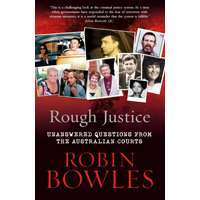
rough-justiceThis is a challenging look at the criminal justice system. At a time when governments have responded to the fear of terrorism with extreme measures, it is a useful reminder that the system is fallible. Julian Burnside QC, quoted on the cover of Rough Justice

I picked up my copy of Rough Justice by Robin Bowles through a discount online bookstore over a year ago and it has been sitting on my shelves waiting for a moment when I had the time and inclination to pick it up. That moment came this week when I tripped and gashed my knee, forcing me to take time off. What better way to recover from an injury than to read. As I’m currently writing a novel which involves crime, the “true crime” genre appeals to me: I welcome any insights I can glean into the workings of police, investigative journalists, prosecutors and defence lawyers, as well as the courts, as background material for my fiction. Rough Justice provides plenty of such insights.

Bowles’ book is subtitled “Unanswered Questions from the Australian Courts” and it certainly raises more questions than it answers. It discusses eight cases, three in Victoria, one each in South Australia, Western Australia, the Northern Territory, Queensland and New South Wales. Some of the cases are well known, including that of Bradley Murdoch, convicted of murdering British backpacker Peter Falconio; and of Greg Domaszewicz, who, despite having been acquitted of murdering toddler Jaidyn Leskie, subsequently had a coronial finding against him. Other cases are less well known, at least to me. In each case, the defendants have protested their innocence. Several have been exonerated; others are still fighting for “justice” – or, at least, to clear their names.

But what is “justice”? That’s the real unanswered question this book poses.

Bowles looks at the processes behind these cases and reveals grave flaws in the judicial system. Her discussion identifies various points at which an innocent person can be unjustly convicted, including incompetence in how evidence is gathered or interpreted, possible police corruption and coercion of witnesses, bias created in the minds of both witnesses and potential jurors by the media, and flawed judicial proceedings. The problems, she suggests, come from our adversarial system which demands two sides play off against one another; the winner, she implies, is often the side with the deepest pockets. Thus wealth, privilege and class – or the lack of these – ensure not a “fair” trial, but what can be successfully argued in court, a recipe for creating an underclass who risk being incarcerated simply because they are too poor to mount a convincing defence.

Readers of reviews on my blog may know of my ambivalence to the fiction of Caroline Overington. Despite being riveted by Overington’s tales, I’m left with an uneasy feeling resulting from a forced encounter with moral ambiguity. I experience something similar when reading Bowles’ book. In her efforts to tell two (or more) sides of the story, Bowles, I feel, manipulates me; it’s as if I’m being drawn to form one opinion, only for the facts subsequently to be presented in an equally convincing, sometimes opposite way. It’s a clever ploy, as it reinforces the book’s theme and underlines the problems faced by police, investigators, jurors and judges in deciding what is “true”. Often, it appears to come down to, not what is true but what is “believable”, and that is restricted by the evidence known or presented at any one time.

I’m also made uneasy by the subtext about class, derived by way of language. In looking for information about these cases online, I came across a thread on a website where people (the “public”) were giving their opinions on the Jaidyn Leskie murder. One commentator mentioned how so many of these sensational cases involve communities where people have names that are spelled with “yn”, instead of (presumably upper-class) names like “Jeremy”. This (somewhat bizarre) comment made me think. Both Favel Parrett in Past the Shallows and Tara June Winch in Swallow the Air write about poor, uneducated protagonists; but both authors depict these protagonists’ worlds using language which is richly poetic. The authors’ beautiful prose has the effect of dignifying the poverty and tragedy of their characters’ lives. Both Bowles and Overington, by contrast, use plain language – a “journalistic” style – combined with, at times, the idioms consistent with the class, background and education of the people they write about; this plainness – and, at times, crudeness – does nothing to disguise the poverty of these people’s lives and values. As readers, we’re forced into an uncomfortable position. Are we meant to judge or empathise with these people? Do we stand above, or do we consider “them” to be our equals?

Bowles weighs down, in my view, on the side of empathy for the defendants, not because she demonstrates their innocence or virtue, but because she shows how these people – guilty or innocent – are equally screwed by the system. At the same time, she shows how they’re equally capable of screwing the system in return – and so is she. At one point, she describes how Denis Tanner, a man who was found by a coroner to have shot his sister-in-law, had an entirely separate charge of assault brought against him. Bowles writes:

At one point, he was charged with whacking a photojournalist in the testicles with his heavy briefcase as he left the coroner’s court. He was acquitted because a visit by the Magistrate’s Court to the scene of the alleged ‘crime’ showed that the police witness who said he saw the whole thing couldn’t have seen anything from his office because of a tree outside his window. They didn’t ask me, though. I saw everything! (161)

What did Bowles see? She doesn’t state. But “everything” could hardly be “nothing”. It’s hard to escape the conclusion that, for Bowles, in this instance at least, seeming impartiality and actual complicity are one and the same thing. It could be a metaphor for the equally fraught nature of the Australian justice system. Perhaps it was intended to be.

~

Author: Robin Bowles
Title: Rough Justice: Unanswered Questions from the Australian Courts
Publisher: The Five Mile Press
Date: 2007
ISBN: 9781741786606

This review counts towards both the Australian Women Writers Challenge 2014 and the 2014 Aussie Author Challenge.

Are teenaged girls just like that? Kirsten Krauth’s just_a_girl and Lolita: a response

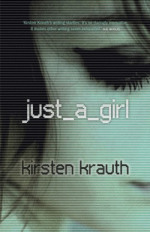
just-a-girl-krauthThis book should come with a warning.

Anyone who cares for – or has been – a sexually precocious adolescent girl, be prepared for an emotionally harrowing read.

just_a_girl tears into the fabric of contemporary culture. A Puberty Blues for the digital age, a Lolita with a webcam. It’s what happens when young girls are forced to grow up too fast Or never get the chance to grow up at all. (Source: back cover copy)

I haven’t read Puberty Blues, but I did read Lolita in my early twenties and hated it. I think anyone who, like me, experienced the trauma of being repeatedly ‘interfered with’ by a sexual predator from a very early age, and subsequently became sexually precocious, would cringe with painful identification at how vulnerable young girls can be when first exploring their sexuality.

Maybe you wouldn’t need to have a history of childhood sexual assault (CSA) to have that reaction to Nabokov’s classic; I don’t know. But the author’s ‘beautiful’ writing did nothing to compensate me for the trauma of reliving the horror, the reminder of how easily seduced one can be by an older man, if you have such a history; how needy, how lonely and lost; how at the mercy of others’ violence, sexual perversity and power plays. It was a confronting and, for me, very distressing read.

Apart from my own visceral reaction, another reason why I hated Lolita – and why I’ve never been able to bring myself to reread it or to explore Nabokov’s other books – was that, while I recognized Lolita’s behaviour, I didn’t think Nabokov had her motivation right. I didn’t believe in the child-woman ‘tease’, the girl who is attracted to and exercises her sexual power over much older men; I didn’t think she could spring out of nowhere. My unconscious assumption, I realize now, was shaped by my own history. I thought such behaviour had to stem from CSA; I couldn’t see how it could be a ‘dance’ played between the adult man-who-should-know-better and an adolescent girl who simply doesn’t realize the dangers of exercising her sexual power. (If I’m mis-remembering Lolita, forgive me. Maybe I’ve blanked out Lolita’s back story.) For me Nabokov’s way of viewing the interplay seemed to elide the experience of the girl, denying her victimhood: it was a story a man might have written out of ignorance, I thought, a man who couldn’t know the full story.

However, reading Kristin Krauth’s just_a_girl, I find myself questioning my assumptions. Here’s Layla, a teenaged character self-consciously acting like a 21st-century Lolita, written by a woman. A 14-year-old girl with no apparent history of early childhood CSA, Layla is right out there sexually with men twice her age and more, and getting herself into potentially life-threatening trouble as a result.

The risks Layla takes are, for me, horrifying.

The most horrifying aspect is, as Krauth suggests very convincingly, that any teenaged girl might find herself acting like a Lolita; girls who – like Layla – have suffered the trauma of a father’s abandonment or absence, a mother’s post-natal depression, personal feelings of isolation and social dislocation, the pain of ‘growing up’ – ordinary, if distressing, life circumstances and events. If Krauth is right, then so perhaps was Nabokov, something I’ve resisted believing for years. Maybe adolescent girls – especially in the internet age – face a much greater danger than I realized. The danger, it would appear, is in themselves, not because of what someone has done to them. That is the truly frightening premise of just-a-girl. It could be your daughter, niece or granddaughter. It might have been you at that age.

So have I had it wrong? Are some ordinary teenaged girls ‘just like that’?

Maybe I’m not giving Krauth enough credit for subtlety.

Krauth does, in fact, lay the seeds of a different understanding of Layla’s behaviour, one that fits better with my own intuition. It’s not just the girl’s history we need to take into account, Krauth suggests, but also that of the generations that have gone before her: her parents and what shaped their relationship, her mother’s childhood experience, and the abuses and suffering of previous family members. In this systemic context Layla’s vulnerability makes sense. Layla’s god-fearing mother is a reformed addict, whose first marriage was to a closeted gay man; she comes from a history of family abuse and, like Layla, is vulnerable to a sexual predator. Layla’s seeming obliviousness to her own trauma isn’t because it doesn’t exist; it’s because she is in denial and ‘acting out’, indulging in risk-taking behaviour as a defence mechanism. All this, to me, is psychologically convincing. In this reading (which I find more saddening than alarming), Krauth suggests that such dangerous precocity doesn’t, after all, spring out of nowhere, and the girl – however sexualised her behaviour – isn’t to blame for what happens to her, even though, on first reading, her recklessness would appear to be a contributing factor.

If you’re prepared to be confronted by a talented new voice in Australian fiction, read just_a_girl and let me know what you think.

For less personal accounts of Krauth’s debut novel see:

~

Title: just_a_girl
Author: Kirsten Krauth
UWA Publishing 2013
ISBN: 9781742584959

This response to the novel counts towards the Australian Women Writers Challenge and Aussie Author Challenge. Copy kindly supplied by the publisher.