House Rules by Jodi Picoult

imageWhat happens in a family where one child is diagnosed with a disability like autism?

In primary school, I had a best friend who had two brothers and a sister, except the sister didn’t live with them any more. The term “autistic” was mentioned, but I had very little idea what that meant. All I knew was that there had been something wrong with her. She had never grown out of the “terrible twos”: her screaming and tantrums, her inability to communicate wants and needs, wore her (very kind and loving) parents down. She had been sent away to live in an institution, and my friend rarely spoke of her. I have a vague impression that the family visited her, but I can’t be sure. For the rest of us, she had ceased to exist as a person.

This was a time before the government policy of de-institutionalisation, of supporting children with disabilities to live in the community. In those days, the policy for autistic children was “out of sight, out of mind”.

But what would it have been like for my friend and her brothers if their sister had been kept at home? If the parents, in order to cope, had shaped every routine in the house around not triggering tantrums? If the “neuro-typical” – non-autistic – children had been asked to take second place – or not even asked, just relegated to that position? Would they have fantasised about what it would have been like to have grown up in a “normal” family? Maybe even been tempted to act out those fantasies?

This is the scenario explored in Jodi Picoult’s novel, House Rules. In the story, eighteen-year-old Jacob is the “boy” who has Asperger’s, a high-functioning form of autism which manifests as an inability to recognise and respond to social cues, as well as a lack of empathy and imagination. Jacob’s long-suffering and devoted mother Emma has made every sacrifice for her son, leaving Theo, Jacob’s fifteen-year-old brother, longing for a very different family. The boys’ estranged father, Henry, has long since abandoned them, and, when we finally get to meet him, he too displays some characteristic behaviour of autism.

A common feature of people with Asperger’s is a fixation on a particular area of interest, in Jacob’s case: forensic science. This fixation, in part, is the reason why the two boys find themselves embroiled in a dilemma concerning Jacob’s social skills therapist, Jess, a kind-hearted girl whom Jacob fears is being abused by her boyfriend.

In House Rules, Picoult once again weaves a compelling story, one that had me engaged from the start and wanting to stay up reading long into the night. At the same time, I found the story frustrating. From at least halfway through, I could see that the main conflict could be resolved with one good conversation. Ending the novel, I was wondering whether I’d been cheated as a reader, strung out unnecessarily by an unrealistic narrative; or whether the frustration resulted in part from Picoult’s use of irony. After all, the only reason I knew one good conversation would resolve things was because, as a reader, I was privy to Jacob’s point of view; the other characters – crucially, for the plot – were not. A feature of autism is an inability to communicate simply, just as frustration is one of the dominant emotions felt by those living with autism, as well as the people who interact with them. So maybe leaving the reader frustrated was intended? Or maybe not.

Whatever Picoult’s intention, House Rules is still a very good read.

~

Author: Jodi Picoult
Title: House Rules
Publisher: Allen & Unwin
Date: 2010
ISBN : 978 1 74237 365 2


I borrowed a copy from the library.

Watching You by Michael Robotham

robotham watching youBefore picking up a copy of Watching You with a stack of other books at the library before Christmas, the only story I’d read by Michael Robotham was Bombproof. I remember having enjoyed Bombproof as a fast-paced, witty thriller, and I have intended to read more of Robotham’s work ever since.

It’s a measure of Robotham’s skill as a storyteller that I didn’t immediately pick this story as part of a series. As it turns out it’s Book 7 in the Joe O’Loughlin series. Joe is a clinical psychologist who has a history and faces health challenges, but the story doesn’t really belong to him. It belongs to one of his patients, Marnie, a woman with a traumatic childhood and a missing husband.

Marnie’s husband Daniel wasn’t the best of husbands. An Aussie journalist living in London and a victim of newspaper downsizing, he took up gambling and disappeared leaving a trail of debts. Nevertheless, Marnie refuses to believe he abandoned her. With no joy from the police investigation and growing evidence Daniel was hiding something from her, now she is being hounded by his creditors. Unable to access his bank accounts or life insurance money, she is forced into desperate acts to pay his debts and keep from being evicted from their home. She is also desperate for help for their sick child, four-year-old Elijah.

Marnie’s behaviour doesn’t impress Zoe, her teenaged daughter from her first marriage. Troubled and resentful of her mum, Zoe misses her step-dad; she can’t understand why their TV has been hocked, and why her mother is suddenly dressing up at night and being met by a chauffeur who takes her out. Zoe seeks solace online and, unknown to her mother, sets up  a Facebook page dedicated to trying to find her missing father. That isn’t the only thing she hides from Marnie.

To the world, Marnie is the epitome of the battler struggling against immense odds. To cope, she seeks help from her clinical psychologist, Joe O’Loughlin, but she isn’t entirely truthful to Joe. She doesn’t tell him, for example, that she has had mental health problems before. Nor does she mention that people who cross her have a habit of ended up being harmed. She does hint, however, that she has a feeling she is being watched.

Watching You is an interesting page-turner from a series which features some apparently already well-loved characters. It also reads well as a stand-alone novel. There were times when I felt I was reading more to assess Robotham’s skill as a storyteller, rather than being engaged in the story, but this didn’t detract from my enjoyment. I’m looking forward to reading Robotham’s latest novel, Life or Death, which I’ve heard great things about.

~

So that I don’t entirely lose my focus on supporting books by Australian women this year, I’d like, when I can, to recommend books by Australian women similar to the ones I’m reviewing. My pick of a match for Michael Robotham – based on a very small sample of his work – is Jaye Ford. Ford writes fast-paced action thrillers with a psychological edge. But maybe readers who are more familiar with his work will other ideas?

~

Author: Michael Robotham
Title: Watching You
Publisher: Sphere/Hachette
Year: 2013

I borrowed a copy from the library.


This review is the second book I’ll count towards the 2015 Aussie Author challenge.

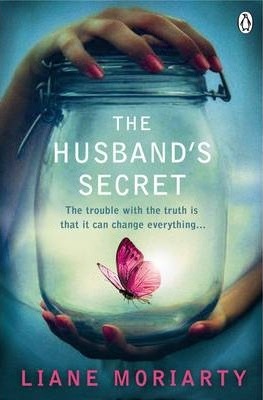
The Husband’s Secret by Liane Moriarty

Liane Moriarty’s Husbands Secret MoriartyThe Husband’s Secret is a page-turner featuring believable characters, interesting moral issues and more. I read it over the Australia Day weekend and the timing seemed fitting somehow. It could easily be subtitled, ‘A portrait of suburban Australian lives’.

The characters in this novel are ordinary, everyday people who inhabit Sydney’s north shore. They’re people like me, or my sisters, my friends, our mothers and daughters. Catholic-raised, but not observant; juggling haphazard careers and family responsibilities; coping with the ups and downs of problematic marriages, teenaged children, competitiveness, grandchildren, imperfect husbands, as well as past traumas that rise up in the present with unexpected and unpredictable consequences.

There’s Cecilia, the wife of the husband with a secret. She’s a perfectionist, a candidate for a diagnosis of OCD; impossibly organised, generous and thoughtful; quite possibly unbearable as a friend or family member, but also vulnerable and a loving mother.

There’s Rachel, an administrator at Cecilia’s son’s primary school; an aging grandmother who has never quite got over the death of her teenaged daughter, and finds it hard to show love to her adult son.

Then there’s Tess who, until a week ago, would have described her marriage as happy…

These characters’ lives intersect in a narrative that made me both laugh and cry as I identified with the experiences, thoughts, failings, fantasies and bad behaviour of normal human beings under pressure.

Books like this show me how ordinary lives can be extraordinary and interesting. Moriarty seems to write easy-to-read prose effortlessly, adding a degree of emotional truth that surprises me for popular fiction. No wonder she was recently voted Australia’s second-most popular author in a recent online bookshop poll.

~
This review forms part of my contribution to the 2015 Australian Women Writers Challenge and Aussie Author challenge.

Author: Liane Moriarty
Title: The Husband’s Secret
Publisher: Penguin
Publication date: 2013
ISBN: 978140591665

I borrowed a copy from a friend.