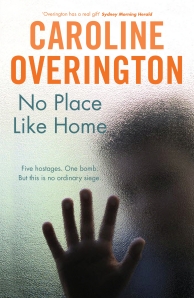
 Ever get the feeling that the book you’ve just finished reading and the one by the same title being lauded in reviews isn’t the same book?
That’s how I felt after finishing Caroline Overington’s latest, No Place Like Home.
Overington’s previous book, Sisters of Mercy (reviewed here), had me fuming, so I wasn’t surprised to find No Place Like Home equally provocative. What did surprise me, though, was how different from mine were other reviewers’ reactions to the novel. Where I’d felt angry, by contrast, the ending left more than one other reviewer feeling sad. Whereas I found the narrator shallow and deeply problematic ethically, another thought him “likeable and moderate in his thinking”. Where I saw the majority of the characters as caricatures, others found these figures believable. Where one reviewer regarded the novel to have been written with compassion, I saw, through the eyes of a deeply flawed narrator, a disgust and contempt for the flaws of other human beings.
Were we reading the same book?
No Place Like Home was published this month by Bantam Australia, an imprint of Random House. In her 30 second pitch for The Book Circle, Overington describes the book as “unashamedly a thriller”. Its premise is simple:
A young man walks into a shopping centre. He’s wearing a hoodie zipped up to his neck. He starts to run, security guards start to chase him, and he gets into a shop, where he’s locked in. The idea for the reader is: Who is he? How will he get out? And will the people stuck in the shop with him also get out alive?
The narrator is a former police chaplain who recounts the events of that day. No reason is given as to why this ex-priest elects to tell all – and to betray, as he does, the confidences of people whom he was paid to counsel after their ordeal. Seemingly to satisfy his own curiosity and exploit the sensationalism surrounding the day’s events, he exposes to public gaze the private foibles and flaws of those involved, their hypocrisies, narcissism and, at times, downright stupidity.
The young man at the centre of the “hostage crisis”, Ali Khan/Nudie, is an Australian citizen. As an immigrant and one-time refugee from Tanzania, he has been let down by his community, his rescuer, the Department of Immigration, his landlady, African community outreach workers, and now police hostage negotiators and bystanders. Few are exempt from the priest’s scathing criticism. There’s Marj, who took in Nudie only to reject him, an urban Greens-voting do-gooder; she was disappointed that “her refugee” wasn’t tall and black, someone “that she could parade around, showing how tolerant she was”, but instead was grey in skin colour, possibly Albino, an outcast from his own community. The priest opines:
I got the feeling that Marj got involved because she’s always got to be involved in something, and if it’s on the Left, it’s for her.”
There’s the bystander/victim held “hostage” by Nudie, the real estate agent from Melbourne, with his shallow, spendthrift wife, and attention-grabbing stripper girlfriend. There’s the African community worker who ran from Nudie, screaming about “evil”, instead of helping him. There’s the priest-narrator himself, lacking in self-awareness (“Everyone’s entitled to their opinion. I tend not to give mine”), standing in judgement over others while ignorantly referring to refugee boat arrivals as “illegal” and “queue-jumping”.
When I asked via Twitter who else was reading No Place Like Home, one tweep answered, “I would rather eat my hands than read another of her novels. Overblown, sensationalist tripe.”
That got me thinking.
I like reading Overington’s books, even while I suspect her politics and mine are vastly different. I like that her work provokes and outrages me, that she brings up issues of morality, ethics and social justice in her writing, and that she takes vicious stabs at “political correctness”. I don’t find her writing realistic, heartwarming or even insightful, but does it have to be? Perhaps there’s a different way of reading it.
Is No Place Like Home satire? Is that how it should be read?
As an undergraduate, I read Candide, the poems of Alexander Pope, Gulliver’s Travels, Huckleberry Finn, The Trial and 1984; more recently, I was provoked by Gillian Flynn’s Gone Girl (reviewed here); all of these could be described as satire. It’s not my preferred genre and I can’t say I really have a handle on it, but I think Overington’s work might fit this category. Wikipedia says of the Roman poet Juvenal, one of the first proponents of satire: “In a tone and manner ranging from irony to apparent rage, Juvenal criticizes the actions and beliefs of many of his contemporaries, providing insight more into value systems and questions of morality and less into the realities of Roman life.” (source) Australian satirist David Foster has been described by Susan Lever in the following terms:
[H]is writing sets itself deliberately against the favourite beliefs of the educated readers who are most likely to read it. His work is opinionated, misanthropic… Foster is a novelist of ideas rather than character; readers cannot slip into sympathetic identification with his characters because they exist to express ideas rather than individual psychologies. (source)
It’s my view that Overington’s work can also be read in these terms and, as satire – a genre traditionally associated with male writers and deemed “unladylike” – it’s worth reading.
In British Women Writing Satirical Novels in the Romantic Period, Lisa M Wilson notes:
[R]eviewers of the period seem to have been as likely to praise or to condemn a satirical novel based on their opinion of the author’s politics as of the author’s gender.
I’d prefer not to do that.
No Place Like Home is compelling reading. The reader wants to know what happens next, and along the way Overington ranges over several of the most important questions facing Australia today. What kind of country do we want to be? What kind of generation do we want to be remembered as? A generation which has allowed dog-whistle politics to whip up feelings of invasion and xenophobia, instead of tolerance and compassion? People who fail to act to restrain greenhouse gas emissions, only to have our government’s policy of “stop the boats” overwhelmed by a tidal flood of global human migration when sea levels begin to flood low-lying countries? It’s exciting to see such issues being addressed in popular fiction.
One of the bonuses of reading and reviewing for the Australian Women Writers Challenge* has been discovering the diversity of political opinions among our talented contemporary women writers. I’m grateful for authors who can tackle big questions from all sides of politics – even if I don’t like the values they or their characters appear to espouse. Anger, the dominant emotion I see being conveyed and evoked by Overington’s writing, can be a powerful tool for change. Harnessed in a compelling narrative in simple-to-read language, it may reach a wide audience of people who don’t normally read. (“Not everyone knows what an inquest is,” says Overington’s priest-narrator, before going on to explain.) My hope is that this book will inspire its readers to think about the values they hold and why, not simply reinforce their prejudices. My fear is that some readers may not be able to distinguish between Overington and her ignorant narrator. Rather than criticise Overington’s work for its simplifications and the shallowness of its characters, however, I’d prefer to see it in terms of its strengths. No Place Like Home is thought-provoking and challenging, and a page-turning read.
* If you’re interested in finding out more about the Australian Women Writers Challenge, please read this recent article published by if:book Australia.
~
This review counts towards my contribution to the Australian Women Writers Challenge (AWW) and the Aussie Author Challenge.
Author: Caroline Overington
Title: No Place Like Home
ISBN: 9781742758015
Published: 01/10/2013
Imprint: Bantam Australia
Review copy (ebook) kindly supplied by Random House Australia via Netgalley.

 National Book Bloggers Forum will be held tomorrow to coincide with the opening of the Sydney Writers Festival.
 Devoted Eclectic